Randomized Controlled Trial
. 2013 Jul 26:13:348.
doi: 10.1186/1471-2334-13-348.

Selection of an adjuvant for seasonal influenza vaccine in elderly people: modelling immunogenicity from a randomized trial

Affiliations
Randomized Controlled Trial

Selection of an adjuvant for seasonal influenza vaccine in elderly people: modelling immunogenicity from a randomized trial

Hans C Rümke et al. BMC Infect Dis. .

Abstract

Background: Improved influenza vaccines are needed to reduce influenza-associated complications in older adults. The aim of this study was to identify the optimal formulation of adjuvanted seasonal influenza vaccine for use in elderly people.

Methods: This observer-blind, randomized study assessed the optimal formulation of adjuvanted seasonal influenza vaccine based on immunogenicity and safety in participants aged ≥65 years. Participants were randomized (~200 per group) to receive one dose of non-adjuvanted vaccine or one of eight formulations of vaccine formulated with a squalene and tocopherol oil-in-water emulsion-based Adjuvant System (AS03(C), AS03(B) or AS03(A), with 2.97, 5.93 and 11.86 mg tocopherol, respectively) together with the immunostimulant monophosphoryl lipid A (MPL, doses of 0, 25 or 50 mg). Hemagglutination-inhibition (HI) antibody responses and T-cell responses were assessed on Day 0 and 21 days post-vaccination. The ratio of HI-based geometric mean titers in adjuvanted versus non-adjuvanted vaccine groups were calculated and the lower limit of the 90% confidence interval was transformed into a desirability index (a value between 0 and 1) in an experimental domain for each vaccine strain, and plotted in relation to the AS03 and MPL dose combination in the formulation. This model was used to assess the optimal formulation based on HI antibody titers. Reactogenicity and safety were also assessed. The immunogenicity and safety analyses were used to evaluate the optimal formulation of adjuvanted vaccine.

Results: In the HI antibody-based model, an AS03 dose-response was evident; responses against the A/H1N1 and A/H3N2 strains were higher for all adjuvanted formulations versus non-adjuvanted vaccine, and for the AS03(A)-MPL25, AS03(B)-MPL25 and AS03(B)-MPL50 formulations against the B strain. Modelling using more stringent criteria (post hoc) showed a clear dose-range effect for the AS03 component against all strains, whereas MPL showed a limited effect. Higher T-cell responses for adjuvanted versus non-adjuvanted vaccine were observed for all except two formulations (AS03(C) and AS03(B)-MPL25). Reactogenicity increased with increasing AS03 dosage, and with MPL. No safety concerns were raised.

Conclusions: Five formulations containing AS03(A) or AS03(B) were identified as potential candidates to improve immune responses to influenza vaccination; AS03(B) without MPL showed the best balance between improved immunogenicity and acceptable reactogenicity.

Trial registration: This trial is registered at ClinicalTrials.gov, NCT00540592.


Figures
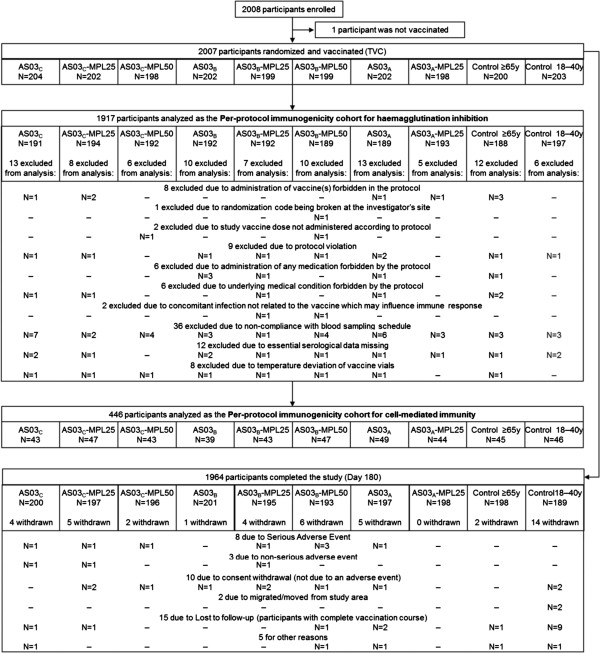
Figure 1
Figure 1
Participant flow.Footnote: TVC, total vaccinated cohort; all participants received inactivated trivalent influenza vaccine; control ≥65 years and control 18–40 years received non-adjuvanted vaccine; eight groups aged ≥65 years received vaccine formulated with an adjuvant. AS03 is a squalene and α-tocopherol oil-in-water emulsion-based Adjuvant System (tocopherol content: A, 11.86 mg; B, 5.93 mg; C, 2.97 mg); MPL is 3-O-desacyl-4’- monophosphoryl lipid A (MPL content: 25, 25 μg; 50, 50 μg).
Figure 2
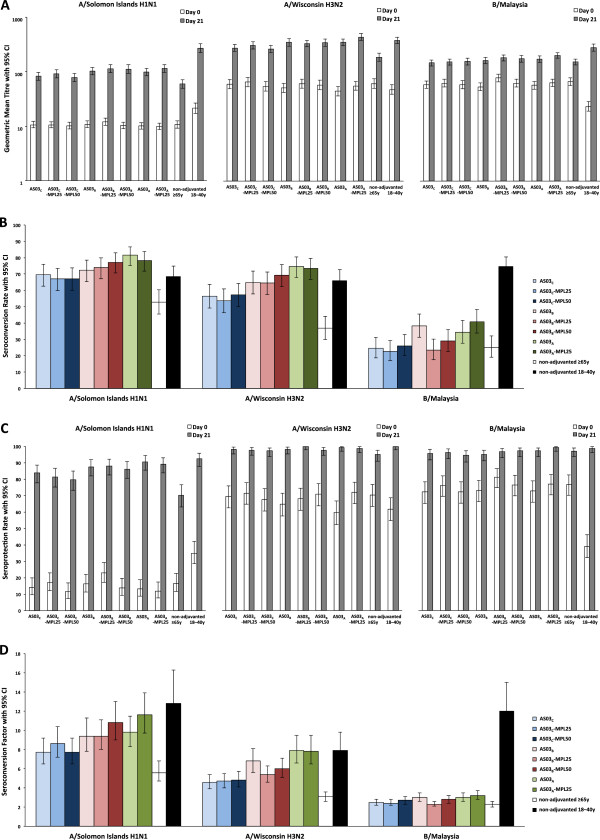
Figure 2
HI antibody responses in the per protocol immunogenicity cohort : Geometric mean titers (A); Seroconversion rates (B); Seroprotection rates (C); Seroconversion factor (D).Footnote: HI, Hemagglutination-inhibition; TVC, total vaccinated cohort; All participants received inactivated trivalent influenza vaccine, non-adjuvanted (≥65 years and 18–40 years) or formulated with an adjuvant. AS03 is a squalene and α-tocopherol oil-in-water emulsion-based Adjuvant System, with tocopherol content 11.86 mg (A), 5.93 mg (B), or 2.97 mg (C); MPL is 3-O-desacyl-4’- monophosphoryl lipid A: 25 μg (MPL-25) or 50 μg (MPL-50).
Figure 3
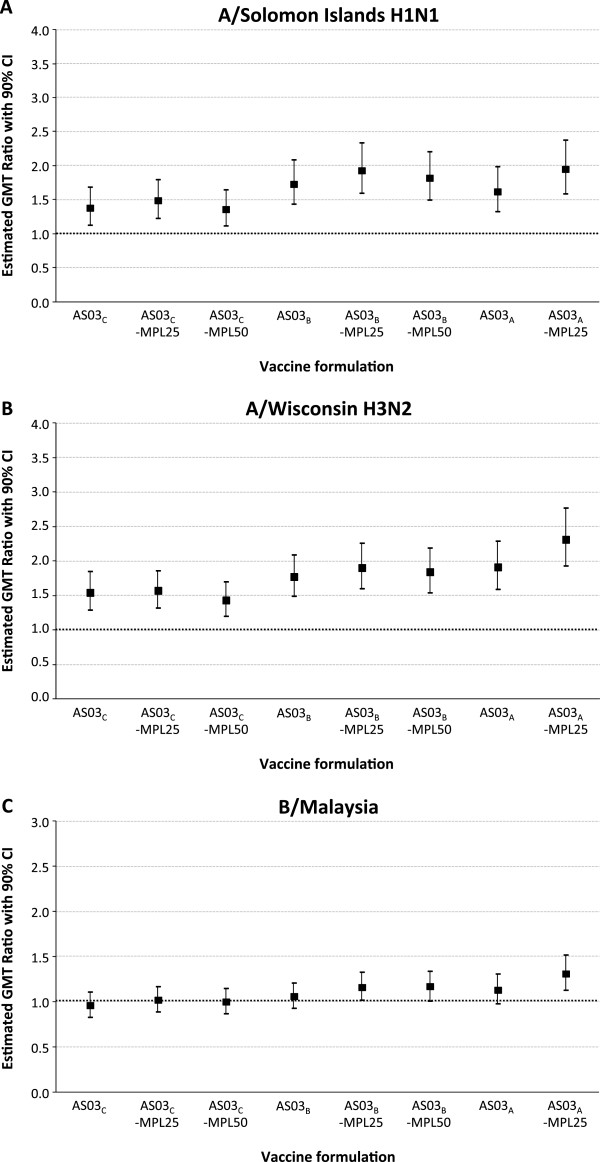
Figure 3
HI GMT ratio for adjuvanted versus non-adjuvanted formulation in the per protocol immunogenicity cohort against A/H1N1 (A), A/H3N2 (B), and influenza B strain (C).Footnote: HI, hemagglutination-inhibition; All participants received inactivated trivalent influenza vaccine, non-adjuvanted (≥65 years and 18–40 years) or formulated with an adjuvant. AS03 is a squalene and α-tocopherol oil-in-water emulsion-based Adjuvant System, with tocopherol content 11.86 mg (A), 5.93 mg (B), or 2.97 mg (C); MPL is 3-O-desacyl-4’- monophosphoryl lipid A: 25 μg (MPL-25) or 50 μg (MPL-50).
Figure 4
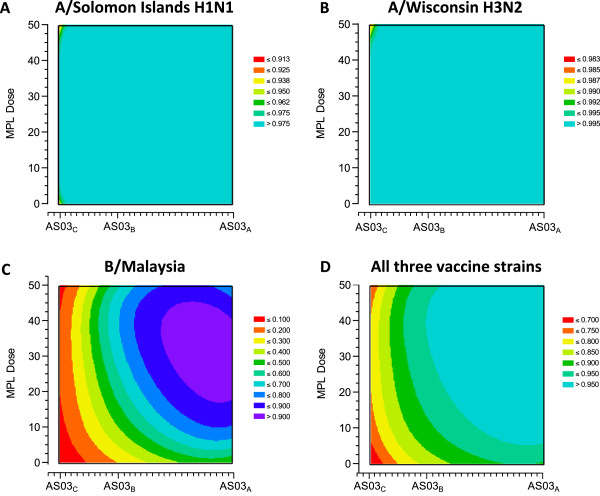
Figure 4
Contour plots of HI antibody responses in the per protocol immunogenicity cohort against A/H1N1 (A), A/H3N2 (B), influenza B (C), and all vaccine strains (D).Footnote: HI, hemagglutination-inhibition; GMT ratios for each adjuvanted formulation versus non-adjuvanted vaccine calculated with two-sided 90% Confidence Interval (CI); the lower limits (LL) of CI were transformed into a desirability index between 0 and 1 using a sigmoidal Derringer function; each LL was transformed to a value between 0 and 1, where 0 indicated an undesirable relative immune response, and 1 a highly desirable relative immune response. LL equal to 1.0 was transformed into a desirability equal to 0.5. The colors range from red (least desirable) to purple (most desirable).
Figure 5
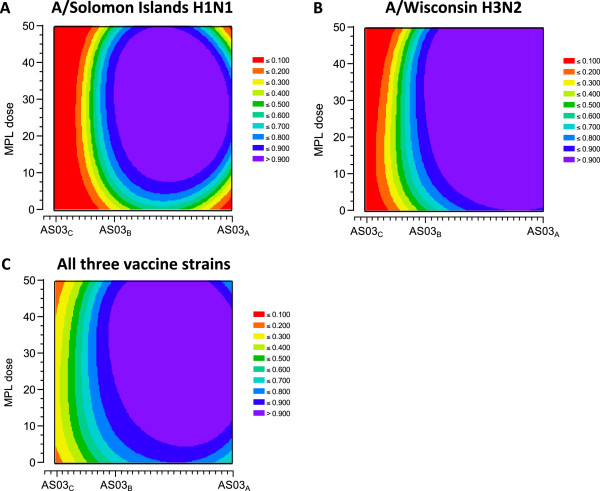
Figure 5
Contour plots (post-hoc) of HI antibody responses in the per protocol immunogenicity cohort against A/H1N1 (A), A/H3N2 (B), and all three vaccine strains (C).Footnote: HI, hemagglutination-inhibition; GMT ratios for each adjuvanted formulation versus non-adjuvanted vaccine calculated with two-sided 90% Confidence Interval (CI); the lower limits (LL) of CI were transformed into a desirability index between 0 and 1 using a sigmoidal Derringer function; each LL was transformed to a value between 0 and 1, where 0 indicated an undesirable relative immune response, and 1 a highly desirable relative immune response. For A/H1N1 and A/H3N2, an LL equal to 1.5 was transformed in desirability equal to 0.5. The colors range from red (least desirable) to purple (most desirable).
Figure 6
Figure 6
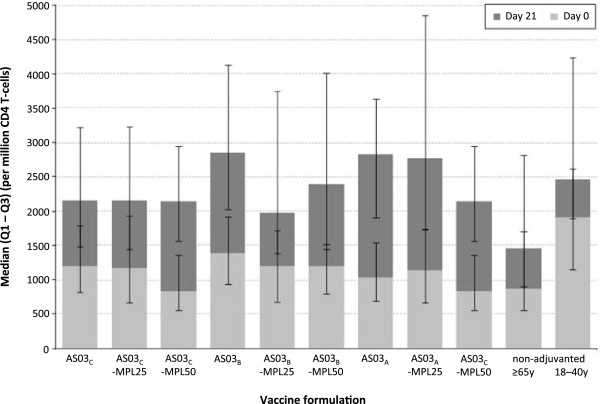
Cell mediated immunogenicity in the per protocol cell mediated immunogenicity cohort.Footnote: Results for each time point are indicated by median values with first and third quartiles. All participants received inactivated trivalent influenza vaccine, non-adjuvanted (≥65 years and 18–40 years) or formulated with an adjuvant. AS03 is a squalene and α-tocopherol oil-in-water emulsion-based Adjuvant System, with tocopherol content 11.86 mg (A), 5.93 mg (B), or 2.97 mg (C); MPL is 3-O-desacyl-4’- monophosphoryl lipid A: 25 μg (MPL-25) or 50 μg (MPL-50).
Figure 7
Figure 7
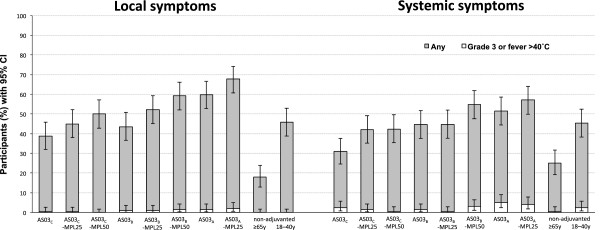
Participants reporting solicited and unsolicited symptoms during the 7-day post-vaccination period in the total vaccinated cohort.Footnote: CI, confidence interval; All participants received inactivated trivalent influenza vaccine, non-adjuvanted (≥65 years and 18–40 years) or formulated with an adjuvant. AS03 is a squalene and α-tocopherol oil-in-water emulsion-based Adjuvant System, with tocopherol content 11.86 mg (A), 5.93 mg (B), or 2.97 mg (C); MPL is 3-O-desacyl-4’- monophosphoryl lipid A: 25 μg (MPL-25) or 50 μg (MPL-50).

References

    1. Thompson WW, Shay DK, Weintraub E, Brammer L, Bridges CB, Cox NJ, Fukuda K. Influenza-associated hospitalizations in the United States. JAMA. 2004;292(11):1333–1340. doi: 10.1001/jama.292.11.1333. - DOI - PubMed
    1. Thompson WW, Shay DK, Weintraub E, Brammer L, Cox N, Anderson LJ, Fukuda K. Mortality associated with influenza and respiratory syncytial virus in the United States. JAMA. 2003;289(2):179–186. doi: 10.1001/jama.289.2.179. - DOI - PubMed
    1. Deng Y, Jing Y, Campbell AE, Gravenstein S. Age-related impaired type 1 T cell responses to influenza: reduced activation ex vivo, decreased expansion in CTL culture in vitro, and blunted response to influenza vaccination in vivo in the elderly. J Immunol. 2004;172(6):3437–3446. - PubMed
    1. Goodwin K, Viboud C, Simonsen L. Antibody response to influenza vaccination in the elderly: a quantitative review. Vaccine. 2006;24(8):1159–1169. doi: 10.1016/j.vaccine.2005.08.105. - DOI - PubMed
    1. McElhaney JE. Prevention of infectious diseases in older adults through immunization: the challenge of the senescent immune response. Expert Rev Vaccines. 2009;8(5):593–606. doi: 10.1586/erv.09.12. - DOI - PubMed

Publication types

Associated data