


Genome sequencing reveals loci under artificial selection that underlie disease phenotypes in the laboratory rat
- PMID: 23890820
- PMCID: PMC3732391
- DOI: 10.1016/j.cell.2013.06.040
Genome sequencing reveals loci under artificial selection that underlie disease phenotypes in the laboratory rat
Abstract
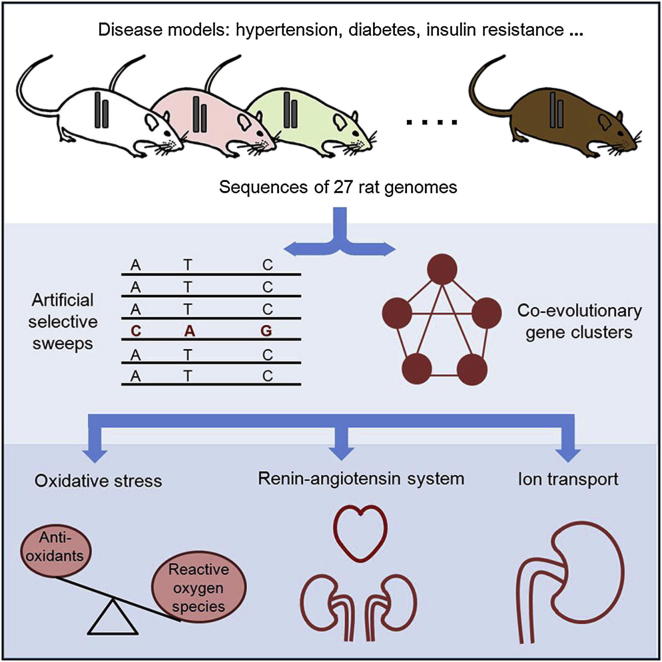
Large numbers of inbred laboratory rat strains have been developed for a range of complex disease phenotypes. To gain insights into the evolutionary pressures underlying selection for these phenotypes, we sequenced the genomes of 27 rat strains, including 11 models of hypertension, diabetes, and insulin resistance, along with their respective control strains. Altogether, we identified more than 13 million single-nucleotide variants, indels, and structural variants across these rat strains. Analysis of strain-specific selective sweeps and gene clusters implicated genes and pathways involved in cation transport, angiotensin production, and regulators of oxidative stress in the development of cardiovascular disease phenotypes in rats. Many of the rat loci that we identified overlap with previously mapped loci for related traits in humans, indicating the presence of shared pathways underlying these phenotypes in rats and humans. These data represent a step change in resources available for evolutionary analysis of complex traits in disease models.
Copyright © 2013 The Authors. Published by Elsevier Inc. All rights reserved.
Figures



References
-
- Aitman T.J., Critser J.K., Cuppen E., Dominiczak A., Fernandez-Suarez X.M., Flint J., Gauguier D., Geurts A.M., Gould M., Harris P.C. Progress and prospects in rat genetics: a community view. Nat. Genet. 2008;40:516–522. - PubMed
-
- Axelsson E., Ratnakumar A., Arendt M.L., Maqbool K., Webster M.T., Perloski M., Liberg O., Arnemo J.M., Hedhammar A., Lindblad-Toh K. The genomic signature of dog domestication reveals adaptation to a starch-rich diet. Nature. 2013;495:360–364. - PubMed
-
- Barrett J.C., Fry B., Maller J., Daly M.J. Haploview: analysis and visualization of LD and haplotype maps. Bioinformatics. 2005;21:263–265. - PubMed
-
- Bianchi G., Ferrari P., Salvati P., Salardi S., Parenti P., Cusi D., Guidi E. A renal abnormality in the Milan hypertensive strain of rats and in humans predisposed to essential hypertension. J. Hypertens. Suppl. 1986;4:S33–S36. - PubMed
Supplemental References
-
- Ben-Ishay D., Saliternik R., Welner A. Separation of two strains of rats with inbred dissimilar sensitivity to Doca-salt hypertension. Experientia. 1972;28:1321–1322. - PubMed
-
- Bianchi G., Fox U., Imbasciati E. The development of a new strain of spontaneously hypertensive rats. Life Sci. 1974;14:339–347. - PubMed
-
- Dupont J., Dupont J.C., Froment A., Milon H., Vincent M. Selection of three strains of rats with spontaneously different levels of blood pressure. Biomedicine. 1973;19:36–41. - PubMed
-
- Goto Y., Kakisaki M., Masaki N. Spontaneous diabetes produced by repeated selective breeding of normal Wistar rats. Proc. Jpn. Acad. 1975;51:80–85.
-
- Huang W., Sherman B.T., Lempicki R.A. Systematic and integrative analysis of large gene lists using DAVID bioinformatics resources. Nat. Protoc. 2009;4:44–57. - PubMed
Publication types
MeSH terms
Grants and funding
- MC_U120061454/MRC_/Medical Research Council/United Kingdom
- G0800024/MRC_/Medical Research Council/United Kingdom
- 075491/Z/04/WT_/Wellcome Trust/United Kingdom
- R01 HL069321/HL/NHLBI NIH HHS/United States
- R01 HL020176/HL/NHLBI NIH HHS/United States
- RE/08/002/BHF_/British Heart Foundation/United Kingdom
- R01 HL089895/HL/NHLBI NIH HHS/United States
- 13031/CRUK_/Cancer Research UK/United Kingdom
- MC_U120097112/MRC_/Medical Research Council/United Kingdom
- WT_/Wellcome Trust/United Kingdom
- HL094446/HL/NHLBI NIH HHS/United States
- R01 HL094446/HL/NHLBI NIH HHS/United States
LinkOut - more resources
Full Text Sources
Other Literature Sources
Research Materials
