


Lexical influences on auditory streaming
- PMID: 23891107
- PMCID: PMC3748342
- DOI: 10.1016/j.cub.2013.06.042
Lexical influences on auditory streaming
Abstract
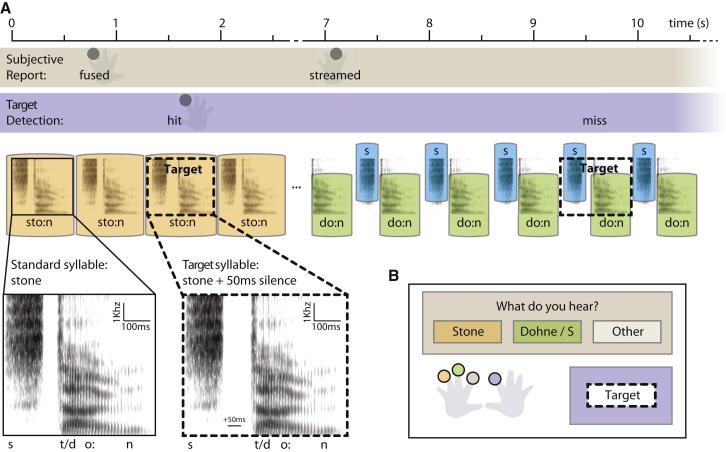
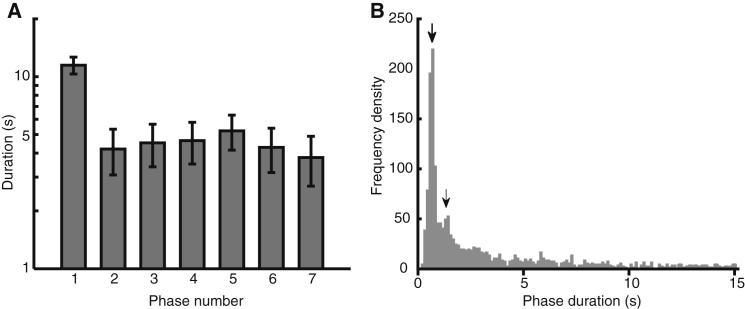
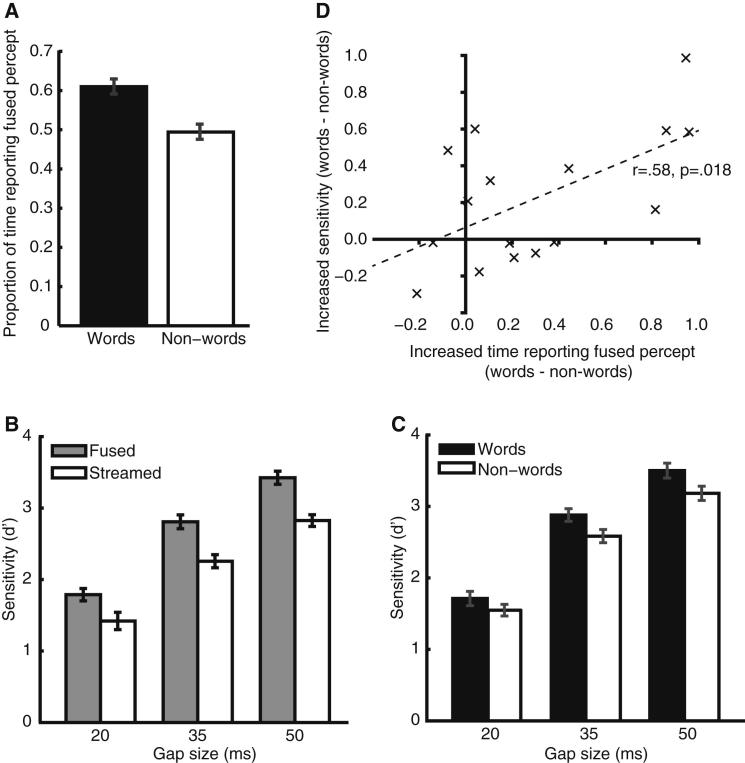
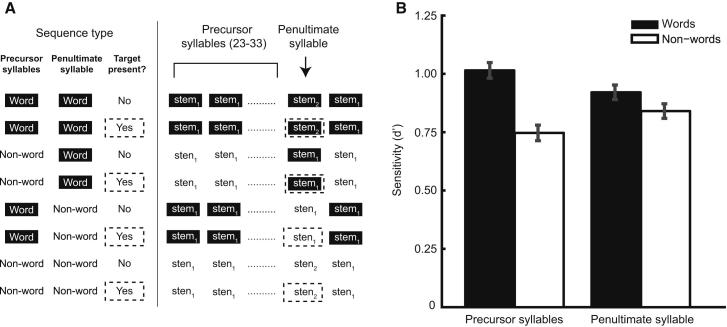
Biologically salient sounds, including speech, are rarely heard in isolation. Our brains must therefore organize the input arising from multiple sources into separate "streams" and, in the case of speech, map the acoustic components of the target signal onto meaning. These auditory and linguistic processes have traditionally been considered to occur sequentially and are typically studied independently [1, 2]. However, evidence that streaming is modified or reset by attention [3], and that lexical knowledge can affect reports of speech sound identity [4, 5], suggests that higher-level factors may influence perceptual organization. In two experiments, listeners heard sequences of repeated words or acoustically matched nonwords. After several presentations, they reported that the initial /s/ sound in each syllable formed a separate stream; the percept then fluctuated between the streamed and fused states in a bistable manner. In addition to measuring these verbal transformations, we assessed streaming objectively by requiring listeners to detect occasional targets-syllables containing a gap after the initial /s/. Performance was better when streaming caused the syllables preceding the target to transform from words into nonwords, rather than from nonwords into words. Our results show that auditory stream formation is influenced not only by the acoustic properties of speech sounds, but also by higher-level processes involved in recognizing familiar words.
Copyright © 2013 The Authors. Published by Elsevier Inc. All rights reserved.
Figures
References
-
- Bregman A.S. M.I.T. Press; Cambridge: 1990. Auditory Scene Analysis: The Perceptual Organization of Sound.
-
- Pisoni D.B., Remez R.E., editors. The Handbook of Speech Perception. Blackwell; Oxford: 2005.
-
- Carlyon R.P., Cusack R., Foxton J.M., Robertson I.H. Effects of attention and unilateral neglect on auditory stream segregation. J. Exp. Psychol. Hum. Percept. Perform. 2001;27:115–127. - PubMed
-
- Elman J.L., McClelland J.L. Cognitive penetration of the mechanisms of perception: Compensation for coarticulation of lexically restored phonemes. J. Mem. Lang. 1988;27:143–165.
-
- Shoaf L.C., Pitt M.A. Does node stability underlie the verbal transformation effect? A test of node structure theory. Percept. Psychophys. 2002;64:795–803. - PubMed
MeSH terms
Grants and funding
LinkOut - more resources
Full Text Sources
Other Literature Sources
Miscellaneous
