


Meta-analysis of gene-level associations for rare variants based on single-variant statistics
- PMID: 23891470
- PMCID: PMC3738834
- DOI: 10.1016/j.ajhg.2013.06.011
Meta-analysis of gene-level associations for rare variants based on single-variant statistics
Abstract
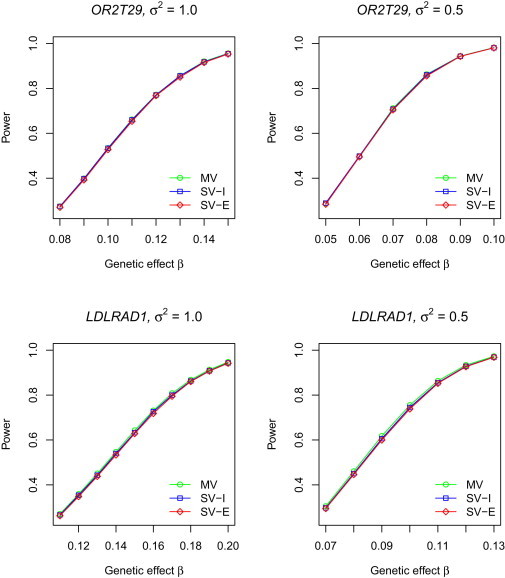
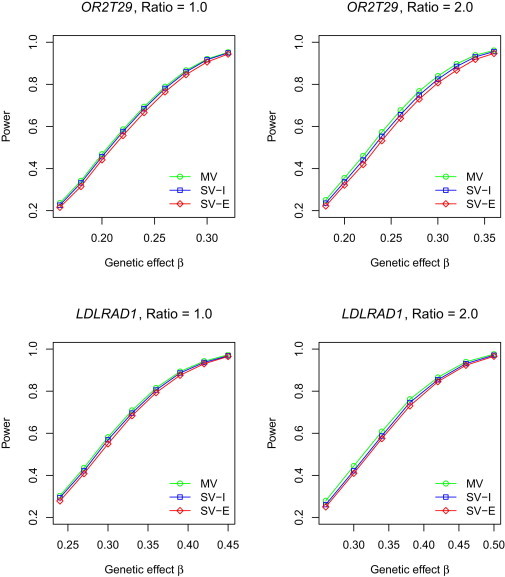
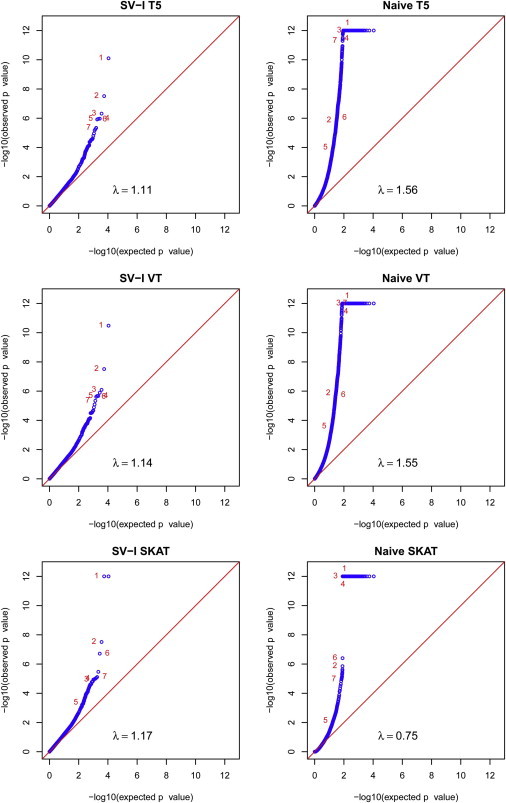
Meta-analysis of genome-wide association studies (GWASs) has led to the discoveries of many common variants associated with complex human diseases. There is a growing recognition that identifying "causal" rare variants also requires large-scale meta-analysis. The fact that association tests with rare variants are performed at the gene level rather than at the variant level poses unprecedented challenges in the meta-analysis. First, different studies may adopt different gene-level tests, so the results are not compatible. Second, gene-level tests require multivariate statistics (i.e., components of the test statistic and their covariance matrix), which are difficult to obtain. To overcome these challenges, we propose to perform gene-level tests for rare variants by combining the results of single-variant analysis (i.e., p values of association tests and effect estimates) from participating studies. This simple strategy is possible because of an insight that multivariate statistics can be recovered from single-variant statistics, together with the correlation matrix of the single-variant test statistics, which can be estimated from one of the participating studies or from a publicly available database. We show both theoretically and numerically that the proposed meta-analysis approach provides accurate control of the type I error and is as powerful as joint analysis of individual participant data. This approach accommodates any disease phenotype and any study design and produces all commonly used gene-level tests. An application to the GWAS summary results of the Genetic Investigation of ANthropometric Traits (GIANT) consortium reveals rare and low-frequency variants associated with human height. The relevant software is freely available.
Copyright © 2013 The American Society of Human Genetics. Published by Elsevier Inc. All rights reserved.
Figures
References
Publication types
MeSH terms
Substances
Grants and funding
- K05 AA017688/AA/NIAAA NIH HHS/United States
- UL1 RR025005/RR/NCRR NIH HHS/United States
- R01CA082659/CA/NCI NIH HHS/United States
- HHSN268201100011I/HL/NHLBI NIH HHS/United States
- U01HG004402/HG/NHGRI NIH HHS/United States
- HHSN26820110006C/PHS HHS/United States
- HHSN26820110005C/PHS HHS/United States
- ImNIH/Intramural NIH HHS/United States
- MR/K013351/1/MRC_/Medical Research Council/United Kingdom
- P01CA142538/CA/NCI NIH HHS/United States
- P01 CA142538/CA/NCI NIH HHS/United States
- R01 HL087641/HL/NHLBI NIH HHS/United States
- HHSN26800625226C/PHS HHS/United States
- R01HL086694/HL/NHLBI NIH HHS/United States
- R01 CA082659/CA/NCI NIH HHS/United States
- HHSN268201100012C/HL/NHLBI NIH HHS/United States
- UL1RR025005/RR/NCRR NIH HHS/United States
- R01HL59367/HL/NHLBI NIH HHS/United States
- HHSN268201100010C/HL/NHLBI NIH HHS/United States
- HHSN26820110009C/PHS HHS/United States
- R01 HL059367/HL/NHLBI NIH HHS/United States
- HHSN268201100011C/HL/NHLBI NIH HHS/United States
- R01 HL086694/HL/NHLBI NIH HHS/United States
- G1000143/MRC_/Medical Research Council/United Kingdom
- U01HG004803/HG/NHGRI NIH HHS/United States
- R01 DK075787/DK/NIDDK NIH HHS/United States
- HHSN268200625226C/PHS HHS/United States
- U01 HG004402/HG/NHGRI NIH HHS/United States
- 097117/WT_/Wellcome Trust/United Kingdom
- HHSN26820110007C/PHS HHS/United States
- 14136/CRUK_/Cancer Research UK/United Kingdom
- HHSN26820110008C/PHS HHS/United States
- R01HL087641/HL/NHLBI NIH HHS/United States
- U01 HG004803/HG/NHGRI NIH HHS/United States
- G0401527/MRC_/Medical Research Council/United Kingdom
- 090532/WT_/Wellcome Trust/United Kingdom
- MC_PC_U127561128/MRC_/Medical Research Council/United Kingdom
LinkOut - more resources
Full Text Sources
Other Literature Sources
