Review
. 2014 Mar 1;66(1):3-21.
doi: 10.1016/j.ymeth.2013.07.024. Epub 2013 Jul 23.

Structure of allergens and structure based epitope predictions

Affiliations
Review

Structure of allergens and structure based epitope predictions

Fabio Dall'antonia et al. Methods. .

Abstract

The structure determination of major allergens is a prerequisite for analyzing surface exposed areas of the allergen and for mapping conformational epitopes. These may be determined by experimental methods including crystallographic and NMR-based approaches or predicted by computational methods. In this review we summarize the existing structural information on allergens and their classification in protein fold families. The currently available allergen-antibody complexes are described and the experimentally obtained epitopes compared. Furthermore we discuss established methods for linear and conformational epitope mapping, putting special emphasis on a recently developed approach, which uses the structural similarity of proteins in combination with the experimental cross-reactivity data for epitope prediction.

Keywords: Allergen structure; IgE epitope; NMR; Protein family; Structure based epitope prediction; X-ray.


Figures

Fig. 1
Fig. 1
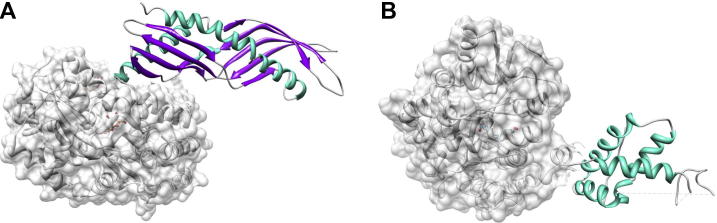
MBP-fusions act as crystallization chaperons. (A) Der p 7 (PDB: 3h4z) and (B) Ara h 2 (3OB4) are shown as maltose-binding protein (MBP)-fusion proteins. Allergen structures are shown in ribbon representation and are colored according their secondary structure composition (α-helices in cyan, β-sheets in magenta). MBP is additionally shown as surface representation (gray). Dashed lines indicate the disordered regions that are missing in the crystal structures.
Fig. 2
Fig. 2
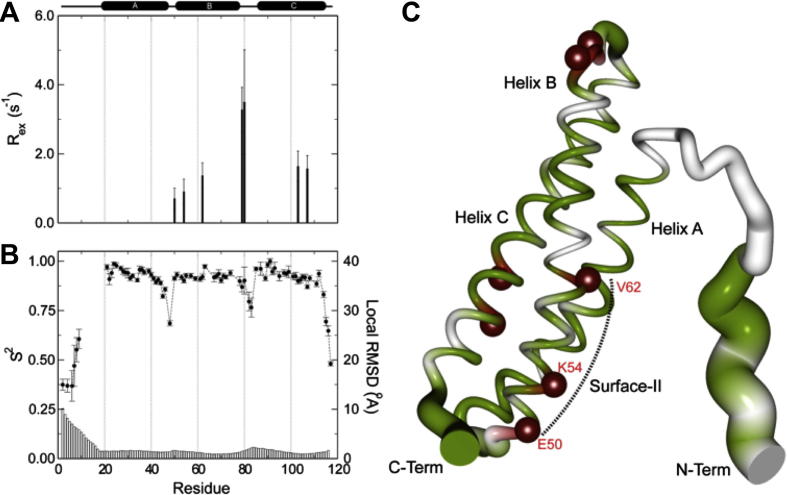
Information on chemical exchange (Rex) on the millisecond-microsecond time scale (A) and order parameter S2 (B) as derived from 15N relaxation measurements are shown as a function of residue number of Blo t 5. In (C) these parameters are mapped onto the sausage structure of Blo t 5 where the thickness is related to 1 − S2 and residues with Rex contributions are represented as red spheres. Reproduced with permission from .
Fig. 3
Fig. 3
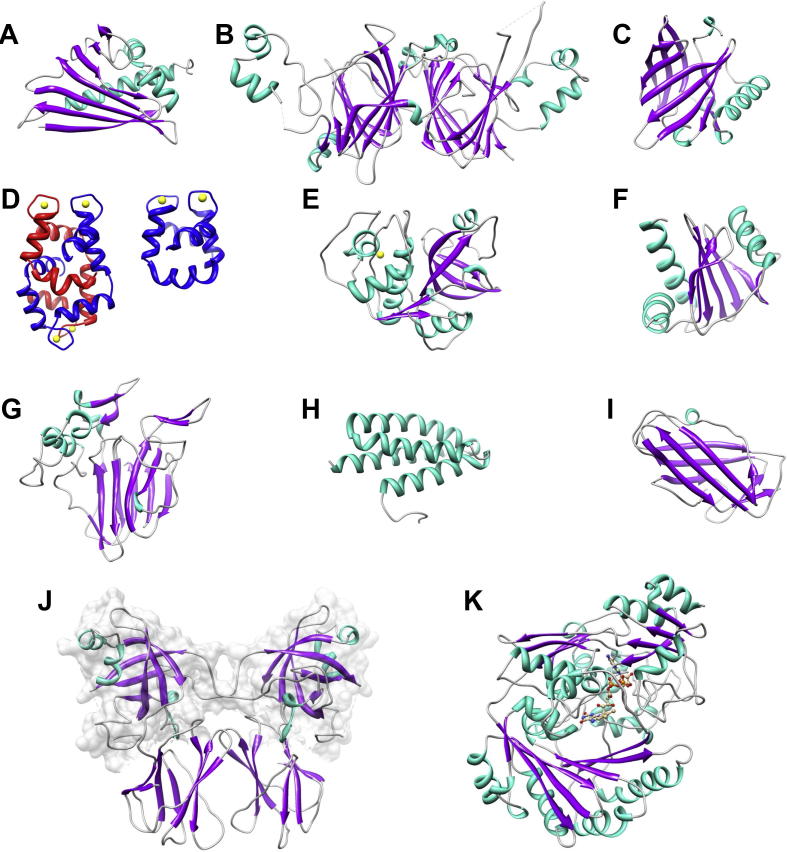
Representative structures of important allergen families. Allergen structures are presented according to their secondary structure composition (α-helices in cyan, β-sheets in magenta). A: Bet v 1 (PDB: 1BV1), B:Ara h 1 (3S7E), C: Bos d 2 (1BJ7), D: Phl p 7 (1K9U, 2LVK), E: Der p 1 (3F5 V), F: Ara h 5 (4ESP), G: Pru av 1 (2AHN), H: Phl p 6 (1NLX), I: Der p 2 (1KTJ), J: Phlp1 (1N10) and Phl p 4 (3TSH). Ca2+ atoms are shown in yellow and FAD cofactor (K) in ball-and-stick representation. (D) Comparison of Phl p 7 dimer (as observed in the X-ray structure) and monomer (as present in the NMR structure). (J) Allergen Phl p 1 belonging to the expansin family consists of 2 domains and forms a dimer. The N-terminal domains are distinguished as grey surface representation.
Fig. 4
Fig. 4
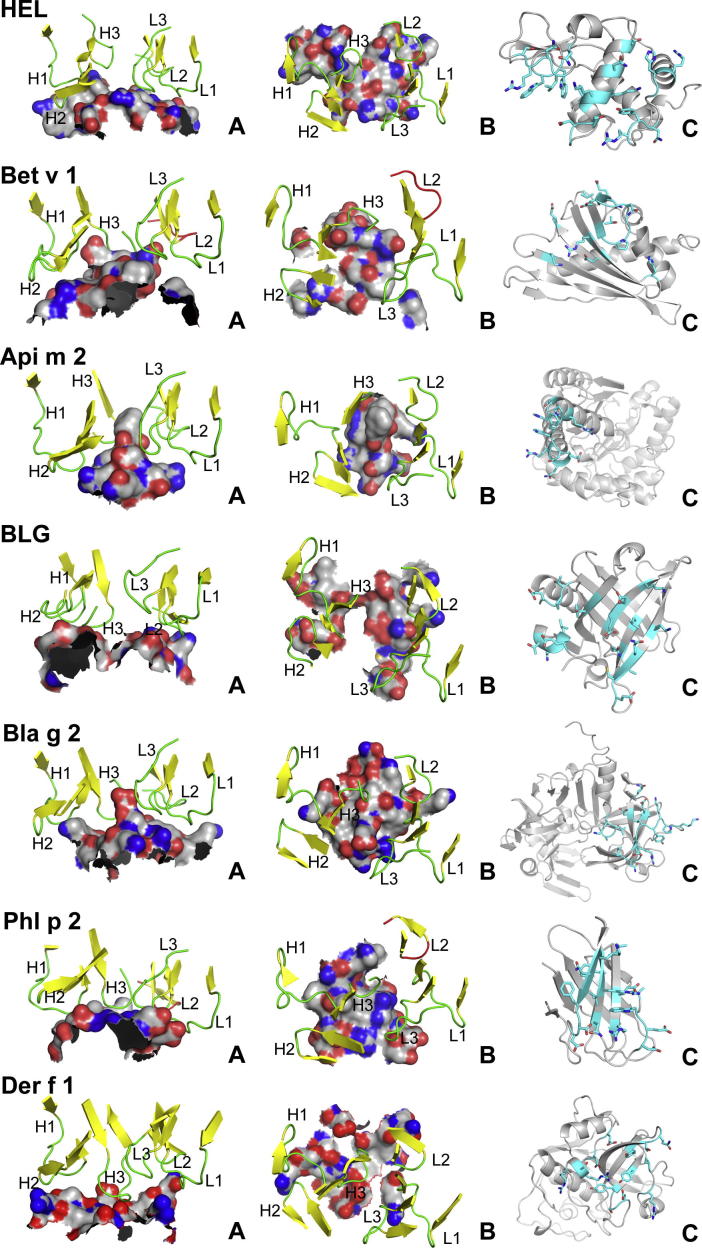
Structural aspects of allergen epitopes and Ab interfaces in complexes. PDB codes are HEL (hen egg-white lysozyme): 1NDG, Bet v 1: 1FSK, Api m 2 (bee venom hyaluronidase): 2J88, BLG (β-lactoglobulin): 2R56, Bla g 2: 2NR6, Phl p 2: 2VXQ, Der f 1: 3RVV. Epitopes in side view (panels A) and top view (B) are represented as surfaces with atom-type colors (carbon grey, nitrogen blue and oxygen red) and the interacting CDRs are shown as secondary structure cartoons with sheets in yellow and loops in green, except when not binding (red). Panels C show the entire allergens as cartoons without Ab in the same top-view orientation. Epitope residues are highlighted in cyan, and with side chain stick representation, nitrogen and oxygen colors as before. Model sizes are not on the same scale. Convexity ratios in top-down order are 0.35, 0.48, 0.69, 0.37, 0.42, 0.43 and 0.39.
Fig. 5
Fig. 5
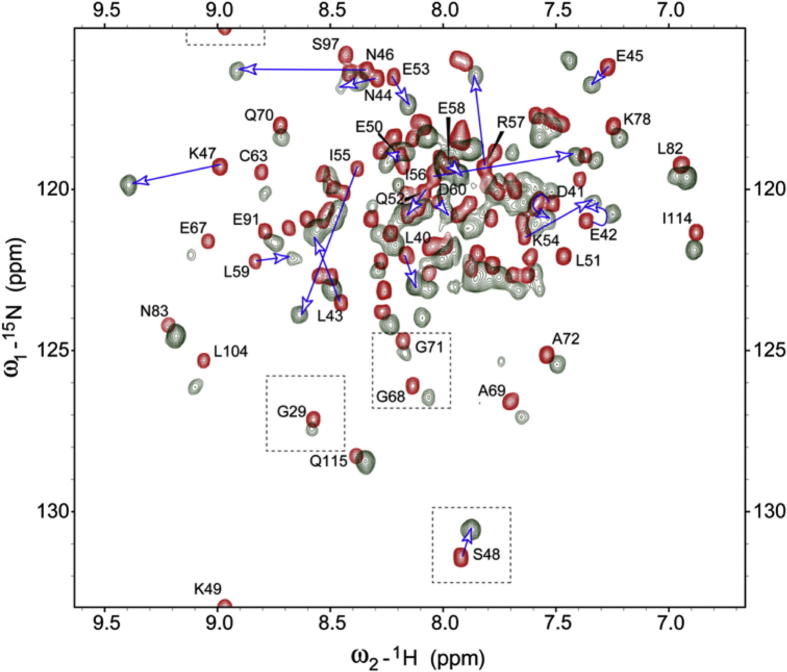
Overlay of TROSY-HSQC spectra of Blo t 5 in the absence (red) and presence (grey) of Fab. Peaks belonging to residues of the interaction region between residues 40 and 60 are indicated by arrows. Folded peaks are in dotted squares. Reproduced with permission from .
Fig. 6
Fig. 6
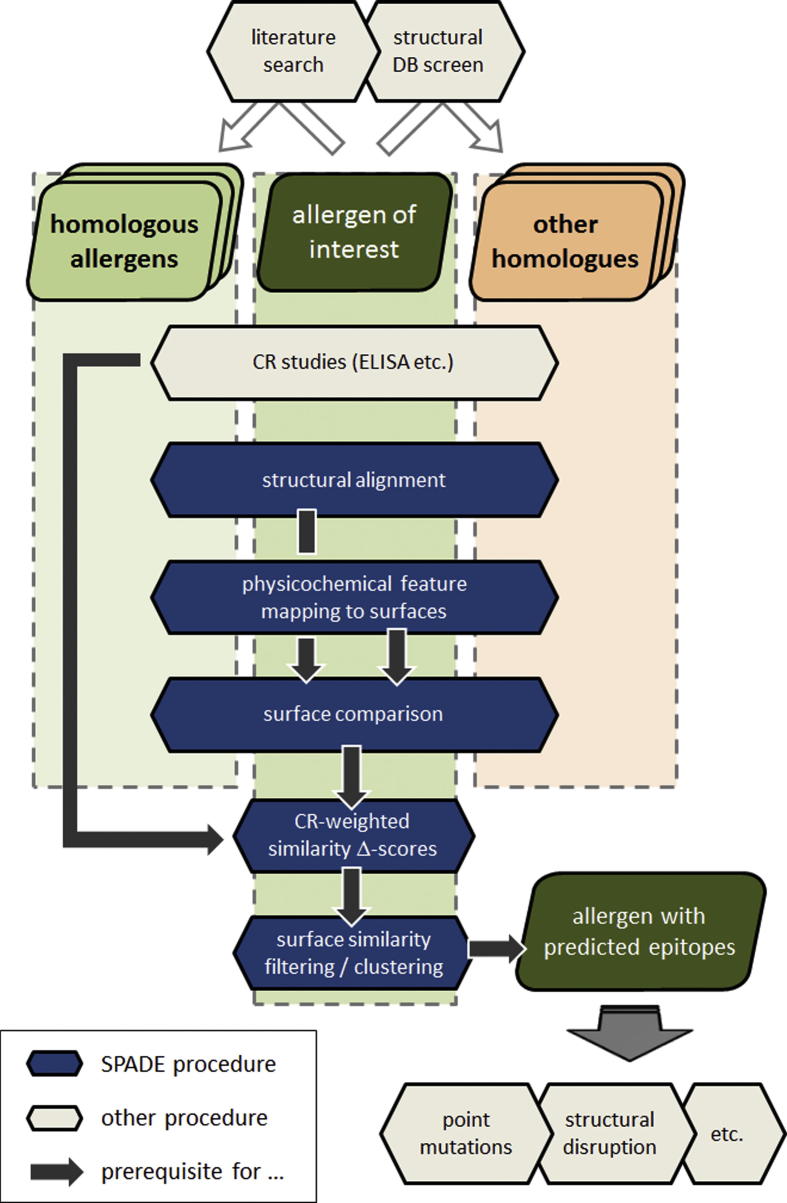
Workflow of a typical IgE epitope localization project with SPADE as prediction tool. In this procedural description starting from a target allergen with available 3D coordinates, the structure determination of homologous allergens is not considered part of the project. It is instead assumed that SPADE is applied in the presence of other pre-determined structures, which can be revealed or confirmed with literature and/or database searches. The actual computational part of the project can/should be supported by immunological data, as quantitative cross-reactivity (CR) values increase the prediction accuracy. Once epitopes and amino acid key residues for IgE-binding are located, the prediction serves as a starting point for follow-up experiments such as point mutations with tests for reduced IgE binding.
Fig. 7
Fig. 7
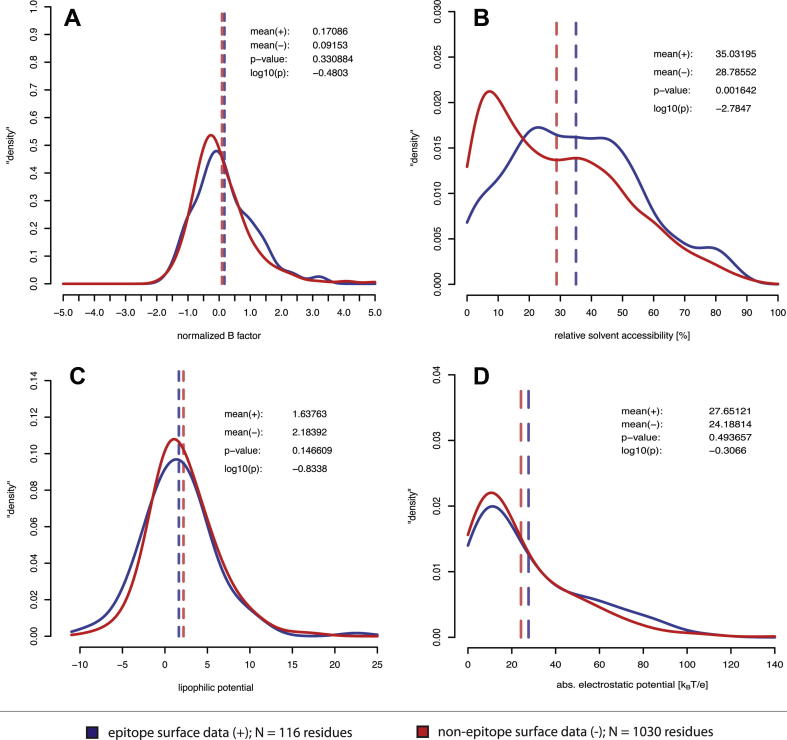
Distribution of physicochemical features in sets of epitope vs. non-epitope surface residues, represented by probability density graphs (Kernel density estimation with R), based on the seven unbound allergen structures HEL (PDB: 1VDQ), Bet v 1 (1BVQ), Hyaluronidase (1FCQ), BLG (1BEB), Bla g 2 (1YG9), Phl p 2 (1WHO) and Der f 1 (3D6S). A: Normalized B-factors of C-α atoms (all residues, separate normalization per structure) were calculated as B-norm = (B–<B>)/σ(B). B: Relative solvent accessibility S [%] was calculated as S = SASA(obs.) / SASA (max.) where SASA(obs.) is the solvent-accessible surface area of a residue Xi calculated with GETAREA and SASA(max.) is the corresponding area in a G-X-G tripeptide, averaged over 30 conformations . C: Atomic lipophilicity parameters were taken from Ghose et al. , mapped to the surface according to the procedure of Heiden et al. and averaged per residue (for surface vertices only). D: The electrostatic potential was calculated with APBS , mapped to the surface vertices and averaged per residue. Absolute quantities of [kBT/e] were used for the statistical analysis. A-D: Two-sided two-sample Kolmogorov–Smirnov tests were performed with R. The statistical significance of differences was defined with a confidence threshold of 0.99, so that it requires log10(p) ⩽ −2. Dashed lines indicate mean values.

References

    1. Greenfield N.J. Nature Protocols. 2006;1:2876–2890. - PMC - PubMed
    1. Verdino P., Keller W. Methods. 2004;32:241–248. - PubMed
    1. Whitmore L., Wallace B.A. Biopolymers. 2008;89:392–400. - PubMed
    1. Lindwall G., Chau M., Gardner S.R., Kohlstaedt L.A. Protein Eng. 2000;13:67–71. - PubMed
    1. Ericsson U.B., Hallberg B.M., Detitta G.T., Dekker N., Nordlund P. Anal. Biochem. 2006;357:289–298. - PubMed

Publication types