. 2013 Sep;163(1):86-94.
doi: 10.1104/pp.113.221788. Epub 2013 Jul 26.

The identification of two arabinosyltransferases from tomato reveals functional equivalency of xyloglucan side chain substituents

Affiliations

The identification of two arabinosyltransferases from tomato reveals functional equivalency of xyloglucan side chain substituents

Alex Schultink et al. Plant Physiol. 2013 Sep.

Abstract

Xyloglucan (XyG) is the dominant hemicellulose present in the primary cell walls of dicotyledonous plants. Unlike Arabidopsis (Arabidopsis thaliana) XyG, which contains galactosyl and fucosyl substituents, tomato (Solanum lycopersicum) XyG contains arabinofuranosyl residues. To investigate the biological function of these differing substituents, we used a functional complementation approach. Candidate glycosyltransferases were identified from tomato by using comparative genomics with known XyG galactosyltransferase genes from Arabidopsis. These candidate genes were expressed in an Arabidopsis mutant lacking XyG galactosylation, and two of them resulted in the production of arabinosylated XyG, a structure not previously found in this plant species. These genes may therefore encode XyG arabinofuranosyltransferases. Moreover, the addition of arabinofuranosyl residues to the XyG of this Arabidopsis mutant rescued a growth and cell wall biomechanics phenotype, demonstrating that the function of XyG in plant growth, development, and mechanics has considerable flexibility in terms of the specific residues in the side chains. These experiments also highlight the potential of reengineering the sugar substituents on plant wall polysaccharides without compromising growth or viability.


Figures
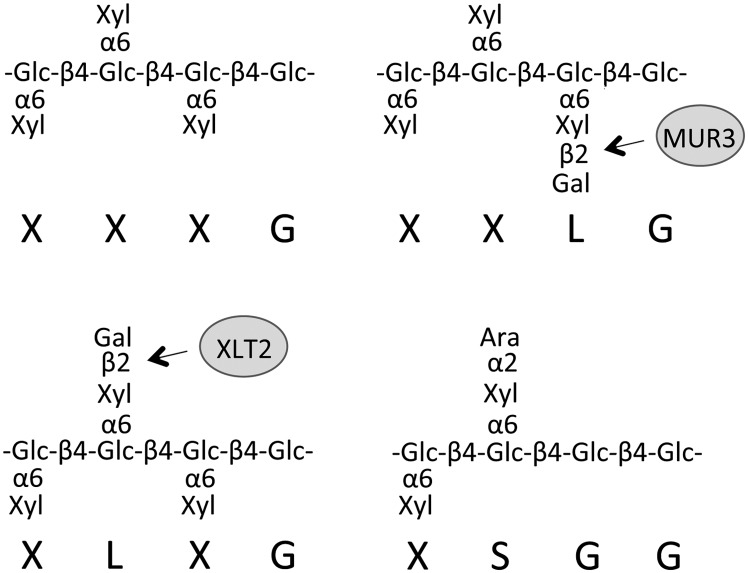
Figure 1.
Figure 1.
Xyloglucan motifs present in the walls of Arabidopsis (XXXG, XXLG, and XLXG) and tomato (XSGG) with nomenclature indicated below the structure. AtMUR3 and AtXLT2 are galactosyltransferases required to produce XXLG and XLXG, respectively. Glc, d-Glucopyranose; Xyl, d-xylopyranose; Gal, d-galactopyranose; Ara, l-arabinofuranose.
Figure 2.
Figure 2.
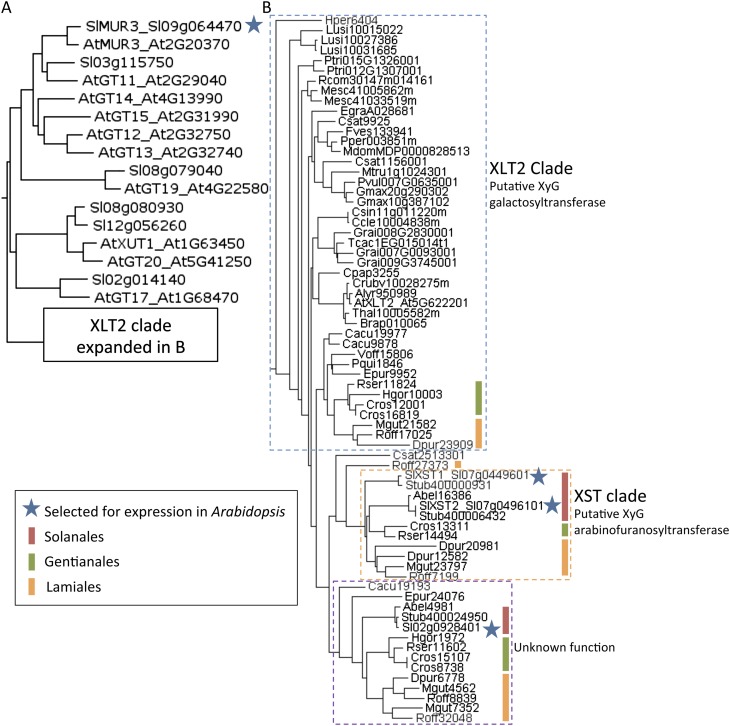
Phylogenetic analysis of the MUR3 and XLT2 subclade of GT family 47. A, Maximum-likelihood tree of Arabidopsis (At) and tomato (Sl) protein sequences. B, The XLT2 clade was expanded with sequences from additional species. The protein sequences are labeled with abbreviations for species (see below) and the gene model (Phytozome) or EST identifier (Medical Plants Genomics Resource). Abel, Atropa belladonna; Alyr, Arabidopsis lyrata; At, Arabidopsis; Brap, Brassica rapa; Cacu, Camptotheca acuminata; Ccle, Citrus clementina; Cpap, Carica papaya; Cros, Catharanthus roseus; Crub, Capsella rubella; Csat, Cannabis sativa; Csin, Citrus sinensis; Dpur, Digitalis purpurea; Dvil, Dioscorea villosa; Egra, Eucalyptus grandis; Epur, Echinacea purpurea; Fves, Fragaria vesca; Gbil, Ginkgo biloba; Gmax, Glycine max; Grai, Gossypium raimondii; Hgor, Hoodia gordonii; Hper, Hypericum perforatum; Lusi, Linum usitatissimum; Mdom, Malus domestica; Mesc, Manihot esculenta; Mgut, Mimulus guttatus; Mtru, Medicago truncatula; Pper, Prunus persica; Pqui, Panax quinquefolius; Ptri, Populus trichocarpa; Pvul, Phaseolus vulgaris; Rcom, Ricinus communis; Roff, Rosmarinus officinalis; Rser, Rauvolfia serpentina; Sl, tomato; Stub, Solanum tuberosum; Tcac, Theobroma cacao; Thal, Thellungiella halophila; Voff, Valeriana officinalis.
Figure 3.
Figure 3.
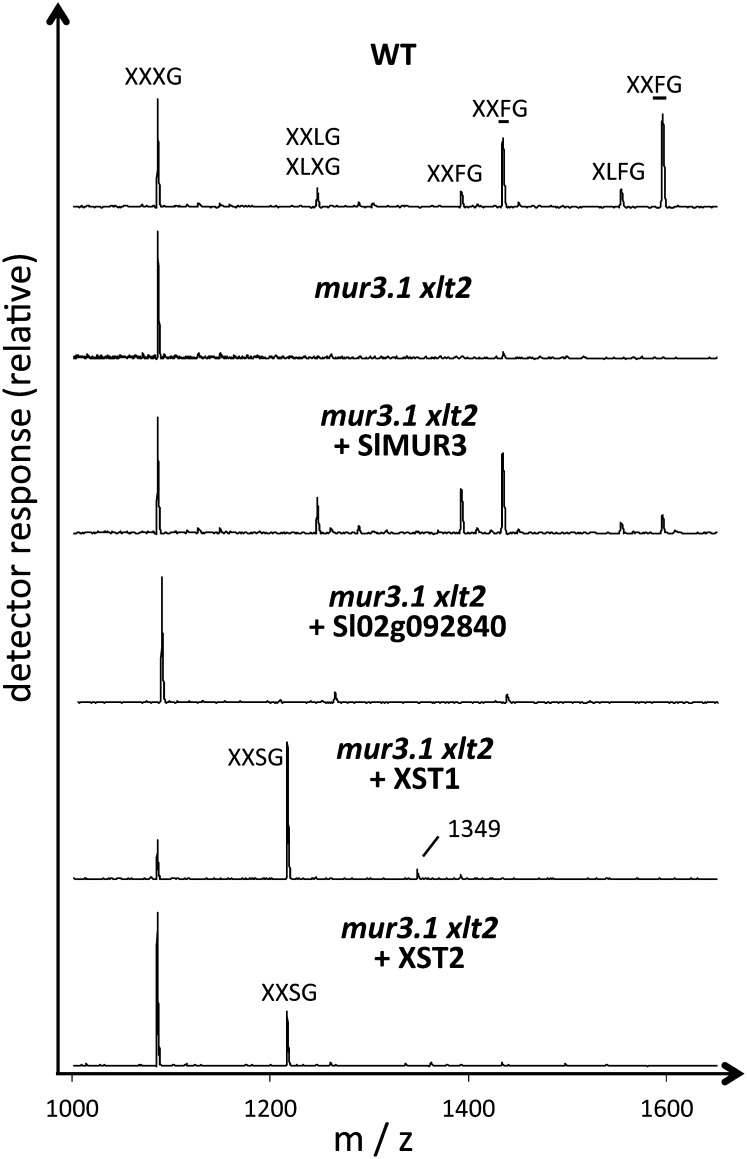
XyG oligosaccharide profile by MALDI-TOF MS from leaf tissue of the Arabidopsis wild type (WT; ecotype Columbia), the double mutant mur3.1 xlt2, and transgenic lines of mur3.1 xlt2 expressing the indicated genes from tomato. Assignment of oligosaccharide structures by one-letter code (Fig. 1) as described in the text.
Figure 4.
Figure 4.
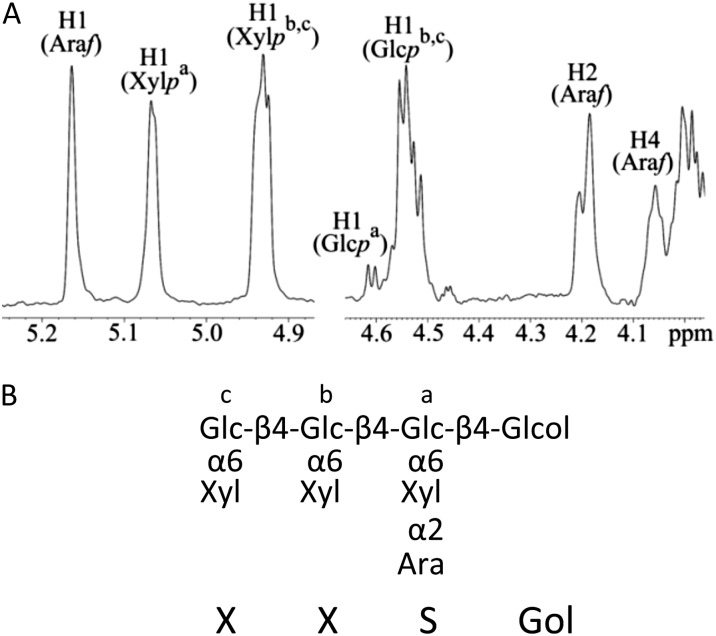
Structure of the novel oligosaccharide. A, 1H-NMR spectrum of the oligosaccharide with an m/z of 1,217 produced in the XST1 overexpression line. B, Proposed structure of the oligosaccharide (reduced to alditol prior to NMR). Superscripts in the spectrum in A refer to the glycosyl units in B. See Supplemental Figure S5 for detailed assignments. Glc, d-Glucopyranose; Xyl, d-xylopyranose; Gal, d-galactopyranose; Ara, l-arabinofuranose.
Figure 5.
Figure 5.
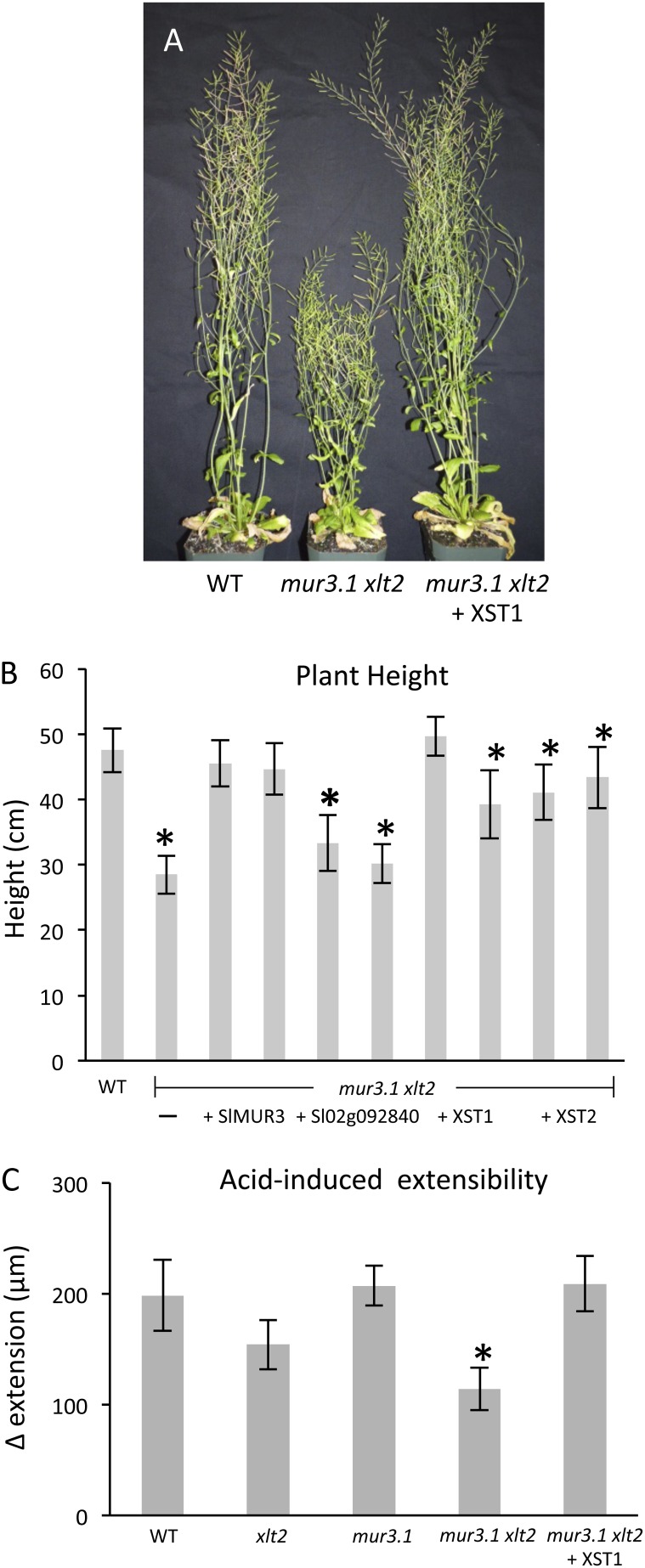
Plant phenotypes and biomechanics. A, Representative 7-week-old Arabidopsis plants for the indicated lines (see Supplemental Fig. S6 for images of all lines). B, Average plant height at 7 weeks with two independent lines for each construct. Error bars indicate sd (n ≥ 4). C, Acid-induced extensibility of leaf petioles under constant force for indicated lines. Error bars show se (n ≥ 9). Asterisk indicates statistically significant difference from the wild type (WT; P < 0.05).

References

    1. Aldington S, Mcdougall GJ, Fry SC. (1991) Structure-activity-relationships of biologically-active oligosaccharides. Plant Cell Environ 14: 625–636
    1. Altschul SF, Madden TL, Schäffer AA, Zhang J, Zhang Z, Miller W, Lipman DJ. (1997) Gapped BLAST and PSI-BLAST: a new generation of protein database search programs. Nucleic Acids Res 25: 3389–3402 - PMC - PubMed
    1. Anders N, Wilkinson MD, Lovegrove A, Freeman J, Tryfona T, Pellny TK, Weimar T, Mortimer JC, Stott K, Baker JM, et al. (2012) Glycosyl transferases in family 61 mediate arabinofuranosyl transfer onto xylan in grasses. Proc Natl Acad Sci USA 109: 989–993 - PMC - PubMed
    1. Bauer S, Vasu P, Mort AJ, Somerville CR. (2005) Cloning, expression, and characterization of an oligoxyloglucan reducing end-specific xyloglucanobiohydrolase from Aspergillus nidulans. Carbohydr Res 340: 2590–2597 - PubMed
    1. Bombarely A, Menda N, Tecle IY, Buels RM, Strickler S, Fischer-York T, Pujar A, Leto J, Gosselin J, Mueller LA. (2011) The Sol Genomics Network (solgenomics.net): growing tomatoes using Perl. Nucleic Acids Res 39: D1149–D1155 - PMC - PubMed

Publication types

MeSH terms

LinkOut - more resources