


Conditioned medium of Wnt/β-catenin signaling-activated olfactory ensheathing cells promotes synaptogenesis and neurite growth in vitro
- PMID: 23893371
- PMCID: PMC11497928
- DOI: 10.1007/s10571-013-9966-z
Conditioned medium of Wnt/β-catenin signaling-activated olfactory ensheathing cells promotes synaptogenesis and neurite growth in vitro
Abstract
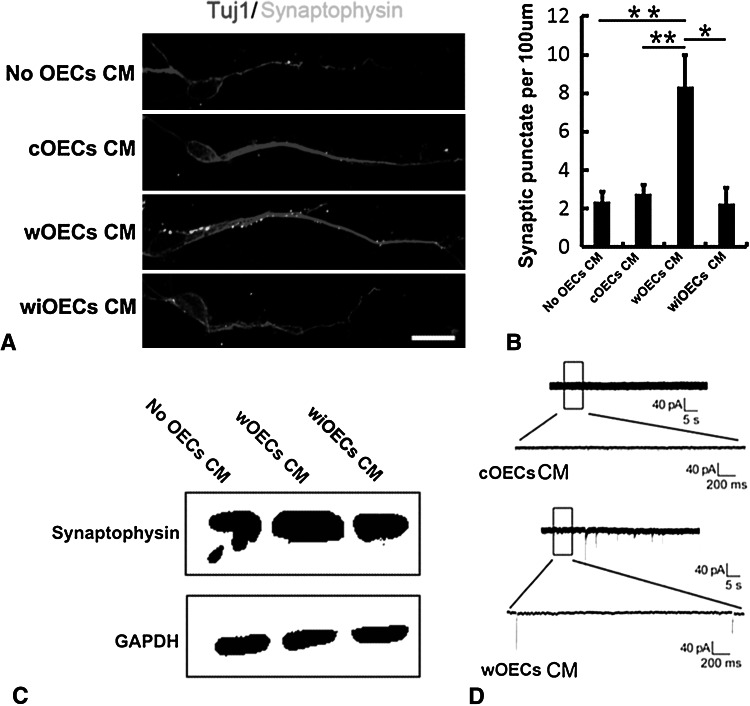
Olfactory ensheathing cells (OECs), the major glia cells in the olfactory system, have been extensively studied because of their ability to promote axonal growth and regeneration. Whether it could facilitate synaptogenesis is an important, but remains as yet an unanswered question. We have identified a subgroup of Wnt signaling-activated OECs, spatiotemporal distribution of which in the olfactory bulb suggests a role for these cells in both axonal growth and synaptogenesis. In the present study, we explored this possibility in vitro. OECs were primarily cultured, in which Wnt signaling was activated by overexpressing β-catenin, and inhibited by dominant negative TCF4. Neurite growth and synaptogenesis were assessed by co-culturing neurons with conditioned medium from control OECs (cOECs CM), Wnt/β-catenin signaling-activated OECs (wOECs CM), or Wnt signaling-inhibited OECs (wiOECs). The results showed that although cOECs CM enhances axonal growth, wOECs CM exhibited a stronger axonal growth-promoting effect, than cOECs CM. More importantly, wOECs CM stimulates synatpogenesis, demonstrated by the expression of Synaptophysin and whole-cell patch clamp recording. In contrast, both cOECs CM and wiOECs CM do not affect synaptogenesis. Our data, for the first time, demonstrated that, in comparison with regularly cultured OECs, wOECs CM are more effective in enhancing axonal growth, and can promote synaptogenesis, probably by secreting factors. These results suggest a potential application of wOECs for treating spinal cord injury.
Conflict of interest statement
The authors claim no conflict of interests.
Figures


References
-
- Chung RS, Woodhouse A, Fung S, Dickson TC, West AK, Vickers JC, Chuah MI (2004) Olfactory ensheathing cells promote neurite sprouting of injured axons in vitro by direct cellular contact and secretion of soluble factors. Cell Mol Life Sci 61(10):1238–1245. doi:10.1007/s00018-004-4026-y - DOI - PMC - PubMed
Publication types
MeSH terms
Substances
LinkOut - more resources
Full Text Sources
Other Literature Sources
