


The progression of cardiometabolic disease: validation of a new cardiometabolic disease staging system applicable to obesity
- PMID: 23894121
- PMCID: PMC3866217
- DOI: 10.1002/oby.20585
The progression of cardiometabolic disease: validation of a new cardiometabolic disease staging system applicable to obesity
Abstract
Objective: To validate a Cardiometabolic Disease Staging (CMDS) system for assigning risk level for diabetes, and all-cause and cardiovascular disease (CVD) mortality.
Design and methods: Two large national cohorts, CARDIA and NHANES III, were used to validate CMDS. CMDS: Stage 0: metabolically healthy; Stage 1: one or two metabolic syndrome risk factors [other than impaired fasting glucose (IFG)]; Stage 2: IFG or impaired glucose tolerance (IGT) or metabolic syndrome (without IFG); Stage 3: two of three (IFG, IGT, and/or metabolic syndrome); and Stage 4: type 2 diabetes mellitus/CVD.
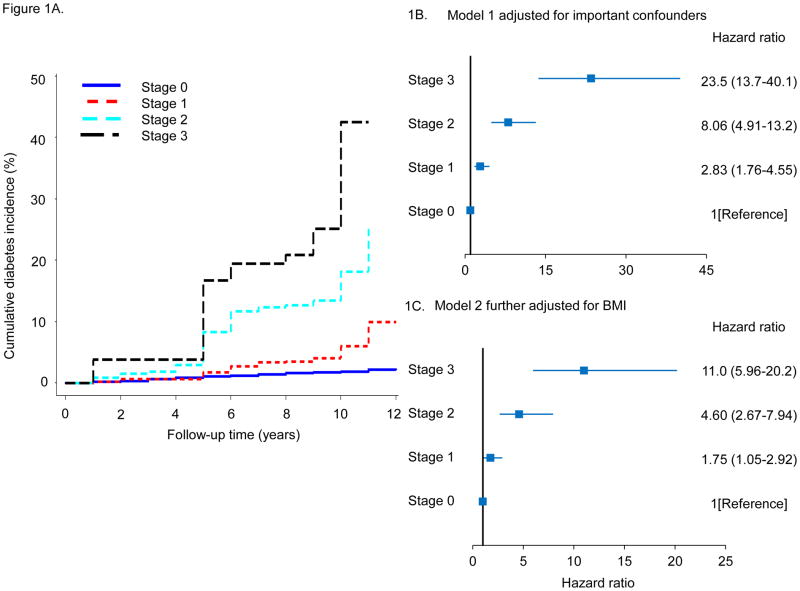
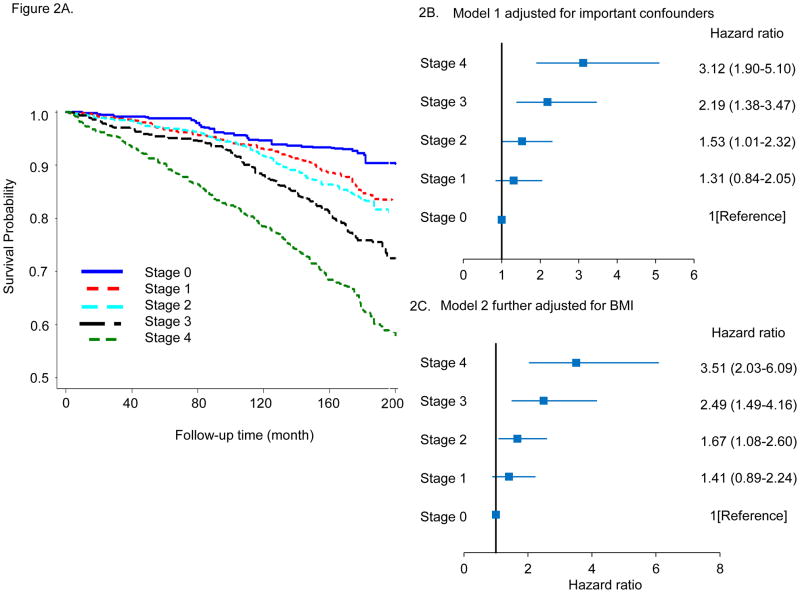
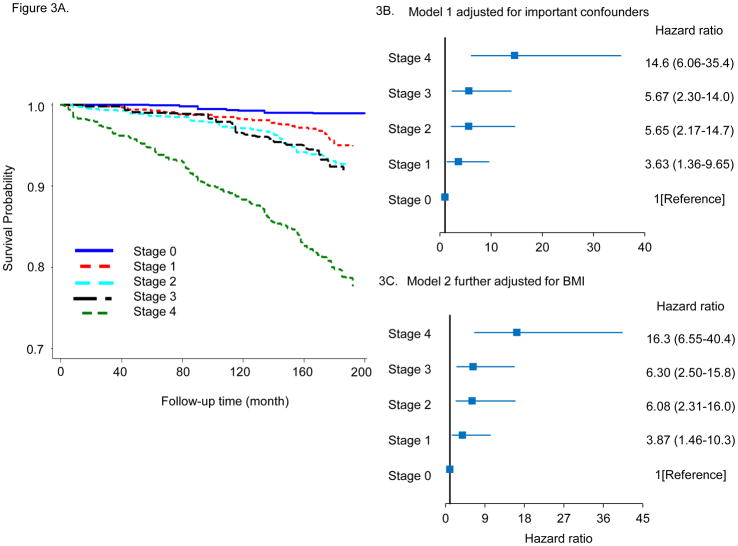
Results: In the CARDIA study, compared with Stage 0 metabolically healthy subjects, adjusted risk for diabetes exponentially increased from Stage 1 [hazard ratio (HR) 2.83, 95% confidence interval (CI): 1.76-4.55], to Stage 2 (HR 8.06, 95% CI 4.91-13.2), to Stage 3 (HR 23.5, 95% CI 13.7-40.1) (P for trend <0.001). In NHANES III, both cumulative incidence and multivariable adjusted HRs markedly increased for both all-cause and CVD mortality with advancement of the risk stage from Stages 0 to 4. Adjustment for body mass index (BMI) minimally affected the risks for diabetes and all-cause/CVD mortality using CMDS.
Conclusion: CMDS can discriminate a wide range of risk for diabetes, CVD mortality, and all-cause mortality independent of BMI, and should be studied as a risk assessment tool to guide interventions that prevent and treat cardiometabolic disease.
Copyright © 2013 The Obesity Society.
Conflict of interest statement
Dr. Garvey is an advisor for Alkermes, Plc., Daiichi-Sankyo, Inc., LipoScience, VIVUS, Inc., Janssen Pharmaceuticals, and Tethys; is a speaker for Merck; and is a stockholder for Bristol-Myers Squibb Company, Isis/Genzyme, Merck, Pfizer, Inc., Eli Lilly and Company, and VIVUS, Inc. He has received research support from Amylin Pharmaceuticals, Inc., Merck & Co., and Weight Watchers International, Inc.
Figures
References
-
- Danaei G, Finucane MM, Lu Y, et al. National, regional, and global trends in fasting plasma glucose and diabetes prevalence since 1980: systematic analysis of health examination surveys and epidemiological studies with 370 country-years and 2. 7 million participants. Lancet. 2011;378:31–40. - PubMed
-
- Cleeman JI, Grundy SM, Becker D, et al. Executive summary of the Third Report of the National Cholesterol Education Program (NCEP) expert panel on detection, evaluation, and treatment of high blood cholesterol in adults (Adult Treatment Panel III) JAMA. 2001;285:2486–2497. - PubMed
-
- Lara-Castro C, Garvey WT. Diet, insulin resistance, and obesity: zoning in on data for Atkins dieters living in South Beach. J Clin Endocrinol Metab. 2004;89:4197–4205. - PubMed
-
- Welborn TA, Dhaliwal SS, Bennett SA. Waist-hip ratio is the dominant risk factor predicting cardiovascular death in Australia. Med J Aust. 2003;179:580–585. - PubMed
Publication types
MeSH terms
Substances
Grants and funding
LinkOut - more resources
Full Text Sources
Other Literature Sources
Medical
