


Porous chitosan scaffolds with embedded hyaluronic acid/chitosan/plasmid-DNA nanoparticles encoding TGF-β1 induce DNA controlled release, transfected chondrocytes, and promoted cell proliferation
- PMID: 23894564
- PMCID: PMC3720934
- DOI: 10.1371/journal.pone.0069950
Porous chitosan scaffolds with embedded hyaluronic acid/chitosan/plasmid-DNA nanoparticles encoding TGF-β1 induce DNA controlled release, transfected chondrocytes, and promoted cell proliferation
Abstract
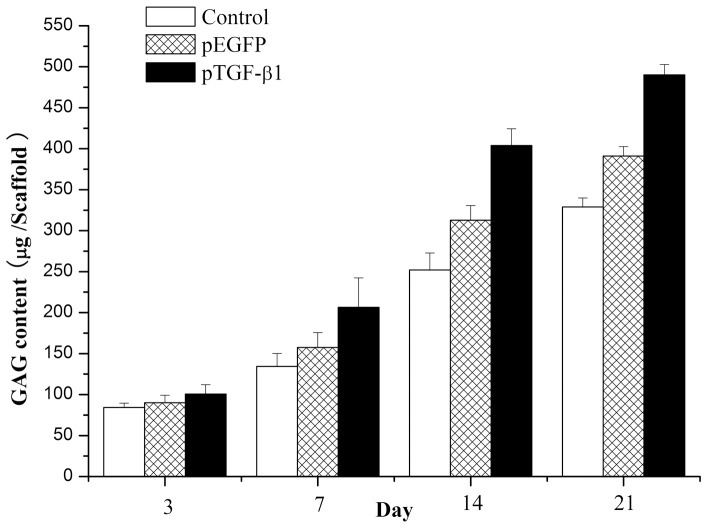
Cartilage defects resulting from traumatic injury or degenerative diseases have very limited spontaneous healing ability. Recent progress in tissue engineering and local therapeutic gene delivery systems has led to promising new strategies for successful regeneration of hyaline cartilage. In the present study, tissue engineering and local therapeutic gene delivery systems are combined with the design of a novel gene-activated matrix (GAM) embedded with hybrid hyaluronic acid(HA)/chitosan(CS)/plasmid-DNA nanoparticles encoding transforming growth factor (TGF)-β1. A chitosan scaffold functioned as the three-dimensional carrier for the nanoparticles. Results demonstrated that scaffold-entrapped plasmid DNA was released in a sustained and steady manner over 120 days, and was effectively protected in the HA/CS/pDNA nanoparticles. Culture results demonstrated that chondrocytes grown in the novel GAM were highly proliferative and capable of filling scaffold micropores with cells and extracellular matrix. Confocal laser scanning microscopy indicated that chondrocytes seeded in the GAM expressed exogenous transgenes labeled with green fluorescent protein. ELISA results demonstrated detectable TGF-β1 expression in the supernatant of GAM cultures, which peaked at the sixth day of culture and afterwards showed a moderate decline. Histological results and biochemical assays confirmed promotion of chondrocyte proliferation. Cell culture indicated no affects on phenotypic expression of ECM molecules, such as GAG. The results of this study indicate the suitability of this novel GAM for enhanced in vitro cartilage tissue engineering.
Conflict of interest statement
Figures



References
-
- Bachmann G, Basad E, Lommel D, Steinmeyer J (2004) [MRI in the follow-up of matrix-supported autologous chondrocyte transplantation (MACI) and microfracture]. Radiologe 44: 773–782 doi:10.1007/s00117-004-1084-y. PMID: 15278206 - DOI - PubMed
-
- Macchiarini P, Jungebluth P, Go T, Asnaghi MA, Rees LE, et al. (2008) Clinical transplantation of a tissue-engineered airway. Lancet 372: 2023–2030 doi:10.1016/S0140-6736(08)61598-6. PMID: 19022496 - DOI - PubMed
-
- Asnaghi MA, Jungebluth P, Raimondi MT, Dickinson SC, Rees LE, et al. (2009) A double-chamber rotating bioreactor for the development of tissue-engineered hollow organs: from concept to clinical trial. Biomaterials 30: 5260–5269 doi:10.1016/j.biomaterials.2009.07.018. PMID: 19647867 - DOI - PubMed
-
- Chung C, Burdick JA (2008) Engineering cartilage tissue. Adv Drug Deliv Rev 60: 243–262 doi:10.1016/j.addr.2007.08.027. PMID: 17976858 - DOI - PMC - PubMed
-
- Guo T, Zhao J, Chang J, Ding Z, Hong H, et al. (2006) Porous chitosan-gelatin scaffold containing plasmid DNA encoding transforming growth factor-beta1 for chondrocytes proliferation. Biomaterials 27: 1095–1103 doi:10.1016/j.biomaterials.2005.08.015, PMID: 16143394. - DOI - PubMed
Publication types
MeSH terms
Substances
LinkOut - more resources
Full Text Sources
Other Literature Sources
