


Epidemiology of noise-induced tinnitus and the attitudes and beliefs towards noise and hearing protection in adolescents
- PMID: 23894638
- PMCID: PMC3722160
- DOI: 10.1371/journal.pone.0070297
Epidemiology of noise-induced tinnitus and the attitudes and beliefs towards noise and hearing protection in adolescents
Abstract
Background and objectives: Previous research showed an increase of noise-induced symptoms in adolescents. Permanent tinnitus as a consequence of loud music exposure is usually considered as noise-induced damage. The objective was to perform an epidemiological study in order to obtain prevalence data of permanent noise-induced tinnitus as well as temporary tinnitus following noise exposure in a young population. In addition the attitudes and beliefs towards noise and hearing protection were evaluated in order to explain the use/non-use of hearing protection in a young population.
Methods: A questionnaire was completed by 3892 high school students (mean age: 16.64 years old, SD: 1.29 years). The prevalence of temporary and permanent tinnitus was assessed. In addition the 'Youth Attitudes to Noise Scale' and the 'Beliefs About Hearing Protection and Hearing Loss' were used in order to assess the attitudes and beliefs towards noise and hearing protection respectively.
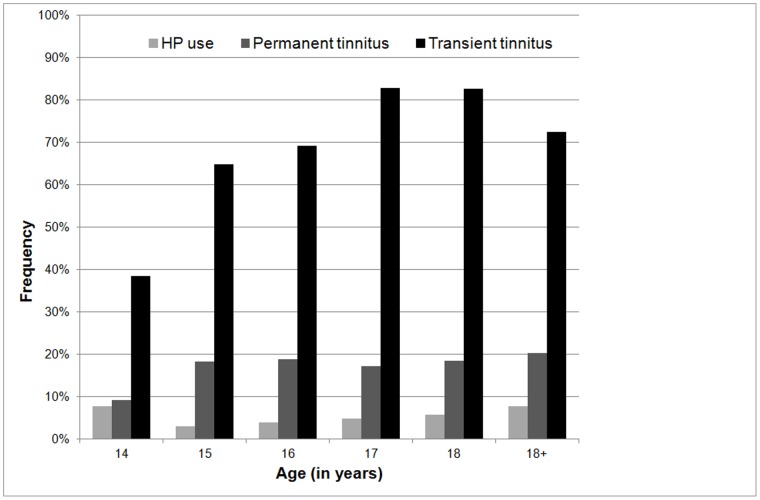
Results: The prevalence of temporary noise-induced tinnitus and permanent tinnitus in high school students was respectively 74.9% and 18.3%. An increasing prevalence of temporary tinnitus with age was present. Most students had a 'neutral attitude' towards loud music and the use of hearing protection was minimal (4.7%). The limited use of hearing protection is explained by a logistic regression analysis showing the relations between certain parameters and the use of hearing protection.
Conclusions: Despite the very high prevalence of tinnitus in such a young population, the rate of hearing protection use and the knowledge about the risks of loud music is extremely low. Future preventive campaigns should focus more on tinnitus as a warning signal for noise-induced damage and emphasize that also temporary symptoms can result in permanent noise-induced damage.
Conflict of interest statement
Figures
References
-
- Vogel I, Brug J, Van der Ploeg CP, Raat H (2007) Young people's exposure to loud music: a summary of the literature. Am J Prev Med 33: 124–133. - PubMed
-
- Smith PA, Davis A, Ferguson M, Lutman ME (2000) The prevalence and type of social noise exposure in young adults in England. Noise Health 2: 41–56. - PubMed
-
- Serra MR, Biassoni EC, Richter U, Minoldo G, Franco G, et al. (2005) Recreational noise exposure and its effects on the hearing of adolescents. Part I: an interdisciplinary long-term study. Int J Audiol 44: 65–73. - PubMed
-
- Sadhra S, Jackson CA, Ryder T, Brown MJ (2002) Noise exposure and hearing loss among student employees working in university entertainment venues. Ann Occup Hyg 46: 455–463. - PubMed
-
- Portnuff CD, Fligor BJ, Arehart KH (2011) Teenage use of portable listening devices: a hazard to hearing? J Am Acad Audiol 22: 663–677. - PubMed
Publication types
MeSH terms
LinkOut - more resources
Full Text Sources
Other Literature Sources
Medical
