


Assessment of the reporting quality of randomized controlled trials on the treatment of diabetes mellitus with traditional chinese medicine: a systematic review
- PMID: 23894675
- PMCID: PMC3722156
- DOI: 10.1371/journal.pone.0070586
Assessment of the reporting quality of randomized controlled trials on the treatment of diabetes mellitus with traditional chinese medicine: a systematic review
Abstract
Background: After the publication of the CONSORT 2010 statement, few studies have been conducted to assess the reporting quality of randomized clinical trials (RCTs) on treatment of diabetes mellitus with Traditional Chinese Medicine (TCM) published in Chinese journals.
Objective: To investigate the current situation of the reporting quality of RCTs in leading medical journals in China with the CONSORT 2010 statement as criteria.
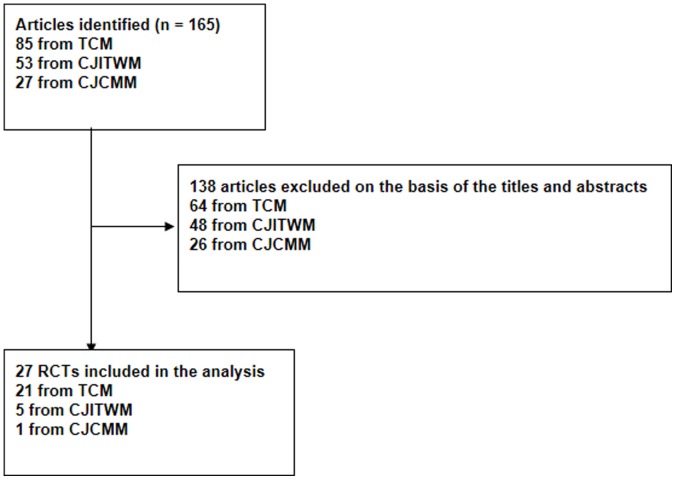
Methods: The China National Knowledge Infrastructure (CNKI) electronic database was searched for RCTs on the treatment of diabetes mellitus with TCM published in the Journal of Traditional Chinese Medicine, Chinese Journal of Integrated Traditional & Western Medicine, and the China Journal of Chinese Materia Medica from January to December 2011. We excluded trials reported as "animal studies", "in vitro studies", "case studies", or "systematic reviews". The CONSORT checklist was applied by two independent raters to evaluate the reporting quality of all eligible trials after discussing and comprehending the items thoroughly. Each item in the checklist was graded as either "yes" or "no" depending on whether it had been reported by the authors.
Results: We identified 27 RCTs. According to the 37 items in the CONSORT checklist, the average reporting percentage was 45.0%, in which the average reporting percentage for the "title and abstract", the "introduction", the "methods", the "results", the "discussion" and the "other information" was 33.3%, 88.9%, 36.4%, 54.4%, 71.6% and 14.8%, respectively. In the Journal of Traditional Chinese Medicine, Chinese Journal of Integrated Traditional & Western Medicine, and the China Journal of Chinese Materia Medica the average reporting percentage was 42.2%, 56.8%, and 46.0%, respectively.
Conclusions: The reporting quality of RCTs in these three journals was insufficient to allow readers to assess the validity of the trials. We recommend that editors require authors to use the CONSORT statement when reporting their trial results as a condition of publication.
Conflict of interest statement
Figures
References
-
- Schulz KF, Altman DG, Moher D, for the CONSORT Group (2010) CONSORT 2010 Statement: updated guidelines for reporting parallel group randomised trials for the CONSORT Group. BMJ 340 c332: 698–702 doi:10.1136/bmj.c332 - DOI - PMC - PubMed
-
- Halpern SH, Darani R, Douglas MJ, Wight W, Yee J (2004) Compliance with the CONSORT checklist in obstetric anaesthesia randomised controlled trials. Int J Obstet Anesth 13: 207–214 doi:10.1016/j.ijoa.2004.03.009 - DOI - PubMed
-
- Erin NK, Robert MS, Nader P, Aaron SD (2011) Standards for reporting randomized controlled trials in neurosurgery. J Neurosurg 114: 280–285. - PubMed
-
- Li WL, Zheng HC, Bukuru J, Kimpe ND (2004) Natural medicines used in the traditional Chinese medical system for therapy of diabetes mellitus. J Ethnopharmacol 92: 1–21 doi:10.1016/j.jep.2003.12.031 - DOI - PubMed
Publication types
MeSH terms
LinkOut - more resources
Full Text Sources
Other Literature Sources
Medical
