


Breast cancer metastasis: issues for the personalization of its prevention and treatment
- PMID: 23895915
- PMCID: PMC3791679
- DOI: 10.1016/j.ajpath.2013.06.012
Breast cancer metastasis: issues for the personalization of its prevention and treatment
Abstract
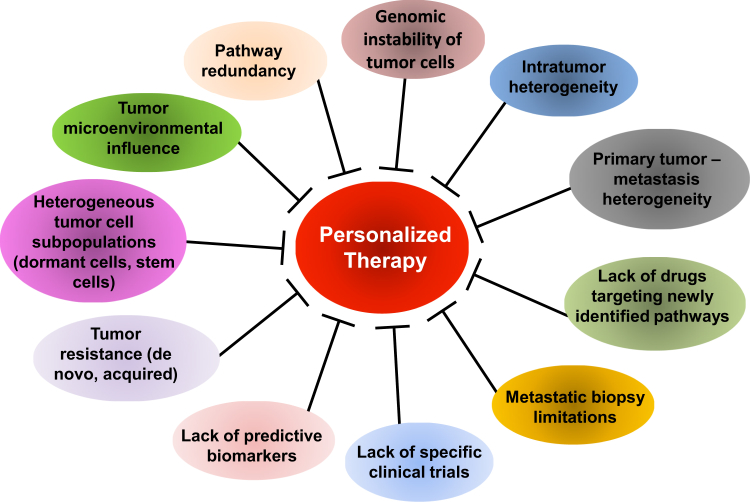
Despite important progress in adjuvant and neoadjuvant therapies, metastatic disease often develops in breast cancer patients and remains the leading cause of their deaths. For patients with established metastatic disease, therapy is palliative, with few breaks and with mounting adverse effects. Many have hypothesized that a personalized or precision approach (the terms are used interchangeably) to cancer therapy, in which treatment is based on the individual characteristics of each patient, will provide better outcomes. Here, we discuss the molecular basis of breast cancer metastasis and the challenges in personalization of treatment. The instability of metastatic tumors remains a leading obstacle to personalization, because information from a patient's primary tumor may not accurately reflect the metastasis, and one metastasis may vary from another. Furthermore, the variable presence of tumor subpopulations, such as stem cells and dormant cells, may increase the complexity of the targeted treatments needed. Although molecular signatures and circulating biomarkers have been identified in breast cancer, there is lack of validated predictive molecular markers to optimize treatment choices for either prevention or treatment of metastatic disease. Finally, to maximize the information that can be obtained, increased attention to clinical trial design in the metastasis preventive setting is needed.
Copyright © 2013 American Society for Investigative Pathology. Published by Elsevier Inc. All rights reserved.
Figures
References
-
- Steeg P.S. Tumor metastasis: mechanistic insights and clinical challenges. Nat Med. 2006;12:895–904. - PubMed
-
- Comen E., Norton L., Massagué J. Clinical implications of cancer self-seeding. Nat Rev Clin Oncol. 2011;8:369–377. - PubMed
-
- Klein C.A. Parallel progression of primary tumours and metastases. Nat Rev Cancer. 2009;9:302–312. - PubMed
-
- Paget S. The distribution of secondary growths in cancer of the breast. 1889. Cancer Metastasis Rev. 1989;8:98–101. - PubMed
Publication types
MeSH terms
Grants and funding
LinkOut - more resources
Full Text Sources
Other Literature Sources
Medical
