


Efficacy of intermittent androgen deprivation therapy vs conventional continuous androgen deprivation therapy for advanced prostate cancer: a meta-analysis
- PMID: 23896094
- PMCID: PMC4154705
- DOI: 10.1016/j.urology.2013.01.078
Efficacy of intermittent androgen deprivation therapy vs conventional continuous androgen deprivation therapy for advanced prostate cancer: a meta-analysis
Abstract
Objective: To compare the efficacy of intermittent androgen deprivation therapy (IADT) vs continuous androgen deprivation therapy (CADT) for the treatment of advanced prostate cancer; we performed a meta-analysis of randomized controlled trials (RCTs), assessing the risks of disease progression, all-cause, and disease-specific mortality.
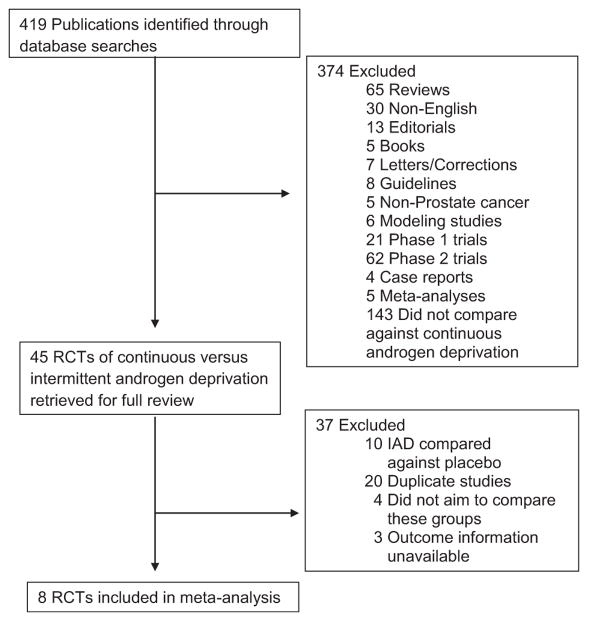
Materials and methods: We conducted a systematic search of several bibliographic systems to identify all RCTs of IADT in men with newly diagnosed metastatic or biochemical only prostate cancer. We abstracted outcome data, study characteristics, and participant demographics. We performed heterogeneity tests and calculated the summarized risk differences (RD) and risk ratios at 95% confidence intervals (CI), using inverse variance methods in random-effects approaches.
Results: We identified 8 RCTs (N = 4664) comparing mortality between IADT and CADT. For all men combined, we observed small but nonsignificant differences in all-cause mortality (RD = 0.02, 95% CI = -0.02, 0.06), disease-specific mortality (RD = 0.04, 95% CI = -0.01, 0.08), and disease progression (RD = -0.03, 95% CI = -0.09, 0.04). Among the prespecified subgroup with histologically confirmed, newly diagnosed metastatic disease, we found no difference in overall survival (RD = 0.00, 95% CI = -0.09, 0.09).
Conclusion: We found no difference in overall survival, but a small increased risk in disease-specific survival for men treated with IADT relative to CADT was observed. IADT could be considered as an alternative to CADT because of better quality of life outcome. Patients should be informed of the possible risks and benefits of both therapies. More research confirming the benefits of IADT vs CADT is needed to inform treatment decisions.
Copyright © 2013 Elsevier Inc. All rights reserved.
Figures

Comment in
-
Editorial comment.Urology. 2013 Aug;82(2):333-4; discussion 334. doi: 10.1016/j.urology.2013.01.079. Urology. 2013. PMID: 23896095 No abstract available.
References
-
- Ismail M, Ferroni M, Gomella LG. Androgen suppression strategies for prostate cancer: is there an ideal approach? Curr Urol Rep. 2011;12:188–196. - PubMed
-
- Youssef E, Tekyi-Mensah S, Hart K, et al. Intermittent androgen deprivation for patients with recurrent/metastatic prostate cancer. Am J Clin Oncol. 2003;26:e119–e123. - PubMed
-
- Bruchovsky N, Rennie PS, Coldman AJ, et al. Effects of androgen withdrawal on the stem cell composition of the Shionogi carcinoma. Cancer Res. 1990;50:2275–2282. - PubMed
-
- Sato N, Gleave ME, Bruchovsky N, et al. Intermittent androgen suppression delays progression to androgen-independent regulation of prostate-specific antigen gene in the LNCaP prostate tumor model. J Steroid Biochem Mol Biol. 1996;58:139–146. - PubMed
Publication types
MeSH terms
Substances
Grants and funding
LinkOut - more resources
Full Text Sources
Other Literature Sources
Medical
Miscellaneous
