


Scoping review on search queries and social media for disease surveillance: a chronology of innovation
- PMID: 23896182
- PMCID: PMC3785982
- DOI: 10.2196/jmir.2740
Scoping review on search queries and social media for disease surveillance: a chronology of innovation
Abstract
Background: The threat of a global pandemic posed by outbreaks of influenza H5N1 (1997) and Severe Acute Respiratory Syndrome (SARS, 2002), both diseases of zoonotic origin, provoked interest in improving early warning systems and reinforced the need for combining data from different sources. It led to the use of search query data from search engines such as Google and Yahoo! as an indicator of when and where influenza was occurring. This methodology has subsequently been extended to other diseases and has led to experimentation with new types of social media for disease surveillance.
Objective: The objective of this scoping review was to formally assess the current state of knowledge regarding the use of search queries and social media for disease surveillance in order to inform future work on early detection and more effective mitigation of the effects of foodborne illness.
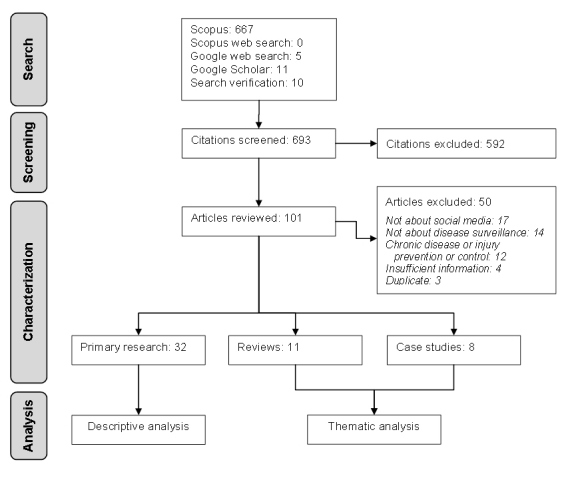
Methods: Structured scoping review methods were used to identify, characterize, and evaluate all published primary research, expert review, and commentary articles regarding the use of social media in surveillance of infectious diseases from 2002-2011.
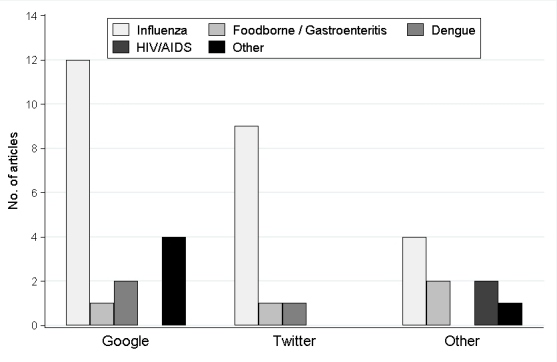
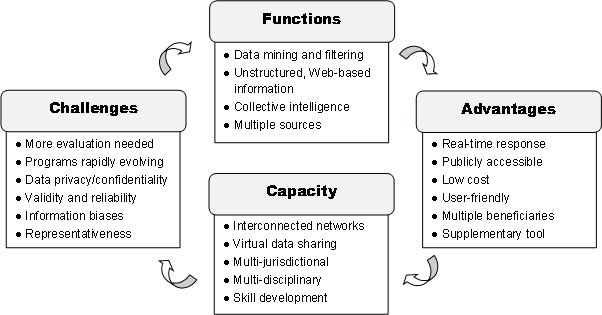
Results: Thirty-two primary research articles and 19 reviews and case studies were identified as relevant. Most relevant citations were peer-reviewed journal articles (29/32, 91%) published in 2010-11 (28/32, 88%) and reported use of a Google program for surveillance of influenza. Only four primary research articles investigated social media in the context of foodborne disease or gastroenteritis. Most authors (21/32 articles, 66%) reported that social media-based surveillance had comparable performance when compared to an existing surveillance program. The most commonly reported strengths of social media surveillance programs included their effectiveness (21/32, 66%) and rapid detection of disease (21/32, 66%). The most commonly reported weaknesses were the potential for false positive (16/32, 50%) and false negative (11/32, 34%) results. Most authors (24/32, 75%) recommended that social media programs should primarily be used to support existing surveillance programs.
Conclusions: The use of search queries and social media for disease surveillance are relatively recent phenomena (first reported in 2006). Both the tools themselves and the methodologies for exploiting them are evolving over time. While their accuracy, speed, and cost compare favorably with existing surveillance systems, the primary challenge is to refine the data signal by reducing surrounding noise. Further developments in digital disease surveillance have the potential to improve sensitivity and specificity, passively through advances in machine learning and actively through engagement of users. Adoption, even as supporting systems for existing surveillance, will entail a high level of familiarity with the tools and collaboration across jurisdictions.
Keywords: disease; review; social media; surveillance.
Conflict of interest statement
Conflicts of Interest: None declared.
Figures
References
-
- Eysenbach G. Infodemiology: tracking flu-related searches on the web for syndromic surveillance. AMIA Annu Symp Proc. 2006:244–8. http://europepmc.org/abstract/MED/17238340 - PMC - PubMed
-
- Polgreen PM, Chen Y, Pennock DM, Nelson FD. Using internet searches for influenza surveillance. Clin Infect Dis. 2008 Dec 1;47(11):1443–8. doi: 10.1086/593098. http://www.cid.oxfordjournals.org/cgi/pmidlookup?view=long&pmid=18954267 - DOI - PubMed
Publication types
MeSH terms
LinkOut - more resources
Full Text Sources
Other Literature Sources
Miscellaneous
