


An Internet-based guided self-help intervention for panic symptoms: randomized controlled trial
- PMID: 23896222
- PMCID: PMC3742403
- DOI: 10.2196/jmir.2362
An Internet-based guided self-help intervention for panic symptoms: randomized controlled trial
Abstract
Background: Internet-based guided self-help is efficacious for panic disorder, but it is not known whether such treatment is effective for milder panic symptoms as well.
Objective: To evaluate the effectiveness of Don't Panic Online, an Internet-based self-help course for mild panic symptoms, which is based on cognitive behavioral principles and includes guidance by email.
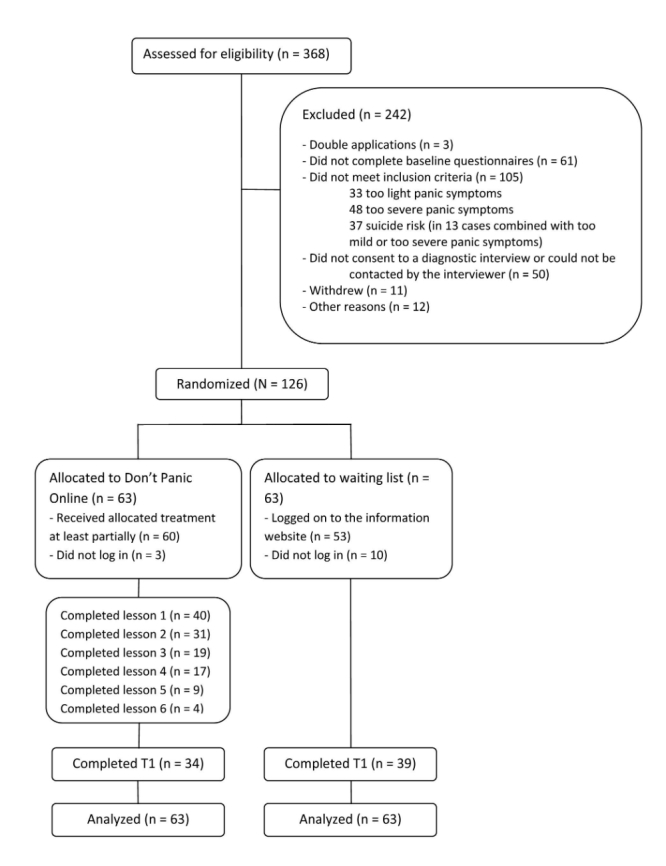
Methods: A pragmatic randomized controlled trial was conducted. Participants (N=126) were recruited from the general population and randomized to either the intervention group or to a waiting-list control group. Inclusion criteria were a Panic Disorder Severity Scale-Self Report (PDSS-SR) score between 5-15 and no suicide risk. Panic symptom severity was the primary outcome measure; secondary outcome measures were anxiety and depressive symptom severity. Measurements were conducted online and took place at baseline and 12 weeks after baseline (T1). At baseline, diagnoses were obtained by telephone interviews.
Results: Analyses of covariance (intention-to-treat) showed no significant differences in panic symptom reduction between groups. Completers-only analyses revealed a moderate effect size in favor of the intervention group (Cohen's d=0.73, P=.01). Only 27% of the intervention group finished lesson 4 or more (out of 6). Nonresponse at T1 was high for the total sample (42.1%). Diagnostic interviews showed that many participants suffered from comorbid depression and anxiety disorders.
Conclusions: The Internet-based guided self-help course appears to be ineffective for individuals with panic symptoms. However, intervention completers did derive clinical benefits from the intervention.
Trial registration: Nederlands Trial Register: NTR1639; http://www.trialregister.nl/trialreg/admin/rctview.asp?TC=1639 (Archived by WebCite at http://www.webcitation.org/6ITZPozs9).
Keywords: Internet; anxiety disorders; panic disorder; patient adherence; self-help.
Conflict of interest statement
Conflicts of Interest: None declared.
Figures
References
-
- Taylor CB. Panic disorder. BMJ. 2006 Apr 22;332(7547):951–5. doi: 10.1136/bmj.332.7547.951. http://europepmc.org/abstract/MED/16627512 - DOI - PMC - PubMed
-
- Bystritsky A, Kerwin L, Niv N, Natoli JL, Abrahami N, Klap R, Wells K, Young AS. Clinical and subthreshold panic disorder. Depress Anxiety. 2010 Apr;27(4):381–9. doi: 10.1002/da.20622. http://europepmc.org/abstract/MED/20013957 - DOI - PMC - PubMed
Publication types
MeSH terms
LinkOut - more resources
Full Text Sources
Other Literature Sources
Medical
Research Materials
