. 2013 Sep;51(11):2305-17.
doi: 10.1016/j.neuropsychologia.2013.06.031. Epub 2013 Jul 26.

Visuo-spatial working memory is an important source of domain-general vulnerability in the development of arithmetic cognition

Affiliations

Visuo-spatial working memory is an important source of domain-general vulnerability in the development of arithmetic cognition

Sarit Ashkenazi et al. Neuropsychologia. 2013 Sep.

Abstract

The study of developmental disorders can provide a unique window into the role of domain-general cognitive abilities and neural systems in typical and atypical development. Mathematical disabilities (MD) are characterized by marked difficulty in mathematical cognition in the presence of preserved intelligence and verbal ability. Although studies of MD have most often focused on the role of core deficits in numerical processing, domain-general cognitive abilities, in particular working memory (WM), have also been implicated. Here we identify specific WM components that are impaired in children with MD and then examine their role in arithmetic problem solving. Compared to typically developing (TD) children, the MD group demonstrated lower arithmetic performance and lower visuo-spatial working memory (VSWM) scores with preserved abilities on the phonological and central executive components of WM. Whole brain analysis revealed that, during arithmetic problem solving, left posterior parietal cortex, bilateral dorsolateral and ventrolateral prefrontal cortex, cingulate gyrus and precuneus, and fusiform gyrus responses were positively correlated with VSWM ability in TD children, but not in the MD group. Additional analyses using a priori posterior parietal cortex regions previously implicated in WM tasks, demonstrated a convergent pattern of results during arithmetic problem solving. These results suggest that MD is characterized by a common locus of arithmetic and VSWM deficits at both the cognitive and functional neuroanatomical levels. Unlike TD children, children with MD do not use VSWM resources appropriately during arithmetic problem solving. This work advances our understanding of VSWM as an important domain-general cognitive process in both typical and atypical mathematical skill development.

Keywords: Arithmetic problem solving; Intra-parietal sulcus; Mathematical disabilities; Visuo-spatial working memory.


Figures

Fig. 1
Fig. 1
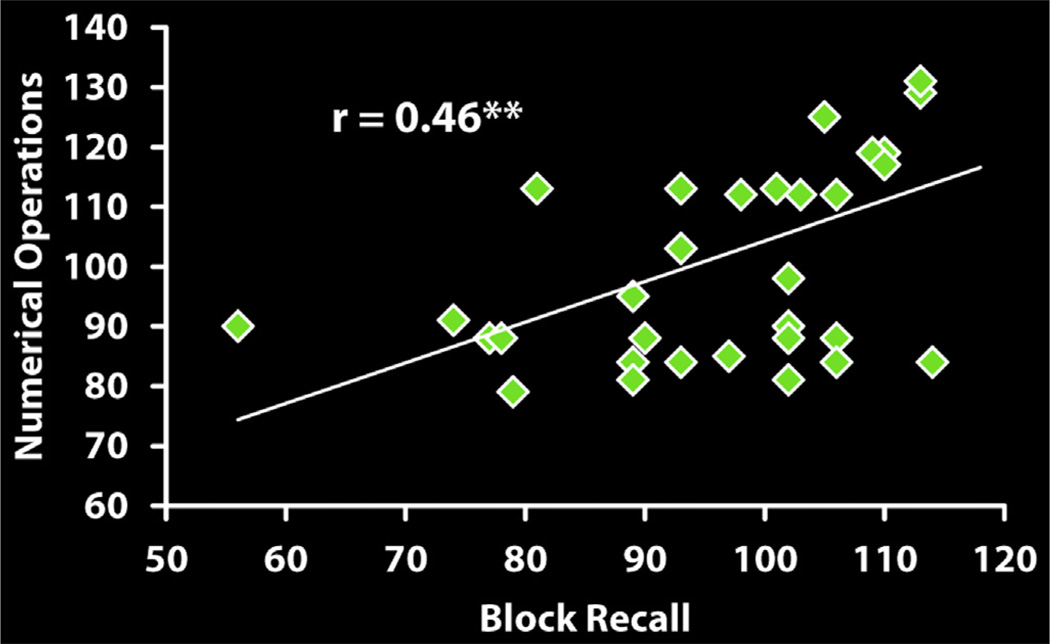
Visuo-spatial working memory ability predicts arithmetic performance. Step-wise regression analyses confirmed that Block Recall, a measure of visuo-spatial working memory, uniquely predicted arithmetic performance among multi-component working memory capacities, and hierarchical modelling confirmed this relationship was independent of domain general performance variables, IQ and reading ability (**p<.01).
Fig. 2
Fig. 2
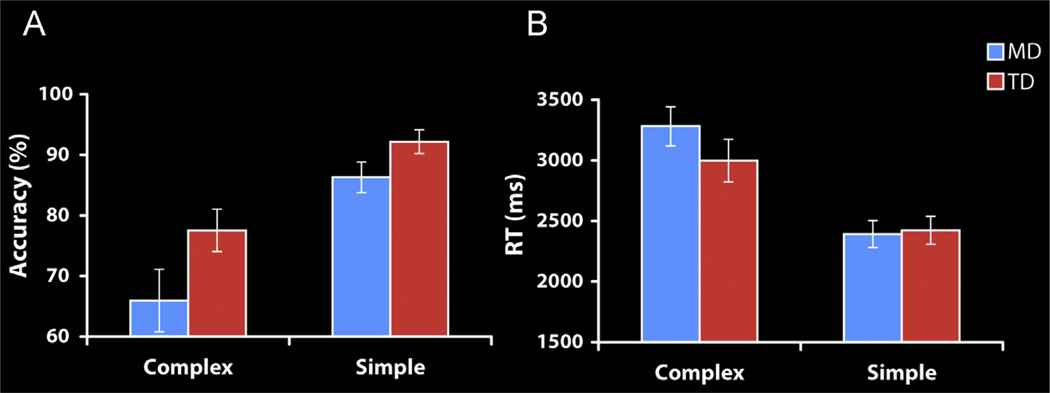
Arithmetic task performance in MD and TD groups. (A) Accuracy and (B) Reaction time (RT) for Complex and Simple addition problems. Both groups showed strong performance differences with addition problem complexity; Simple problems were solved faster and more accurately than Complex problems (ps < .001). For accuracy, the effect of Group was marginally significant (p=.054)—the mathematical disabilities (MD) group had slightly lower accuracy rates compared to the typically developing (TD) group. The interaction between Group and Complexity was not significant (p=.23). Planned follow-up t-tests indicated that MD children with had marginally lower performance than TD children on Complex problems (p=.072), and Simple ones (p=.076). For RT, there was no main effect of group, (p=.51), but there was a marginally significant interaction between Group and Complexity (p=.053). Planned follow up t-tests revealed no significant differences between the groups for either Complex (p=.24) or Simple (p=.85) problems.
Fig. 3
Fig. 3
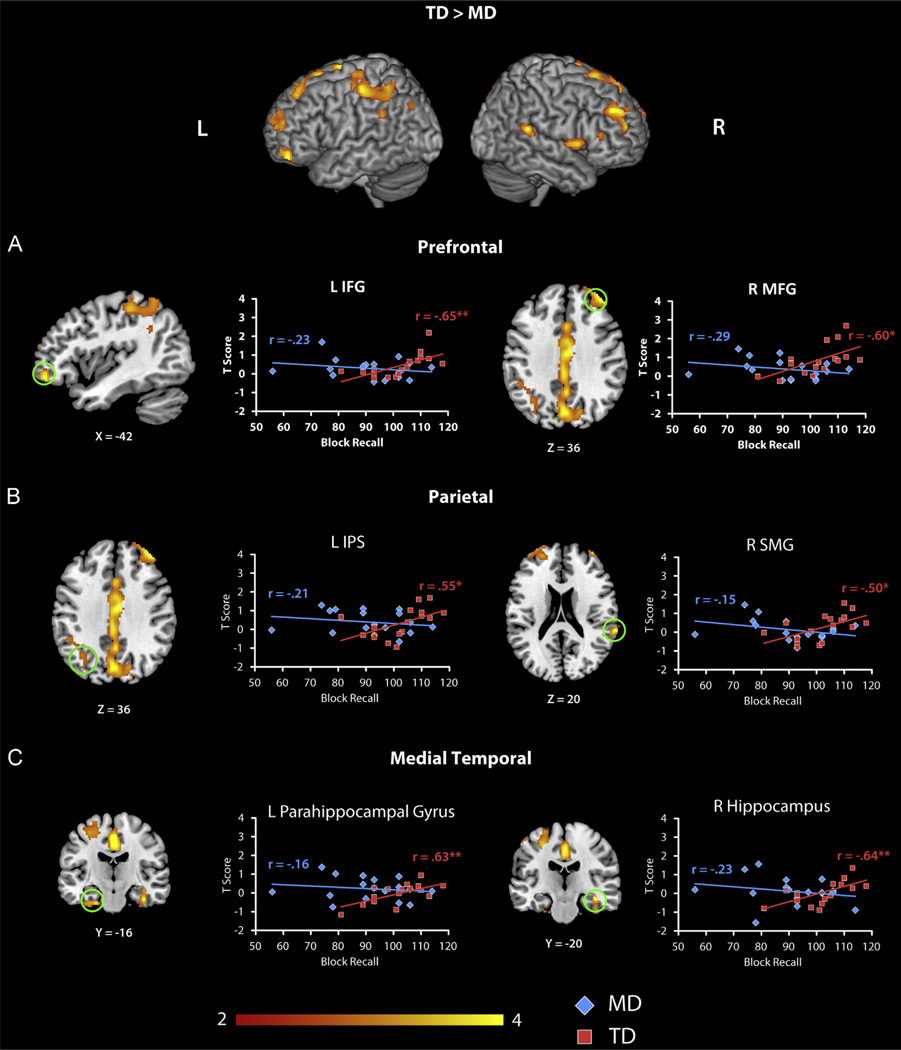
Brain areas where the relation between activity during arithmetic problem solving and visuo-spatial working memory abilities differed significantly between the TD and MD groups. (A) Prefrontal cortex. In typically developing (TD) children, left inferior frontal gyrus (IFG) and right middle frontal gyrus (MFG) showed significant positive correlation between activation during Complex addition problems and Block Recall, a measure of visuo-spatial working memory. In contrast, correlations were nonsignificant in children with mathematical disabilities (MD). (B) Parietal cortex. In TD children, the left intraperiatal sulcus (IPS), and right supramarginal gyrus (SMG) showed significant positive correlation between activation during Complex addition trials and Block Recall. In the MD group there were no significant correlations. (C) Medial temporal cortex. In TD children, left parahippocampal gyrus and right hippocampus showed significant correlations between activation during Complex addition trials and Block Recall. In the MD group there were no significant correlations (*p<.05, **p<.01).
Fig. 4
Fig. 4
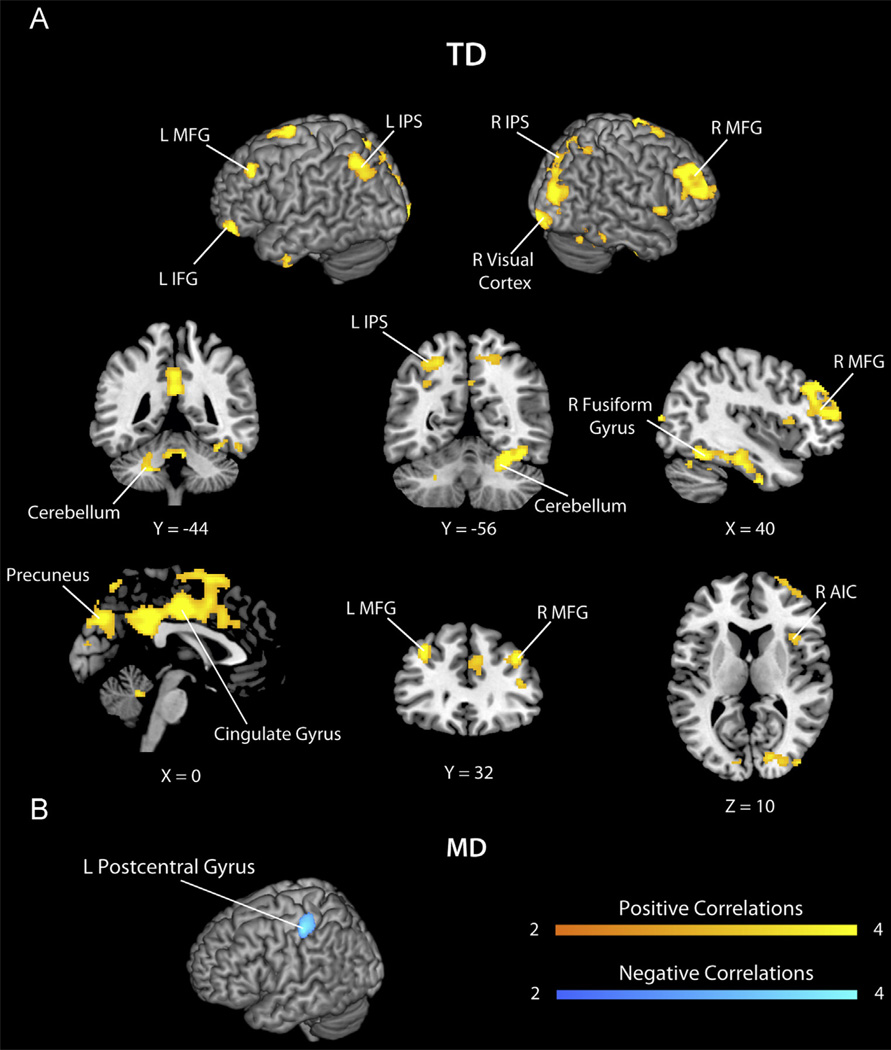
Brain areas in which activity during arithmetic problem solving was significantly correlated with visuo-spatial working memory abilities in the TD and MD groups. (A) In the typically developing (TD) group, Block Recall, a measure of visuo-spatial working memory, was correlated with activity in bilateral middle frontal gyrus (MFG), left inferior frontal gyrus (IFG), right anterior insula (AIC), anterior, middle and posterior cingulate cortex and precuneus, bilateral intraparietal sulcus (IPS), right fusiform gyrus, left temporal pole and the cerebellum. No negative correlations were observed in the TD group. (B) In the mathematical disabilities (MD) group, Block Recall was negatively correlated with activity in left postcentral gyrus. No positive correlations were observed in the MD group.
Fig. 5
Fig. 5
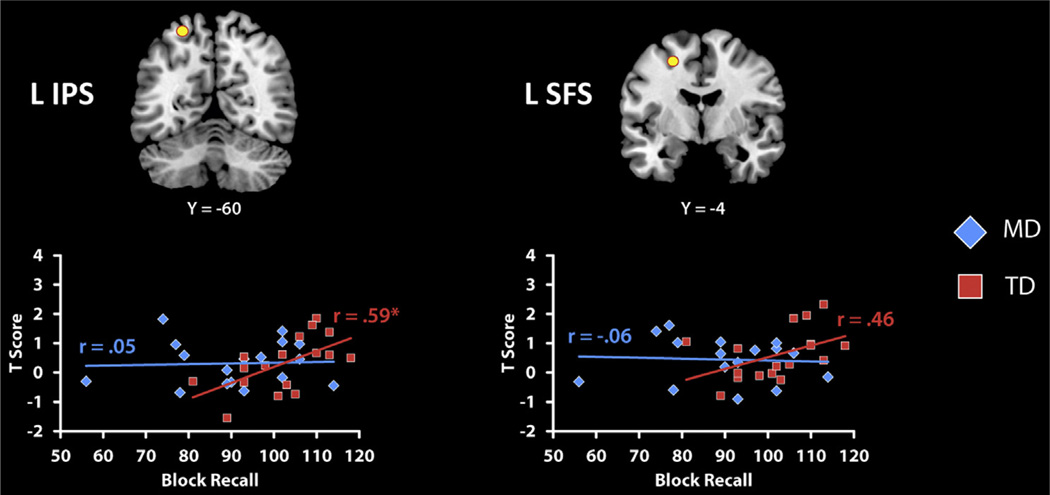
Relation between activity during arithmetic problem solving and visuo-spatial working memory abilities in a priori IPS and SFS ROIs. We used ROIs from an independent neuro-developmental study of visual spatial working memory (VSWM) in adults and children (Klingberg et al., 2002) to further examine the relationship between working memory and arithmetic problem solving. In that study, left IPS and left superior frontal sulcus (SFS) activity was positively correlated with behavioral measures of VSWM ability. Accordingly, we defined ROIs centered in the left IPS (MNI coordinates: −26 −60 60) and SFS (MNI coordinates: −24 −4 52). As with results from whole brain analysis, the correlations were positive and significant in the IPS (*p< .05) and marginally significant in the SFS (p=.062) in the typically develping (TD) group, and nonsignificant in the mathematical disabilities (MD) group.

References

    1. Ansari D. Effects of development and enculturation on number representation in the brain. Nature Reviews Neuroscience. 2008;9(4):278–291. - PubMed
    1. Ansari D, Dhital B. Age-related changes in the activation of the intraparietal sulcus during nonsymbolic magnitude processing: an event-related functional magnetic resonance imaging study. Journal of Cognitive Neuroscience. 2006;18(11):1820–1828. - PubMed
    1. Arsalidou M, Taylor MJ. Is 2+2=4? Meta-analyses of brain areas needed for numbers and calculations. NeuroImage. 2011;54(3):2382–2393. - PubMed
    1. Ashcraft MH, Battaglia J. Cognitive arithmetic—evidence for retrieval and decision-processes in mental addition. Journal of Experimental Psychology-Human Learning and Memory. 1978;4(5):527–538.
    1. Ashkenazi S, Rosenberg-Lee M, Tenison C, Menon V. Weak task-related modulation and stimulus representations during arithmetic problem solving in children with developmental dyscalculia. Developmental Cognitive Neuroscience. 2012;2(Suppl. 10):S152–S166. - PMC - PubMed

Publication types