


Experimental evidence of persistent androgen-receptor-dependency in castration-resistant prostate cancer
- PMID: 23896594
- PMCID: PMC3759876
- DOI: 10.3390/ijms140815615
Experimental evidence of persistent androgen-receptor-dependency in castration-resistant prostate cancer
Abstract
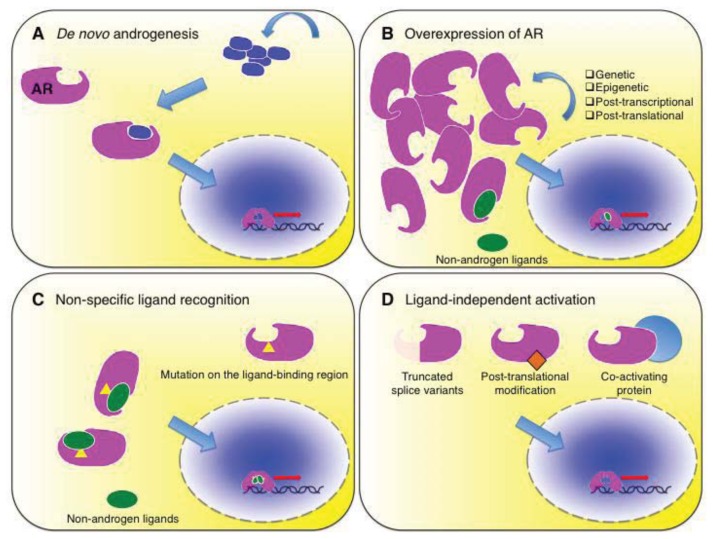
In the majority of castration-resistant prostate cancer (CRPC), prostate-specific antigen (PSA), product of a gene that is almost exclusively regulated by the androgen receptor (AR), still acts as a serum marker reflecting disease burden, indicating that AR signaling is activated even under castrate level of serum androgen. Accumulated evidence shows that transcriptional ability of AR is activated both in ligand-dependent and -independent manners in CRPC cells. Some androgen-independent sublines derived from originally androgen-dependent LNCaP prostate cancer cells overexpress the AR and PSA, for which silencing the AR gene suppresses cellular proliferation. The overexpression of the AR confers androgen-independent growth ability on androgen-dependent prostate cancer cells. Some patient-derived prostate cancer xenograft lines also acquire castration-resistant growth ability secreting PSA. More recent publications have shown that the AR activated in CRPC cells regulates distinct gene sets from that in androgen-dependent status. This concept provides very important insights in the development of novel anti-prostate cancer drugs such as new generation anti-androgens and CYP17 inhibitors.
Figures
References
-
- Petrylak D.P., Tangen C.M., Hussain M.H., Lara P.N., Jr, Jones J.A., Taplin M.E., Burch P.A., Berry D., Moinpour C., Kohli M., et al. Docetaxel and estramustine compared with mitoxantrone and prednisone for advanced refractory prostate cancer. N. Engl. J. Med. 2004;351:1513–1520. - PubMed
-
- Tannock I.F., de Wit R., Berry W.R., Horti J., Pluzanska A., Chi K.N., Oudard S., Theodore C., James N.D., Turesson I., et al. Docetaxel plus prednisone or mitoxantrone plus prednisone for advanced prostate cancer. N. Engl. J. Med. 2004;351:1502–1512. - PubMed
-
- Scher H.I., Buchanan G., Gerald W., Butler L.M., Tilley W.D. Targeting the androgen receptor: Improving outcomes for castration-resistant prostate cancer. Endocr. Relat. Cancer. 2004;11:459–476. - PubMed
-
- Scher H.I., Sawyers C.L. Biology of progressive, castration-resistant prostate cancer: Directed therapies targeting the androgen-receptor signaling axis. J. Clin. Oncol. 2005;23:8253–8261. - PubMed
-
- Scher H.I., Fizazi K., Saad F., Taplin M.E., Sternberg C.N., Miller K., de Wit R., Mulders P., Chi K.N., Shore N.D., et al. Increased survival with enzalutamide in prostate cancer after chemotherapy. N. Engl. J. Med. 2012;367:1187–1197. - PubMed
Publication types
MeSH terms
Substances
LinkOut - more resources
Full Text Sources
Other Literature Sources
Medical
Research Materials
Miscellaneous
