Infant feeding and childhood cognition at ages 3 and 7 years: Effects of breastfeeding duration and exclusivity
- PMID: 23896931
- PMCID: PMC3998659
- DOI: 10.1001/jamapediatrics.2013.455
Infant feeding and childhood cognition at ages 3 and 7 years: Effects of breastfeeding duration and exclusivity
Abstract
Importance: Breastfeeding may benefit child cognitive development, but few studies have quantified breastfeeding duration or exclusivity, nor has any study to date examined the role of maternal diet during lactation on child cognition.
Objectives: To examine relationships of breastfeeding duration and exclusivity with child cognition at ages 3 and 7 years and to evaluate the extent to which maternal fish intake during lactation modifies associations of infant feeding with later cognition.
Design, setting, and participants: Prospective cohort study (Project Viva), a US prebirth cohort that enrolled mothers from April 22, 1999, to July 31, 2002, and followed up children to age 7 years, including 1312 Project Viva mothers and children.
Main exposure: Duration of any breastfeeding to age 12 months.
Main outcomes and measures: Child receptive language assessed with the Peabody Picture Vocabulary Test at age 3 years, Wide Range Assessment of Visual Motor Abilities at ages 3 and 7 years, and Kaufman Brief Intelligence Test and Wide Range Assessment of Memory and Learning at age 7 years.
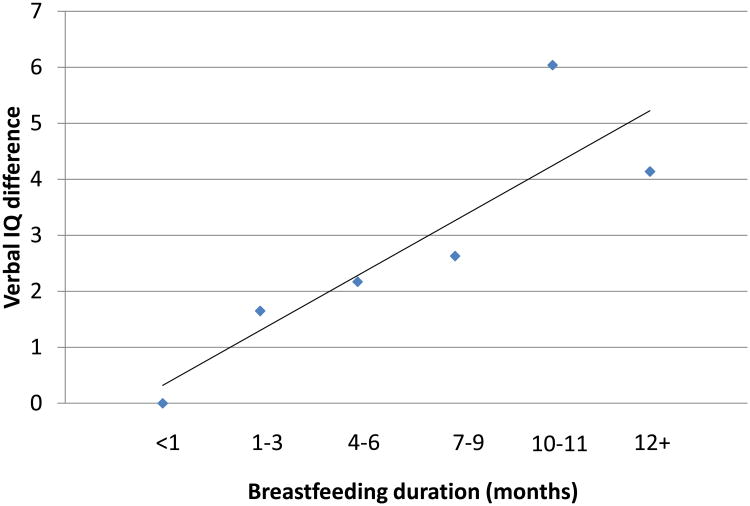
Results: Adjusting for sociodemographics, maternal intelligence, and home environment in linear regression, longer breastfeeding duration was associated with higher Peabody Picture Vocabulary Test score at age 3 years (0.21; 95% CI, 0.03-0.38 points per month breastfed) and with higher intelligence on the Kaufman Brief Intelligence Test at age 7 years (0.35; 0.16-0.53 verbal points per month breastfed; and 0.29; 0.05-0.54 nonverbal points per month breastfed). Breastfeeding duration was not associated with Wide Range Assessment of Memory and Learning scores. Beneficial effects of breastfeeding on the Wide Range Assessment of Visual Motor Abilities at age 3 years seemed greater for women who consumed 2 or more servings of fish per week (0.24; 0.00-0.47 points per month breastfed) compared with less than 2 servings of fish per week (−0.01; −0.22 to 0.20 points per month breastfed) (P = .16 for interaction).
Conclusions and relevance: Our results support a causal relationship of breastfeeding duration with receptive language and verbal and nonverbal intelligence later in life.
Conflict of interest statement
Figures
Comment in
-
Breastfeeding and cognition: Can IQ tip the scale?JAMA Pediatr. 2013 Sep;167(9):796-7. doi: 10.1001/jamapediatrics.2013.470. JAMA Pediatr. 2013. PMID: 23896823 No abstract available.
References
-
- Jain A, Concato J, Leventhal JM. How good is the evidence linking breastfeeding and intelligence? Pediatrics. 2002 Jun;109(6):1044–1053. - PubMed
-
- Anderson JW, Johnstone BM, Remley DT. Breast-feeding and cognitive development: a meta-analysis. Am J Clin Nutr. 1999 Oct;70(4):525–535. - PubMed
-
- Drane DL, Logemann JA. A critical evaluation of the evidence on the association between type of infant feeding and cognitive development. Paediatr Perinat Epidemiol. 2000 Oct;14(4):349–356. - PubMed
Publication types
MeSH terms
Grants and funding
LinkOut - more resources
Full Text Sources
Other Literature Sources
Medical
Miscellaneous