


Applying the concepts of innovation strategies to plastic surgery
- PMID: 23897344
- PMCID: PMC4153345
- DOI: 10.1097/PRS.0b013e3182958c9a
Applying the concepts of innovation strategies to plastic surgery
Abstract
Background: Plastic surgery has a well-known history of innovative procedures and products. However, with the rise in competition, such as aesthetic procedures being performed by other medical specialties, there is a need for continued innovation in plastic surgery to create novel treatments to advance this specialty. Although many articles introduce innovative technologies and procedures, there is a paucity of publications to highlight the application of principles of innovation in plastic surgery.
Methods: The authors review the literature regarding business strategies for innovation.
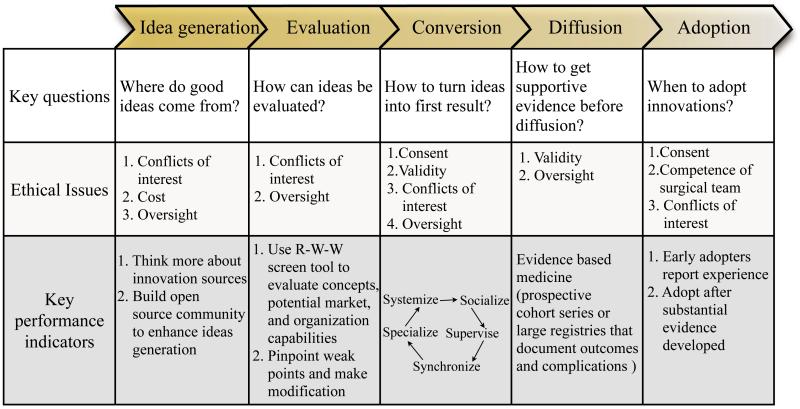
Results: The authors evaluate concepts of innovation, process of innovation (i.e., idea generation, idea evaluation, idea conversion, idea diffusion, and adoption), ethical issues, and application to plastic surgery.
Conclusion: Adopting a business model of innovation is helpful for promoting a new paradigm of progress to propel plastic surgery to new avenues of creativity.
Figures

References
-
- Gurtner GC, Rohrich RJ, Longaker MT. From bedside to bench and back again: technology innovation in plastic surgery. Plastic and reconstructive surgery. 2009;124:1355–6. - PubMed
-
- Mathes SJ. Innovation. Plastic and reconstructive surgery. 2007;120:2110–1. - PubMed
-
- Loonen MP, Hage JJ, Kon M. Plastic Surgery Classics: characteristics of 50 top-cited articles in four Plastic Surgery Journals since 1946. Plastic and reconstructive surgery. 2008;121:320e–7e. - PubMed
-
- Grunwald T, Krummel T, Sherman R. Advanced technologies in plastic surgery: how new innovations can improve our training and practice. Plastic and reconstructive surgery. 2004;114:1556–67. - PubMed
-
- Rosen JM, Long SA, McGrath DM, Greer SE. Simulation in plastic surgery training and education: the path forward. Plastic and reconstructive surgery. 2009;123:729–38. discussion 39-40. - PubMed
Publication types
MeSH terms
Grants and funding
LinkOut - more resources
Full Text Sources
Other Literature Sources
Medical
