


Review
doi: 10.1007/s00018-013-1426-x.
Epub 2013 Jul 30.
Polycomb group proteins and MYC: the cancer connection
Affiliations
- PMID: 23897499
- PMCID: PMC11113285
- DOI: 10.1007/s00018-013-1426-x
Item in Clipboard
Review
Polycomb group proteins and MYC: the cancer connection
Cell Mol Life Sci.
2014 Jan.
Abstract
Polycomb group proteins (PcGs) are transcriptional repressors involved in physiological processes whereas PcG deregulation might result in oncogenesis. MYC oncogene is able to regulate gene transcription, proliferation, apoptosis, and malignant transformation. MYC deregulation might result in tumorigenesis with tumor maintenance properties in both solid and blood cancers. Although the interaction of PcG and MYC in cancer was described years ago, new findings are reported every day to explain the exact mechanisms and results of such interactions. In this review, we summarize recent data on the PcG and MYC interactions in cancer, and the putative involvement of microRNAs in the equation.
Conflict of interest statement
None.
Figures
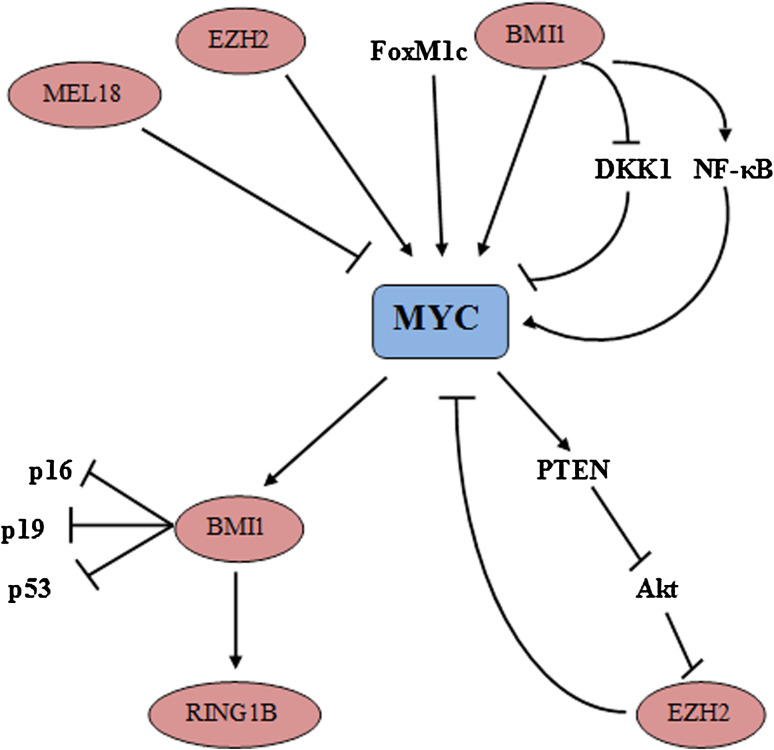
Direct upstream regulators and downstream effectors of MYC oncogene are shown. MYC expression is directly regulated by other transcription factors (FoxM1c) and by different polycomb proteins (EZH2, BMI1, Mel-18). BMI1 also regulates MYC via other transcription factors (nuclear factor [NF]-κB) or via Wnt pathway inhibitors such as Dickkof (DKK1). EZH2 is able to activate c-MYC in a Wnt/b-catenin–EZH2–ERα–MYC axis. MYC represses genes via EZH2, including MYC itself, forming autoregulatory loops with EZH2. MYC controls the polycomb repressive complex (PRC)-1 member RING1B through regulation of its direct downstream regulator BMI1. In turn, BMI1 affects the expression of cell cycle regulators. For a more detailed description see the text
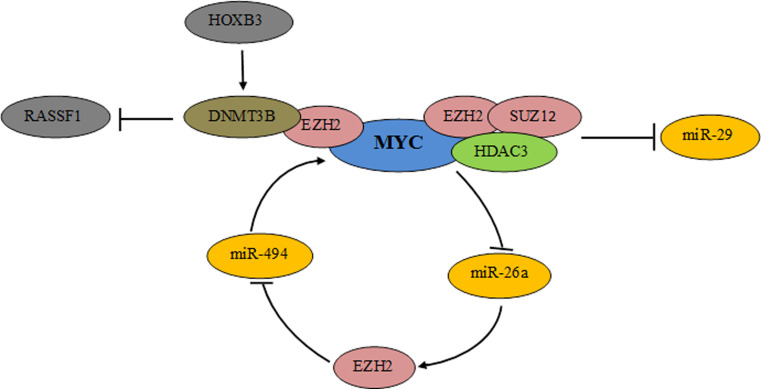
MYC interacts with the histone methyltransferase EZH2 and recruits the DNA methyltransferase DNMT3B, expression of which is enhanced by HOXB3, on the promoter of RASSF1 tumor suppressor repressing its expression. MYC also binds to EZH2/SUZ12 and in cooperation with the histone deacetylase HDAC3 promote silencing of miR-29. MYC is a part of a MYC/miR-26a/EZH2/miR-494 regulatory loop enhancing MYC expression
References
-
- Bracken AP, Helin K. Polycomb group proteins: navigators of lineage pathways led astray in cancer. Nat Rev Cancer. 2009;9:773–784. - PubMed
-
- Bantignies F, Cavalli G. Polycomb group proteins: repression in 3D. Trends Genet. 2011;27:454–464. - PubMed
-
- Sawarkar R, Paro R. Interpretation of developmental signaling at chromatin: the polycomb perspective. Dev Cell. 2010;19:651–661. - PubMed
-
- Villa R, Pasini D, Gutierrez A, Morey L, Occhionorelli M, Viré E, Nomdedeu JF, Jenuwein T, Pelicci PG, Minucci S, Fuks F, Helin K, Di Croce L. Role of the polycomb repressive complex 2 in acute promyelocytic leukemia. Cancer Cell. 2007;11:513–525. - PubMed
-
- Surface LE, Thornton SR, Boyer LA. Polycomb group proteins set the stage for early lineage commitment. Cell Stem Cell. 2010;7:288–298. - PubMed
Publication types
MeSH terms
Substances
LinkOut - more resources
Full Text Sources
Other Literature Sources
