


Bidirectional effects on interhemispheric resting-state functional connectivity induced by excitatory and inhibitory repetitive transcranial magnetic stimulation
- PMID: 23897535
- PMCID: PMC6869044
- DOI: 10.1002/hbm.22300
Bidirectional effects on interhemispheric resting-state functional connectivity induced by excitatory and inhibitory repetitive transcranial magnetic stimulation
Abstract
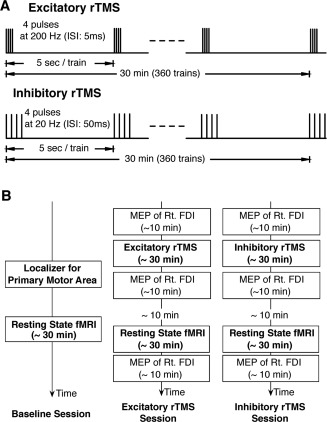
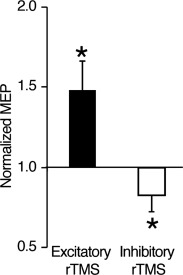
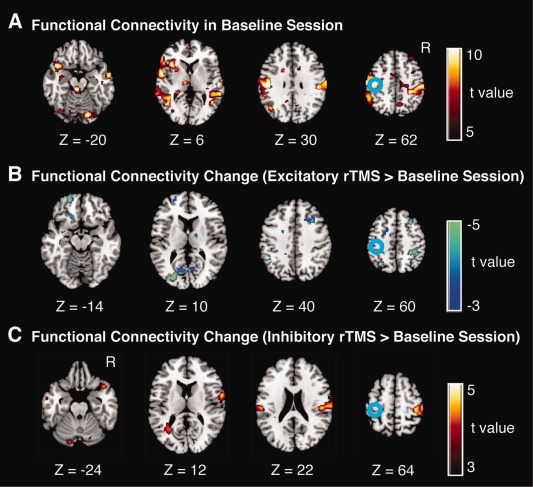
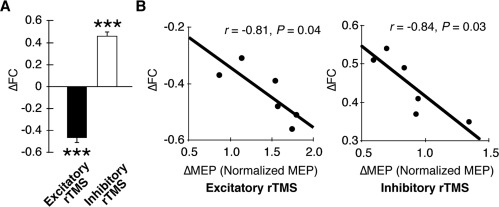
Several recent studies using functional magnetic resonance imaging (fMRI) have shown that repetitive transcranial magnetic stimulation (rTMS) affects not only brain activity in stimulated regions but also resting-state functional connectivity (RSFC) between the stimulated region and other remote regions. However, these studies have only demonstrated an effect of either excitatory or inhibitory rTMS on RSFC, and have not clearly shown the bidirectional effects of both types of rTMS. Here, we addressed this issue by performing excitatory and inhibitory quadripulse TMS (QPS), which is considered to exert relatively large and long-lasting effects on cortical excitability. We found that excitatory rTMS (QPS with interstimulus intervals of 5 ms) decreased interhemispheric RSFC between bilateral primary motor cortices, whereas inhibitory rTMS (QPS with interstimulus intervals of 50 ms) increased interhemispheric RSFC. The magnitude of these effects on RSFC was significantly correlated with that of rTMS-induced effects on motor evoked potential from the corresponding muscle. The bidirectional effects of QPS were also observed in the stimulation over prefrontal and parietal association areas. These findings provide evidence for the robust bidirectional effects of excitatory and inhibitory rTMSs on RSFC, and raise a possibility that QPS can be a powerful tool to modulate RSFC.
Keywords: QPS; fMRI; rTMS; rs-fcMRI; transcallosal connection.
Copyright © 2013 Wiley Periodicals, Inc.
Figures
References
-
- Allen EA, Pasley BN, Duong T, Freeman RD (2007): Transcranial magnetic stimulation elicits coupled neural and hemodynamic consequences. Science 317:1918–1921. - PubMed
-
- Barker AT, Jalinous R, Freeston IL (1985): Non‐invasive magnetic stimulation of human motor cortex. Lancet 1:1106–1107. - PubMed
-
- Biswal B, Yetkin FZ, Haughton VM, Hyde JS (1995): Functional connectivity in the motor cortex of resting human brain using echo‐planar MRI. Magn Reson Med 34:537–541. - PubMed
-
- Biswal BB, Mennes M, Zuo X‐N, Gohel S, Kelly C, Smith SM, Beckmann CF, Adelstein JS, Buckner RL, Colcombe S, Dogonowski AM, Ernst M, Fair D, Hampson M, Hoptman MJ, Hyde JS, Kiviniemi VJ, Kotter R, Li SJ, Lin CP, Lowe MJ, Mackay C, Madden DJ, Madsen KH, Margulies DS, Mayberg HS, McMahon K, Monk CS, Mostofsky SH, Nagel BJ, Pekar JJ, Peltier SJ, Petersen SE, Riedl V, Rombouts SARB, Rypma B, Schlaggar BL, Schmidt S, Seidler RD, Siegle GJ, Sorg C, Teng GJ, Veijola J, Villringer A, Walter M, Wang L, Weng XC, Whitfield‐Gabrieli S Williamson P, Windischberger C, Zang YF, Zhang HY, Castellanos FX, Milham MP (2010): Toward discovery science of human brain function. Proc Natl Acad Sci USA 107:4734–4739. - PMC - PubMed
Publication types
MeSH terms
Substances
LinkOut - more resources
Full Text Sources
Other Literature Sources
Medical
