Serum antioxidant nutrients, vitamin A, and mortality in U.S. Adults
- PMID: 23897583
- PMCID: PMC4026170
- DOI: 10.1158/1055-9965.EPI-13-0381
Serum antioxidant nutrients, vitamin A, and mortality in U.S. Adults
Abstract
Background: Observational studies have suggested that antioxidant nutrients may reduce cancer and overall mortality risks. However, most randomized trials have failed to show survival benefits. Examining nonlinear associations between antioxidant levels and health outcomes may help to explain these discrepant findings.
Methods: We evaluated all-cause, cancer, and cardiovascular mortality risks associated with quintiles (Q1-Q5) of serum antioxidant (vitamins C and E, β-carotene, and selenium) and vitamin A levels, in 16,008 adult participants of The Third National Health and Nutrition Examination Survey (NHANES III; 1988-1994).
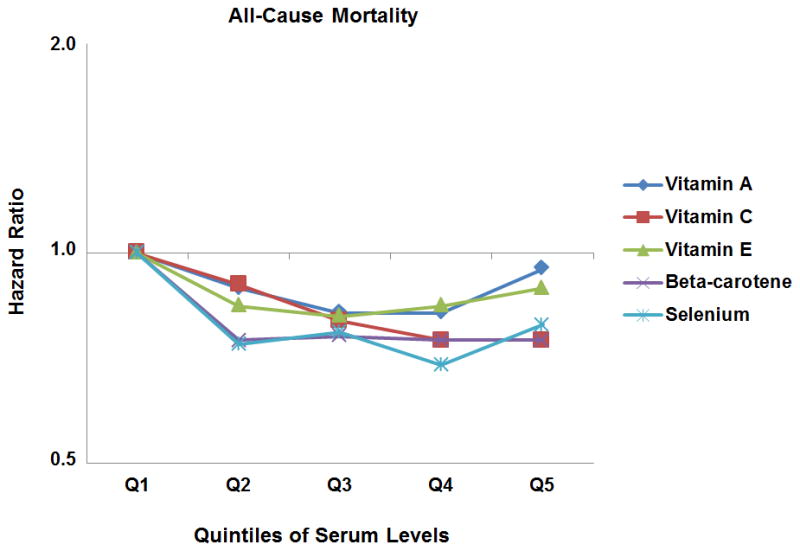
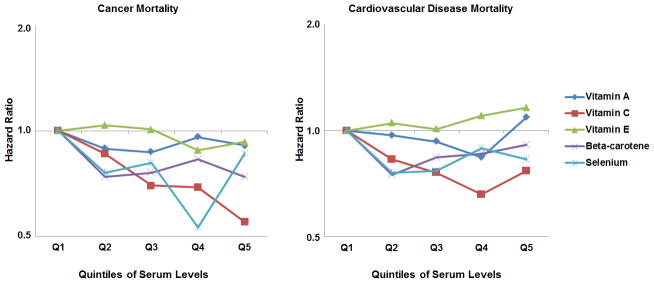
Results: Over a median follow-up period of 14.2 years, there were 4,225 deaths, including 891 from cancer and 1,891 from cardiovascular disease. We observed a dose-response decrease in cancer and overall mortality risks with higher vitamin C levels. In contrast, for vitamin A, risk of cancer death decreased from Q1-Q2, with no further decline in risk at higher levels. For vitamin E, having levels in Q4 was associated with the lowest cancer mortality risk. Both vitamin A and E had U-shaped associations with all-cause mortality. Cancer mortality risks decreased from Q1-Q2 for β-carotene and from Q1-Q4 for selenium. However, for β-carotene and selenium, overall mortality risks decreased from Q1-Q2 but then did not change significantly with higher levels.
Conclusions: Antioxidant supplement use should be studied in the context of overall mortality and other competing mortality risks.
Impact: These data suggest the need for novel intervention studies where doses of these agents are individualized based on their serum levels, and possibly, markers of oxidative stress and systemic inflammatory response.
©2013 AACR.
Conflict of interest statement
Figures
Comment in
-
Oxidative stress, dietary antioxidant supplements, and health: is the glass half full or half empty?Cancer Epidemiol Biomarkers Prev. 2013 Dec;22(12):2145-7. doi: 10.1158/1055-9965.EPI-13-1026. Epub 2013 Oct 15. Cancer Epidemiol Biomarkers Prev. 2013. PMID: 24130222 No abstract available.
References
-
- Gahche J, Bailey R, Burt V, Hughes J, Yetley E, Dwyer J, et al. Dietary supplement use among U.S. adults has increased since NHANES III (1988–1994) NCHS Data Brief. 2011 Apr;(61):1–8. Epub 2011/05/20.eng. - PubMed
-
- Buijsse B, Feskens EJ, Schlettwein-Gsell D, Ferry M, Kok FJ, Kromhout D, et al. Plasma carotene and alpha-tocopherol in relation to 10-y all-cause and cause-specific mortality in European elderly: the Survey in Europe on Nutrition and the Elderly, a Concerted Action (SENECA) The American journal of clinical nutrition. 2005 Oct;82(4):879–86. Epub 2005/10/08.eng. - PubMed
-
- Buijsse B, Feskens EJ, Kwape L, Kok FJ, Kromhout D. Both alpha- and beta-carotene, but not tocopherols and vitamin C, are inversely related to 15-year cardiovascular mortality in Dutch elderly men. J Nutr. 2008 Feb;138(2):344–50. Epub 2008/01/22.eng. - PubMed
-
- Bleys J, Navas-Acien A, Guallar E. Serum selenium levels and all-cause, cancer, and cardiovascular mortality among US adults. Archives of internal medicine. 2008 Feb 25;168(4):404–10. Epub 2008/02/27.eng. - PubMed
Publication types
MeSH terms
Substances
Grants and funding
LinkOut - more resources
Full Text Sources
Other Literature Sources
Medical