. 2013 Oct;81(10):3731-41.
doi: 10.1128/IAI.00646-13. Epub 2013 Jul 29.

Interleukin-25 (IL-25) promotes efficient protective immunity against Trichinella spiralis infection by enhancing the antigen-specific IL-9 response

Affiliations

Interleukin-25 (IL-25) promotes efficient protective immunity against Trichinella spiralis infection by enhancing the antigen-specific IL-9 response

Pornpimon Angkasekwinai et al. Infect Immun. 2013 Oct.

Abstract

Mammalian hosts often develop distinct immune response against the diverse parasitic helminths that have evolved for immune evasion. Interleukin-25 (IL-25), an IL-17 cytokine family member, plays a key role in initiating the protective immunity against several parasitic helminths; however, the involvement and underlying mechanisms by which IL-25 mediates immune response against Trichinella spiralis infection have not been investigated. Here we showed that IL-25 functions in promoting protective immunity against T. spiralis infection. Mice treated with IL-25 exhibited a lower worm burden and fewer muscle larvae in the later stage of T. spiralis infection. In contrast, mice treated with neutralizing antibody against IL-25 failed to expel T. spiralis effectively. During T. spiralis infection, intestinal IL-25 expression was rapidly elevated before the onset of IL-4 and IL-9 induction. While antigen-specific Th2 and Th9 immune responses were both developed during T. spiralis infection, an antigen-specific Th9 response appeared to be transiently induced in the early stage of infection. Mice into which antigen-specific T cells deficient in IL-9 were transferred were less effective in worm clearance than those given wild-type T cells. The strength of the antigen-specific Th9 immune response against T. spiralis could be enhanced or attenuated after treatment with IL-25 or neutralizing antibody against IL-25, respectively, correlating positively with the levels of intestinal mastocytosis and the expression of IL-9-regulated genes, including mast cell- and Paneth cell-specific genes. Thus, our study demonstrates that intestinal IL-25 promotes protective immunity against T. spiralis infection by inducing antigen-specific Th9 immune response.


Figures
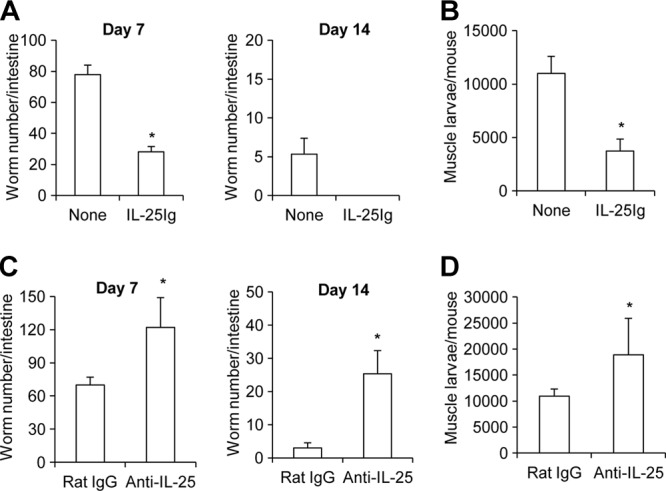
Fig 1
Fig 1
IL-25 mediates protective immunity to T. spiralis infection. (A and B) C57BL/6 mice were untreated or administered IL-25–Ig intraperitoneally at days 0, 1, and 3 following T. spiralis infection. (A) At day 7 and day 14 postinfection, whole intestines were harvested and analyzed for adult worms in the intestine. (B) At day 30 postinfection, whole carcasses of infected mice from different groups were analyzed for muscle larval burden. (C and D) C57BL/6 mice were administered control rat IgG or anti-IL-25 neutralizing antibody intraperitoneally at days 0, 1, and 3 following T. spiralis infection. (C) Adult worms in small intestine were counted at day 7 and day 14 postinfection. (D) Muscle larvae were analyzed in mice sacrificed at day 30 postinfection. Graphs depict mean ± SD and are representative of three independent experiments with three or four mice per group. Significance was determined by Student's t test. *, P < 0.05 (compared with data for the control-treated group).
Fig 2
Fig 2
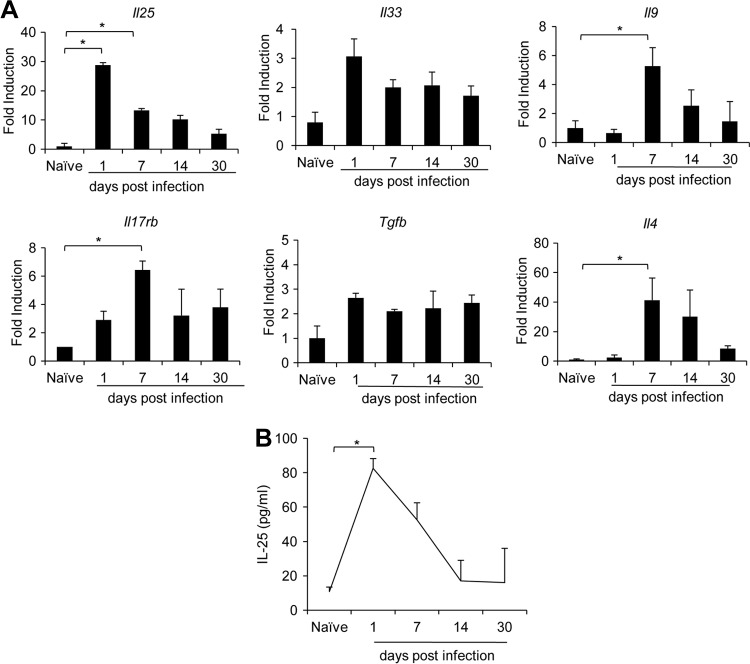
Il25 expression is upregulated transiently and precedes intestinal Il9 induction in T. spiralis-infected mice. C57BL/6 mice were infected with T. spiralis for 1, 7, 14, or 30 days. Small intestines (jejunum) were harvested from naive mice or mice infected at the indicated time points. (A) Total RNA was isolated and subjected to cDNA synthesis and subsequent real-time PCR analysis of cytokine gene expression. Data are expressed as fold induction over actin (Actb) expression, with the mRNA levels in the naive group set as 1. (B) The small intestines (jejunum) of naive and infected mice were homogenized in cold PBS, and supernatant was analyzed for IL-25 content by ELISA. Graphs depict mean ± SD and are representative of at least two independent experiments with three or four mice per group. Significance was determined by one-way ANOVA with Tukey's post hoc analysis (*, P < 0.05).
Fig 3
Fig 3
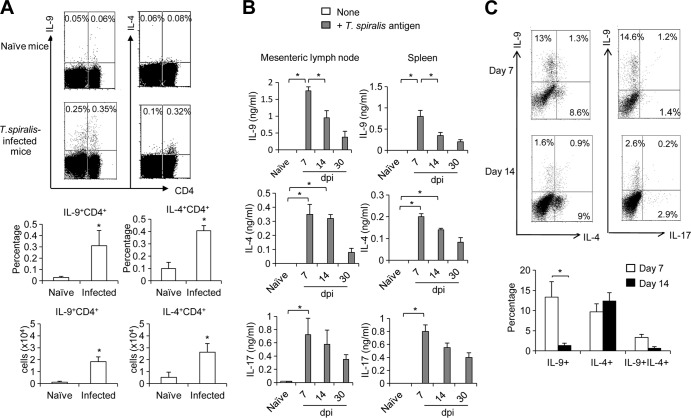
Kinetics of antigen-specific IL-9- and IL-4-producing T cell responses during infection with T. spiralis. (A) C57BL/6 mice were infected with T. spiralis for 7 days. Mesenteric lymph nodes from naive mice and infected mice were harvested and analyzed for surface CD4 staining and intracellular cytokine staining of IL-4 and IL-9. The results are presented as the percentage of the cells and the total cell number (P < 0.05 compared with the number in naive mice). (B) C57BL/6 mice were infected with T. spiralis. At the indicated time points (days postinfection [dpi]), mesenteric lymph nodes or spleens from naive and infected mice were harvested and restimulated with or without T. spiralis extract antigen (concentration of 50 μg/ml) for 3 days. The cytokine levels in culture supernatants were determined by enzyme-linked immunosorbent assay (ELISA). (C) Mesenteric lymph node cells from naive mice or mice infected with T. spiralis for 7 or 14 days were cultured with T. spiralis extract antigen (50 μg/ml) for 7 days and then were enriched for CD4+ T cells by MACS. Enriched CD4+ cells were then restimulated and analyzed for intracellular cytokine staining (plots are gated on CD4+ cells). The results are also presented as the percentage of the cells. Graphs depict mean ± SD and are representative of three experiments with three or four mice per group. Significance was determined by Student's t test (A and C) or one-way ANOVA with Tukey's post hoc analysis (B). *, P < 0.05.
Fig 4
Fig 4
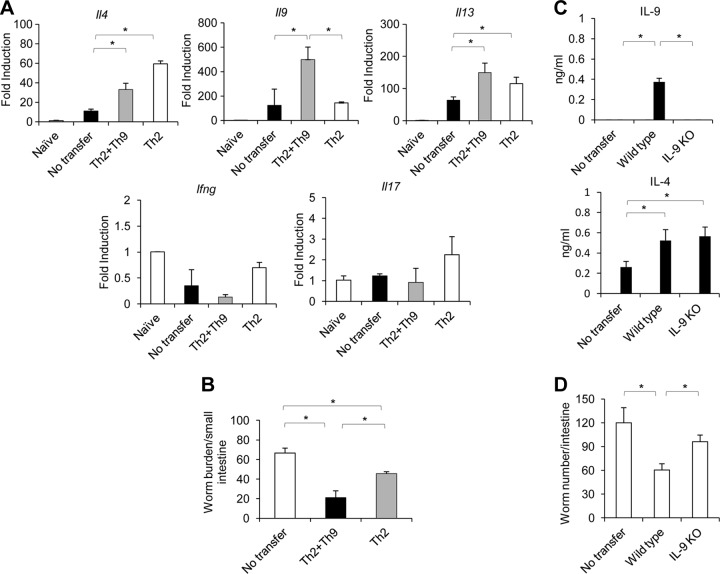
Antigen-specific Th9 cells enhance effective worm expulsion. (A and B) C57BL/6 mice were infected with T. spiralis. At day 7 or day 14 postinfection, mice were sacrificed, and their mesenteric lymph nodes were harvested and cultured with T. spiralis extract antigen. After 7 days of culture, cells of 7-day- or 14-day-infected mice were then collected and enriched for CD4+ cells. Both antigen-specific Th2 and Th9 cells (2 × 10⁷ cells) obtained from 7-day-infected mice or antigen-specific Th2 cells obtained from 14-day-infected mice were transferred into C57BL/6 mice. After 24 h, the recipient mice were then infected with T. spiralis. At 6 days postinfection, mice were sacrificed and analyzed for cytokine gene expression (A) and worm burden (B). (C and D) Antigen-specific CD4+ T cells prepared as described above from wild-type or IL-9-deficient mice were intravenously transferred into IL-9-deficient mice, and the mice were then infected with T. spiralis. At 6 days postinfection, mice were then analyzed for antigen-specific cytokine by ELISA (C) and worm burden (D). Graphs depict mean ± SD and are representative of at least two independent experiments with three or four mice per group. Significance was determined by one-way ANOVA with Tukey's post hoc analysis. *, P < 0.05.
Fig 5
Fig 5
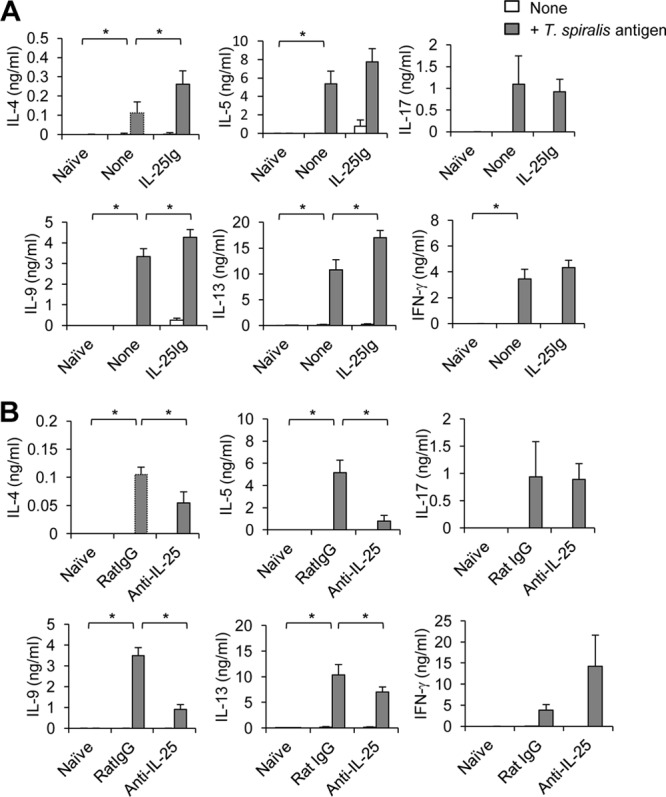
The antigen-specific IL-9 response to T. spiralis is regulated by IL-25. C57BL/6 mice were untreated or administered IL-25–Ig (A) or administered rat IgG antibody or IL-25-neutralizing antibody (B) intraperitoneally at days 0, 1, and 3 following T. spiralis infection. At day 7 postinfection, mesenteric lymph node cells were harvested, and single-cell suspensions were then cultured with or without T. spiralis extract antigen (50 μg/ml). After 3 days, supernatant was collected and analyzed for T. spiralis-specific cytokine production by ELISA. Graphs depict mean ± SD and are representative of at least three independent experiments with three or four mice per group. Significance was determined by one-way ANOVA with Tukey's post hoc analysis. *, P < 0.05.
Fig 6
Fig 6
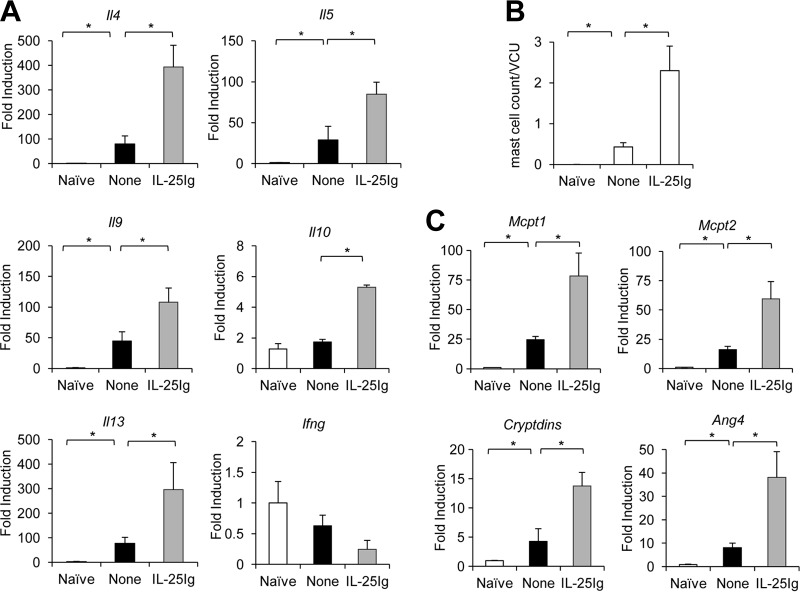
Exogenous IL-25 treatment during T. spiralis infection enhances intestinal IL-9-, mast cell-, and Paneth cell-specific gene expression. C57BL/6 mice were untreated or administered IL-25–Ig intraperitoneally at days 0, 1, and 3 following T. spiralis infection. At day 7 postinfection, small intestines (jejunum) were harvested. (A) Small intestines were subjected to RNA extraction, followed by cDNA synthesis and analysis of cytokine gene expression by real-time PCR. Data are expressed as fold induction over actin (Actb) expression, with the mRNA levels in the naive group set as 1. (B) Small intestines (jejunum) were fixed with 10% formalin buffer and subjected to histological analysis of mast cells by Leder staining. Numbers of mast cells are expressed per villus crypt unit (VCU). (C) cDNA was analyzed for the expression of mouse mast cell protease 1 (Mcpt1), mouse mast cell protease 2 (Mcpt2), and Paneth cell markers Cryptdins and Ang4 by real-time PCR. Graphs depict mean ± SD and are representative of at least two independent experiments with three or four mice per group. Significance was determined by one-way ANOVA with Tukey's post hoc analysis. *, P < 0.05.
Fig 7
Fig 7
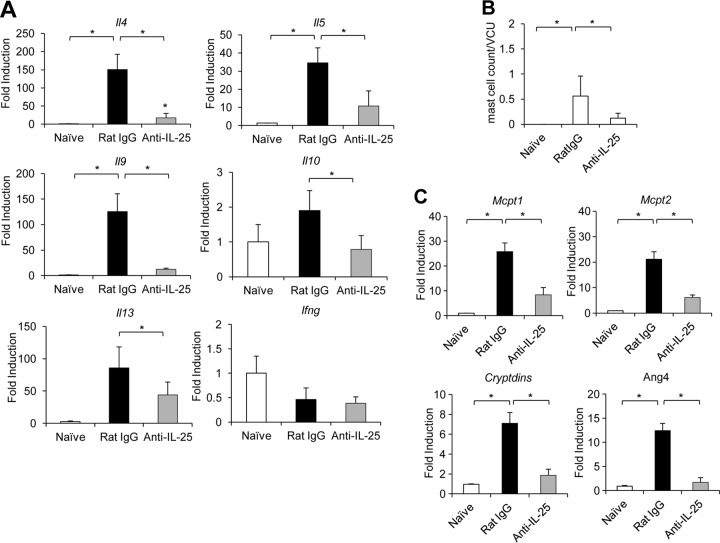
IL-25 blockade during T. spiralis infection reduces intestinal IL-9-, mast cell-, and Paneth cell-specific gene expression. C57BL/6 mice were administered rat IgG (control) or anti-IL-25 neutralizing antibody intraperitoneally at days 0, 1, and 3 after T. spiralis infection. At day 7 postinfection, the small intestines (jejunum) were removed. (A) Cytokine gene expression analysis by real-time RT-PCR. Data are expressed as fold induction over actin (Actb) expression, with the mRNA levels in the naive group set as 1. (B) Jejunum tissue was fixed in 10% formalin buffer and subjected to Leder staining. Numbers of mast cells are expressed per villus crypt unit (VCU). (C) cDNA was analyzed for mast cell- and Paneth cell-specific gene expression by real-time PCR. Graphs depict mean ± SD and are representative of at least three independent experiments with three or four mice per group. Significance was determined by one-way ANOVA with Tukey's post hoc analysis. *, P < 0.05.
Fig 8
Fig 8
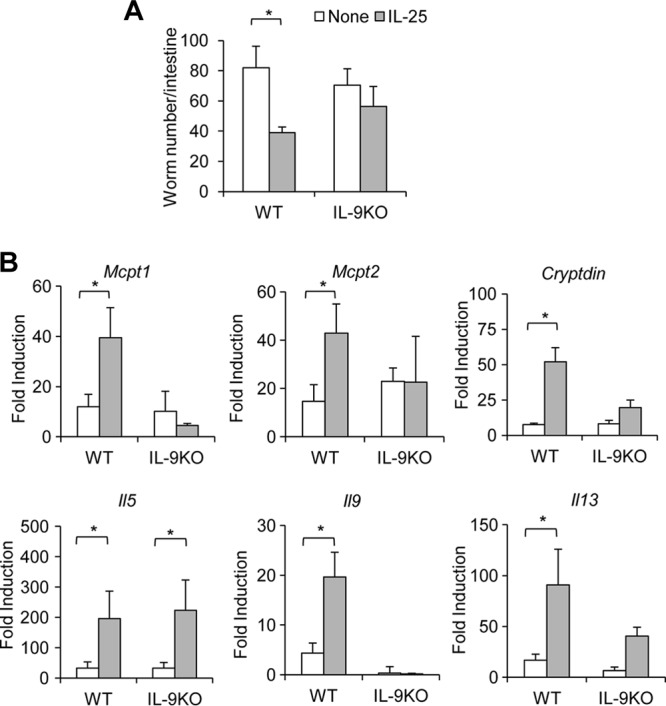
IL-9 is required for IL-25-enhanced T. spiralis worm clearance. IL-9-deficient or wild-type mice were untreated or administered IL-25–Ig intraperitoneally at days 0, 1, and 3 following T. spiralis infection. At day 7 postinfection, small intestines were harvested and analyzed for worm burden (A) or for gene expression by real-time PCR (B). Graphs depict mean ± SD and are representative of at least two independent experiments with three or four mice per group. Significance was determined by one-way ANOVA with Tukey's post hoc analysis. *, P < 0.05.

References

    1. Finkelman FD, Shea-Donohue T, Goldhill J, Sullivan CA, Morris SC, Madden KB, Gause WC, Urban JF., Jr 1997. Cytokine regulation of host defense against parasitic gastrointestinal nematodes: lessons from studies with rodent models. Annu. Rev. Immunol. 15:505–533 - PubMed
    1. Patel N, Kreider T, Urban JF, Jr, Gause WC. 2009. Characterisation of effector mechanisms at the host:parasite interface during the immune response to tissue-dwelling intestinal nematode parasites. Int. J. Parasitol. 39:13–21 - PMC - PubMed
    1. Else KJ, Finkelman FD. 1998. Intestinal nematode parasites, cytokines and effector mechanisms. Int. J. Parasitol. 28:1145–1158 - PubMed
    1. Fort MM, Cheung J, Yen D, Li J, Zurawski SM, Lo S, Menon S, Clifford T, Hunte B, Lesley R, Muchamuel T, Hurst SD, Zurawski G, Leach MW, Gorman DM, Rennick DM. 2001. IL-25 induces IL-4, IL-5, and IL-13 and Th2-associated pathologies in vivo. Immunity 15:985–995 - PubMed
    1. Angkasekwinai P, Park H, Wang YH, Chang SH, Corry DB, Liu YJ, Zhu Z, Dong C. 2007. Interleukin 25 promotes the initiation of proallergic type 2 responses. J. Exp. Med. 204:1509–1517 - PMC - PubMed

Publication types

LinkOut - more resources