. 2013 Jun;25(6):2330-40.
doi: 10.1105/tpc.113.110833. Epub 2013 Jun 28.

The receptor-like protein ReMAX of Arabidopsis detects the microbe-associated molecular pattern eMax from Xanthomonas

Affiliations

The receptor-like protein ReMAX of Arabidopsis detects the microbe-associated molecular pattern eMax from Xanthomonas

Anna Kristina Jehle et al. Plant Cell. 2013 Jun.

Abstract

As part of their immune system, plants have pattern recognition receptors (PRRs) that can detect a broad range of microbe-associated molecular patterns (MAMPs). Here, we identified a PRR of Arabidopsis thaliana with specificity for the bacterial MAMP eMax from xanthomonads. Response to eMax seems to be restricted to the Brassicaceae family and also varied among different accessions of Arabidopsis. In crosses between sensitive accessions and the insensitive accession Shakhdara, eMax perception mapped to receptor-like protein1 (RLP1). Functional complementation of rlp1 mutants required gene constructs that code for a longer version of RLP1 that we termed ReMAX (for receptor of eMax). ReMAX/RLP1 is a typical RLP with structural similarity to the tomato (Solanum lycopersicum) RLP Eix2, which detects fungal xylanase as a MAMP. Attempts to demonstrate receptor function by interfamily transfer of ReMAX to Nicotiana benthamiana were successful after using hybrid receptors with the C-terminal part of ReMAX replaced by that of Eix2. These results show that ReMAX determines specificity for eMax. They also demonstrate hybrid receptor technology as a promising tool to overcome problems that impede interfamily transfer of PRRs to enhance pathogen detection in crop plants.


Figures
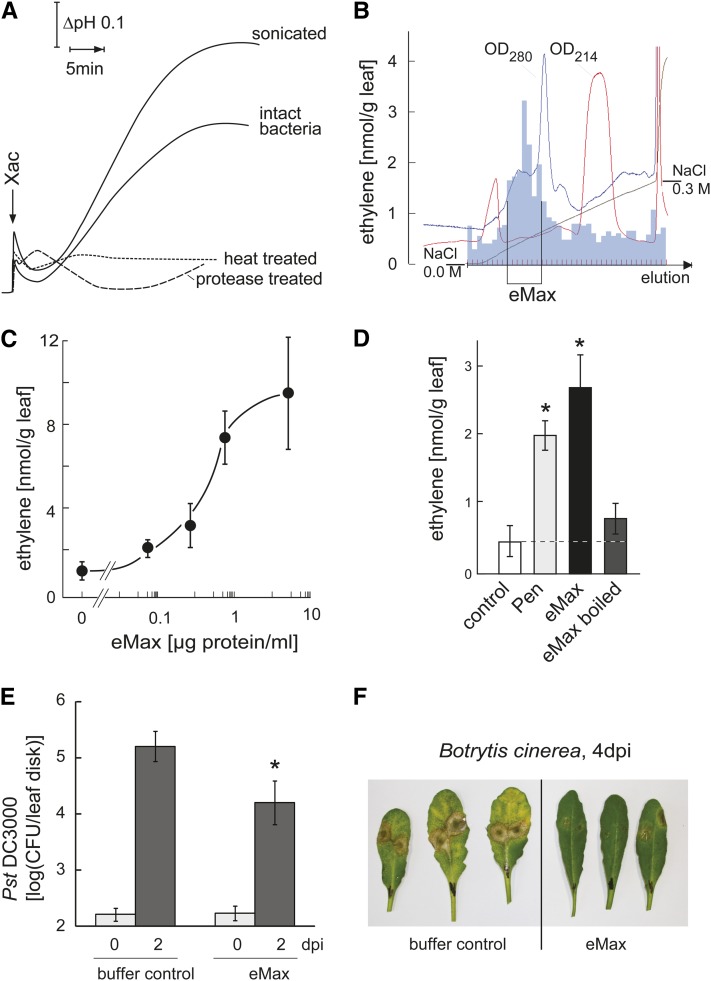
Figure 1.
Figure 1.
MAMP Activity from Xac. (A) Preparations of living Xac bacteria or bacteria after sonication induce extracellular alkalinization in cultured cells of the Arabidopsis double mutant fls2 efr (Col-0 background). The activity is strongly impaired by heating (95°, 10 min) or by digestion with Proteinase K. The data show continuous pH tracings of representative examples from n > 5 repetitions of these experiments. The pH at the start of the experiment was 5.3, and scaling of time (x axis) and pH (y axis) were as indicated by the arrows. (B) Partial purification of the activity in the Xac extract by anion exchange chromatography at pH 8.0. Eluate obtained by increasing NaCl concentration (x axis) was analyzed for OD280 and OD215. Fractions with highest activity (measured by ethylene emission from leaf pieces of fls2 efr plants; y axis) were pooled and denominated eMax as indicated. (C) Dose dependency for ethylene induction. Leaf pieces of fls2 efr plants were treated with different concentrations of eMax. Values represent mean and sd of three replicates. (D) Ethylene production of Col-0 leaf pieces treated with eMax (2 μg/mL), heat-treated eMax (2 μg/mL), or the fungal preparation Pen (90 µg/mL) as positive control. Bars and error bars represent mean and sd of n = 3 replicates. Asterisks show results that differ significantly from control treatment (Student's t test, P < 0.01). (E) PTI against P. syringae pv tomato strain DC3000 (Pst DC3000). Arabidopsis fls2 efr leaves were pretreated by pressure infiltration of leaves with 100 μL of buffer (0.4 mM Tris, pH 8.0, with 5 mM NaCl) or buffer with eMax (0.6 µg protein) for 12 h before pressure infiltration with P. syringae pv tomato strain DC3000. Bars and error bars show mean and sd of bacterial numbers (measured as colony-forming units [CFU], at the indicated days after infection [dpi]) from n = 8 replicates. Asterisks mark significant induction over control based on a Student’s t test, P value < 0.01. (F) PTI against B. cinerea. Arabidopsis fls2 efr plants were sprayed with eMax or buffer and 12 h later infected by spotting 5 μL drops containing ∼500 spores of B. cinerea. Photographs were taken 4 d after infection.
Figure 2.
Figure 2.
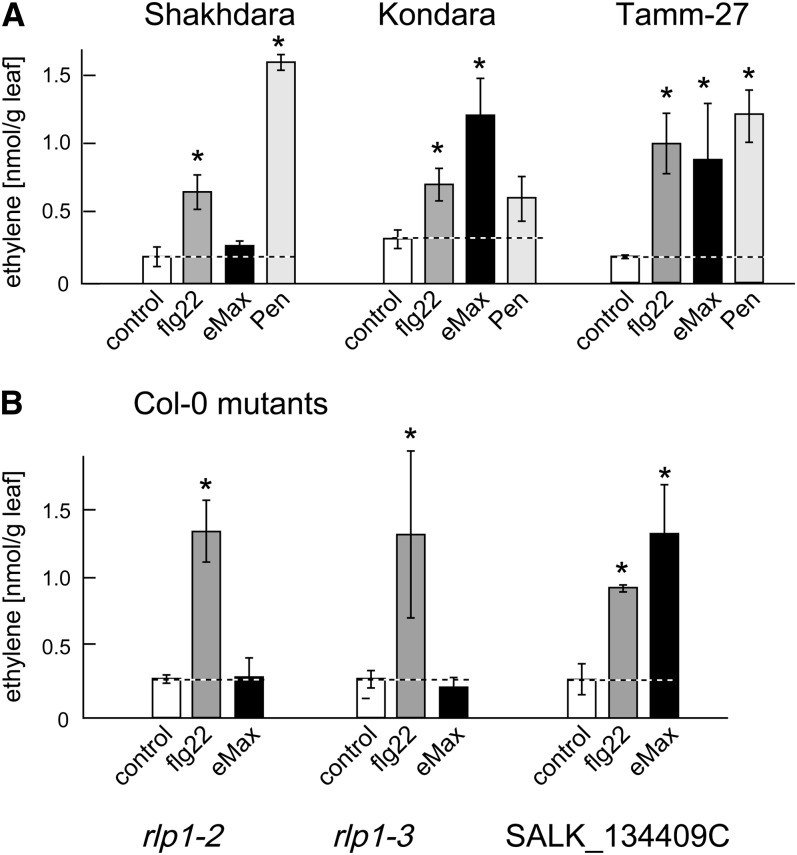
Response to eMax in Leaves from Different Arabidopsis Accessions and Mutants. (A) Ethylene biosynthesis in response to eMax (2 μg/mL), flg22 (100 nM), and the fungal preparation Pen (90 μg/mL) in the accessions Sha, Kondara, and Tamm-27. Responses in the accessions Kondara and Tamm-27 are representative for the majority of the 61 accessions tested. (B) Response to eMax and flg22 in Col-0 plants with T-DNA insertions in the RLK gene At1g06840 (SALK_134409C) or the RLP1 gene At1g07390, lines rlp1-2 (SALK_116923) and rlp1-3 (SALK_049403C), respectively. The bars and error bars show means and sd of three replicates. Asterisks mark significant induction over control based on a Student’s t test, P value < 0.01.
Figure 3.
Figure 3.
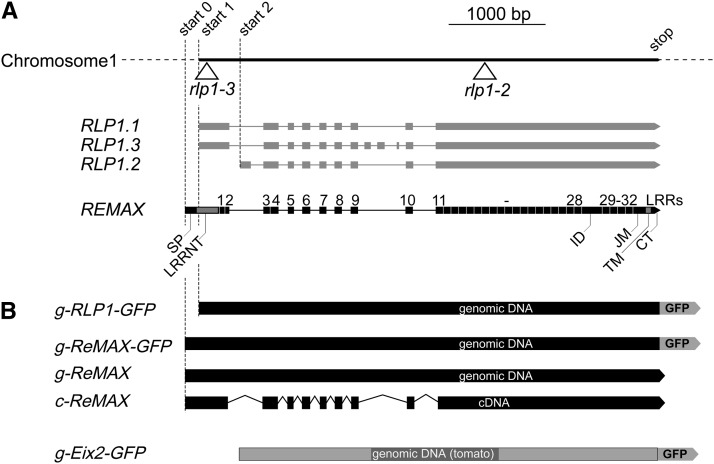
Gene Models for RLP1/ReMAX and Tomato Eix2. (A) Three different gene models with start positions 1 at 2,269,893 or start 2 at 2,270,336 and different splicing options have been proposed for RLP1/At1g07390 (www.tair.org). The mutant lines rlp1-2 (SALK_116923) and rlp1-3 (SALK_049403C) have T-DNA insertions in predicted exons as indicated. Sequencing of Col-0 cDNAs resulted in a gene model with a start at position 2,269,764 (start 0) that we define as ReMAX. SP, signal peptide; LRR-NT, N terminus of the LRR domain; ID, island domain; JM, juxtamembrane domain; TM, transmembrane domain; CT, cytoplasmic tail. (B) Gene constructs used for complementation experiments: Genomic and cDNA with the start positions of ReMAX (start 0) and RLP1.1/RLP1.3 (start 1) were cloned under the control of the 35S promoter. Where indicated, constructs were C-terminally fused in frame with a GFP tag. A similar construct with a GFP tag was produced for the RLP Eix2 (Ron and Avni, 2004) based on genomic DNA from tomato.
Figure 4.
Figure 4.
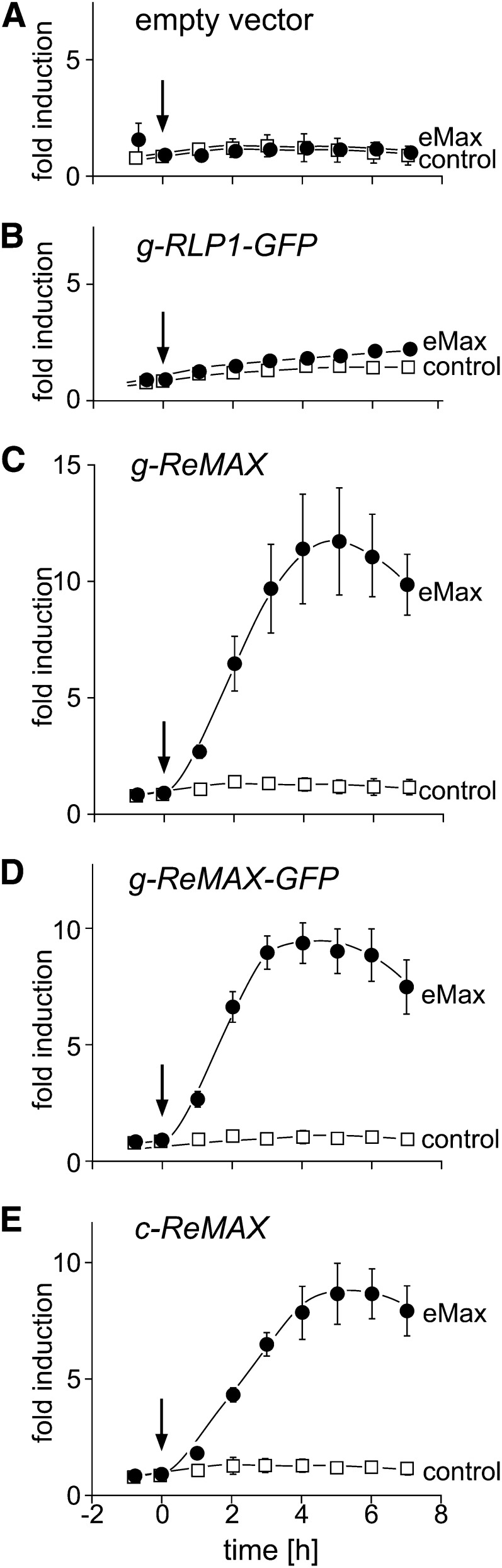
Perception of eMax in Protoplasts of rlp1-2 (Col-0) Plants Expressing RLP1/ReMAX Constructs. Protoplasts were cotransformed with the reporter construct pFRK1:luc and the different constructs of RLP1/ReMAX as indicated. At time t = 0, the protoplasts were treated with eMax (5 μg/mL) or with the inactive peptide flg22A.tum (100 nM) as a control. Fold induction of luciferase activity was calculated with respect to values at time 0. Values, except for results in (B), represent means and sd of three replicates. Results shown are representative for n ≥ 3 independent repetitions of the experiments.
Figure 5.
Figure 5.
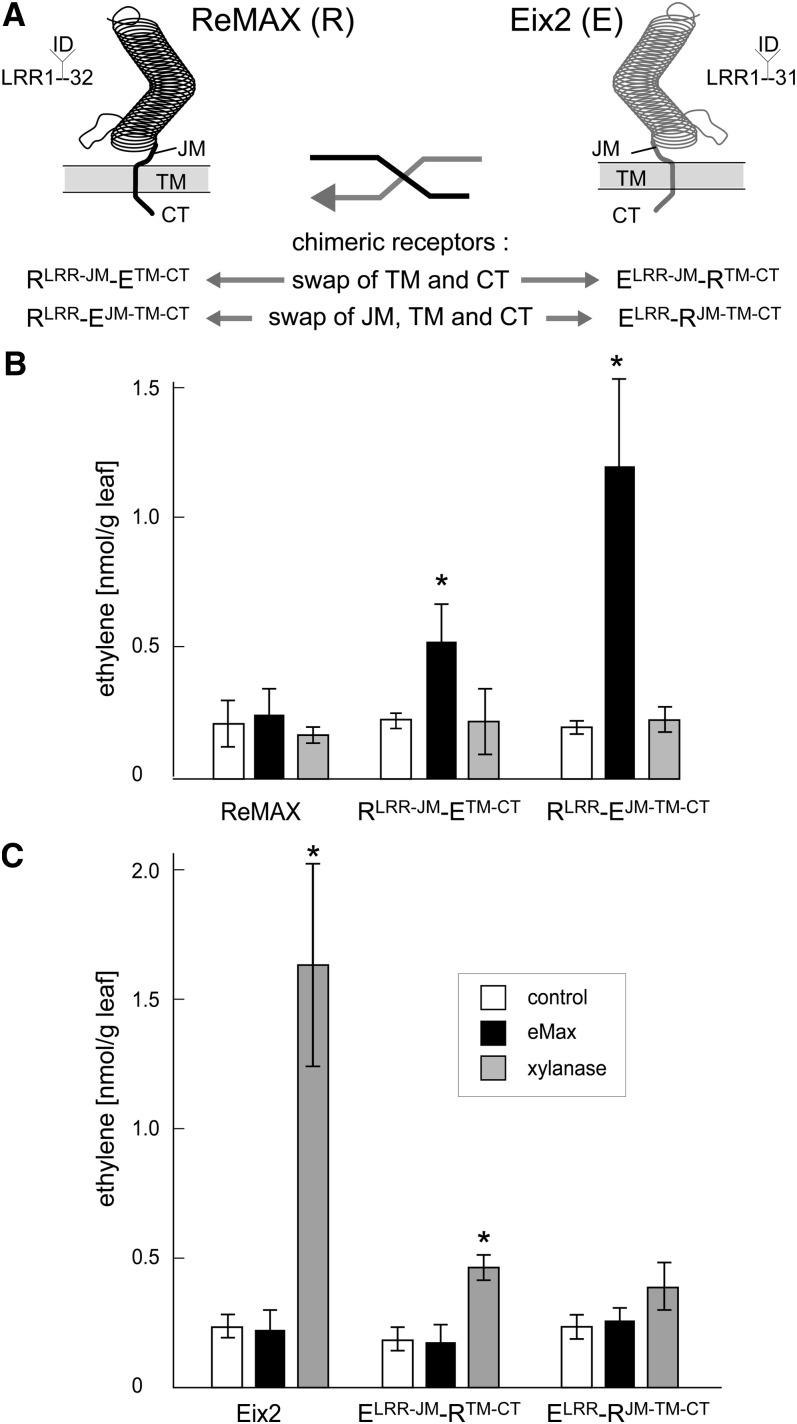
Functionality of ReMAX, Eix2, and Chimeric Forms of These RLPs in N. benthamiana. (A) Schematic representation of ReMAX, Eix2, and the chimeric forms with reciprocal swaps of the C-terminal domains. (B) and (C) Ethylene response of N. benthamiana transformed with the different constructs after treatment with Pen (90 μg/mL) as positive control, eMax (2 μg/mL), or xylanase (2 μg/mL) for 4 h. The bars show means and sd of three replicates. Asterisks mark significant induction over control based on a Student’s t test, P value < 0.05.

References

    1. Akira S., Uematsu S., Takeuchi O. (2006). Pathogen recognition and innate immunity. Cell 124: 783–801 - PubMed
    1. Albert M., Jehle A.K., Mueller K., Eisele C., Lipschis M., Felix G. (2010). Arabidopsis thaliana pattern recognition receptors for bacterial elongation factor Tu and flagellin can be combined to form functional chimeric receptors. J. Biol. Chem. 285: 19035–19042 - PMC - PubMed
    1. Asai T., Tena G., Plotnikova J., Willmann M.R., Chiu W.L., Gómez-Gomez L., Boller T., Ausubel F.M., Sheen J. (2002). MAP kinase signalling cascade in Arabidopsis innate immunity. Nature 415: 977–983 - PubMed
    1. Bleckmann A., Weidtkamp-Peters S., Seidel C.A., Simon R. (2010). Stem cell signaling in Arabidopsis requires CRN to localize CLV2 to the plasma membrane. Plant Physiol. 152: 166–176 - PMC - PubMed
    1. Boller T., Felix G. (2009). A renaissance of elicitors: perception of microbe-associated molecular patterns and danger signals by pattern-recognition receptors. Annu. Rev. Plant Biol. 60: 379–406 - PubMed

MeSH terms