


MAIT cells are critical for optimal mucosal immune responses during in vivo pulmonary bacterial infection
- PMID: 23898209
- PMCID: PMC3746930
- DOI: 10.1073/pnas.1302799110
MAIT cells are critical for optimal mucosal immune responses during in vivo pulmonary bacterial infection
Abstract
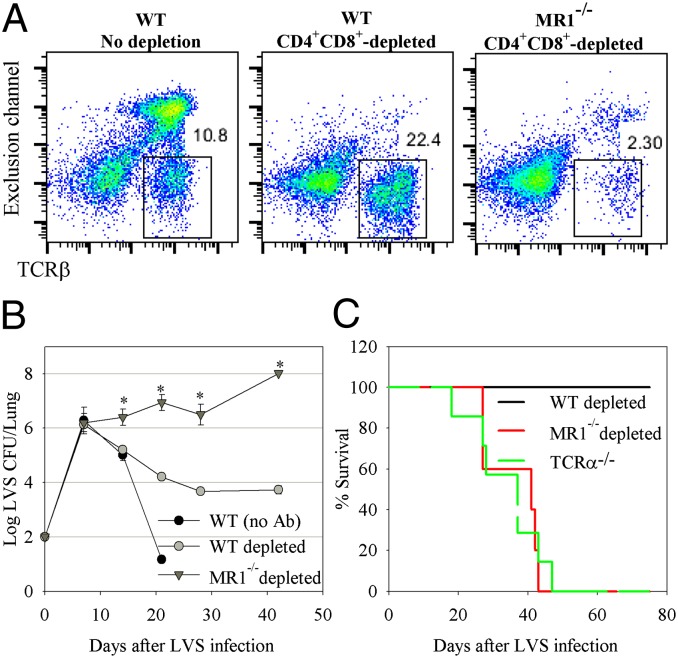
Mucosa-associated invariant T (MAIT) cells are "innate" T cells that express an invariant T-cell receptor α-chain restricted by the nonclassical MHC class I molecule MHC-related protein 1 (MR1). A recent discovery that MR1 presents vitamin B metabolites, presumably from pathogenic and/or commensal bacteria, distinguishes MAIT cells from peptide- or lipid-recognizing αβ T cells in the immune system. MAIT cells are activated by a wide variety of bacterial strains in vitro, but their role in defense against infectious assaults in vivo remains largely unknown. To investigate how MAIT cells contribute to mucosal immunity in vivo, we used a murine model of pulmonary infection by using the live vaccine strain (LVS) of Francisella tularensis. In the early acute phase of infection, MAIT cells expanded robustly in the lungs, where they preferentially accumulated after reaching their peak expansion in the late phase of infection. Throughout the course of infection, MAIT cells produced the critical cytokines IFN-γ, TNF-α, and IL-17A. Mechanistic studies showed that MAIT cells required both MR1 and IL-12 40 kDa subunit (IL-12p40) signals from infected antigen presenting cells to control F. tularensis LVS intracellular growth. Importantly, pulmonary F. tularensis LVS infection of MR1-deficient (MR1(-/-)) mice, which lack MAIT cells, revealed defects in early mucosal cytokine production, timely recruitment of IFN-γ-producing CD4(+) and CD8(+) T cells to the infected lungs, and control of pulmonary F. tularensis LVS growth. This study provides in vivo evidence demonstrating that MAIT cells are an important T-cell subset with activities that influence the innate and adaptive phases of mucosal immunity.
Keywords: respiratory infection; tularemia.
Conflict of interest statement
The authors declare no conflict of interest.
Figures


References
-
- Colmone A, Wang CR. H2-M3-restricted T cell response to infection. Microbes Infect. 2006;8(8):2277–2283. - PubMed
-
- Seaman MS, Wang CR, Forman J. MHC class Ib-restricted CTL provide protection against primary and secondary Listeria monocytogenes infection. J Immunol. 2000;165(9):5192–5201. - PubMed
-
- Chiba A, Dascher CC, Besra GS, Brenner MB. Rapid NKT cell responses are self-terminating during the course of microbial infection. J Immunol. 2008;181(4):2292–2302. - PubMed
MeSH terms
LinkOut - more resources
Full Text Sources
Other Literature Sources
Medical
Molecular Biology Databases
Research Materials
