. 2013 Jul 26:3:197.
doi: 10.3389/fonc.2013.00197. eCollection 2013.

Immunoediting and antigen loss: overcoming the achilles heel of immunotherapy with antigen non-specific therapies

Affiliations

Immunoediting and antigen loss: overcoming the achilles heel of immunotherapy with antigen non-specific therapies

Arta Monir Monjazeb et al. Front Oncol. .

Abstract

Cancer immunotherapy has emerged as a mainstream therapy option in the battle against cancer. Pre-clinical data demonstrates the ability of immunotherapy to harness the immune system to fight disseminated malignancy. Clinical translation has failed to recapitulate the promising results of pre-clinical studies although there have been some successes. In this review we explore some of the short-comings of cancer immunotherapy that have limited successful clinical translation. We will give special consideration to what we consider the most formidable hurdle to successful cancer immunotherapy: tumor-induced immune suppression and immune escape. We will discuss the need for antigen-specific immune responses for successful immunotherapy but also consider the need for antigen specificity as an Achilles heel of immunotherapy given tumor heterogeneity, immune editing, and antigen loss. Finally, we will discuss how combinatorial strategies may overcome some of the pitfalls of antigen specificity and highlight recent studies from our lab which suggest that the induction of antigen non-specific immune responses may also produce robust anti-tumor effects and bypass the need for antigen specificity.

Keywords: bystander T-cells; cancer immunotherapy; immune suppression; immune surveillance; immune tolerance; radiotherapy.


Figures
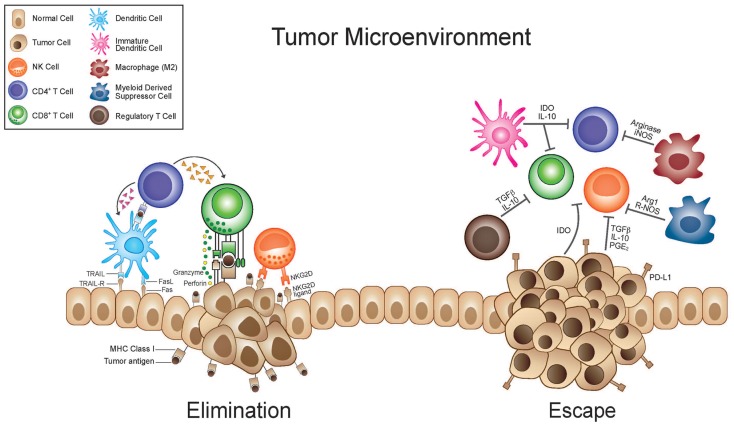
Figure 1
Figure 1
Immunosuppressive tumor microenvironment and antigen loss mediate tumor escape. During the elimination phase immune effector cells such as CTL’s and NK cells with the help of dendritic and CD4+ T-cells are able to recognize and eliminate tumor cells. This killing relies on stress ligands such as NKG2D and recognition of TAA’s in the TCR-MHC complex. As a result of tumor heterogeneity, tumor cells which are less immunogenic or have up-regulated immunosuppressive factors are selected for. These cells are able to subvert the immune response and escape immune surveillance. Tumor cells can secrete cytokines that recruit suppressive cells such as regulatory T (Treg) cells, immature myeloid cells [including immature dendritic cells (iDC) and myeloid-derived suppressor cells (MDSC)], and M2 macrophages. iDC can cause T-cell anergy due to lack of co-stimulatory molecules. M2 macrophages and MDSC inhibit T-cell responses through a variety of mechanisms, including nutrient sequestration via arginase, reactive oxygen species (ROS) generation, nitric oxide (NO), as well as interference with trafficking into the tumor site. Immunosuppressive cytokines and the up-regulation of immunosuppressive enzymes [like indolamine-2,3-dioxygenase (IDO) and arginase] that catabolize essential nutrients required for effector cell activation and also produce immunosuppressive catabolites, contribute to a microenvironment where immune responses are difficult to instigate and sustain. Furthermore tumor cells will down-regulate MHC molecules, loose expression of antigenic molecules, and up-regulate inhibitory molecules such as PD-L1.
Figure 2
Figure 2
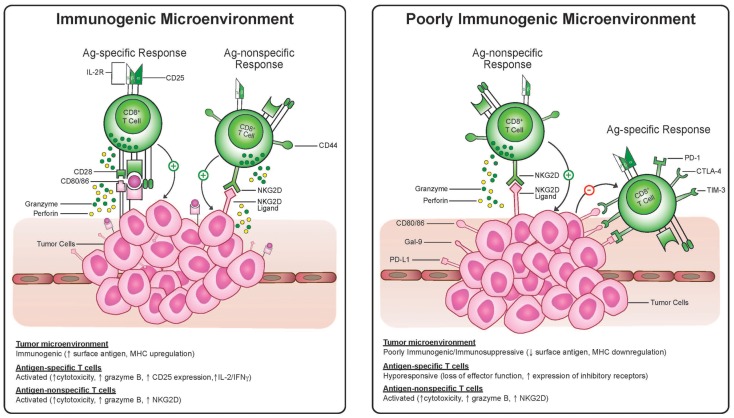
Antigen-specific cytotoxic T-lymphocytes and antigen-non-specific bystander T-cell killing in an immunogenic and suppressive tumor microenvironment. T-cells activated via TCR engagement up-regulate markers, including CD25, CTLA-4, and PD-1. Antigen-non-specific activated cytotoxic T-cells have a CD25 and NKG2D+ phenotype. In the immunosuppressive environment antigen-non-specific activated T-cells may be resistant to suppressive signaling via PD-1 or CTLA-4 and may recognize targets expressing NKG2D ligands even when antigen is lost and MHC is down-regulated whereas antigen-specific T-cells may become anergic.

References

    1. Erlich P. Ueber den jetzigen stand der karzinomforschung. Ned Tijdschr Geneeskd (1909) 5:273–90
    1. Old LJ, Boyse EA. Immunology of experimental tumors. Annu Rev Med (1964) 15:167–8610.1146/annurev.me.15.020164.001123 - DOI - PubMed
    1. Ribas A, Butterfield LH, Glaspy JA, Economou JS. Current developments in cancer vaccines and cellular immunotherapy. J Clin Oncol (2003) 21(12):2415–3210.1200/JCO.2003.06.041 - DOI - PubMed
    1. Palucka K, Ueno H, Banchereau J. Recent developments in cancer vaccines. J Immunol (2011) 186(3):1325–3110.4049/jimmunol.0902539 - DOI - PMC - PubMed
    1. Kantoff PW, Higano CS, Shore ND, Berger ER, Small EJ, Penson DF, et al. Sipuleucel-T immunotherapy for castration-resistant prostate cancer. N Engl J Med (2010) 363(5):411–2210.1056/NEJMoa1001294 - DOI - PubMed