


Deep brain stimulation affects conditioned and unconditioned anxiety in different brain areas
- PMID: 23900312
- PMCID: PMC3731788
- DOI: 10.1038/tp.2013.56
Deep brain stimulation affects conditioned and unconditioned anxiety in different brain areas
Abstract
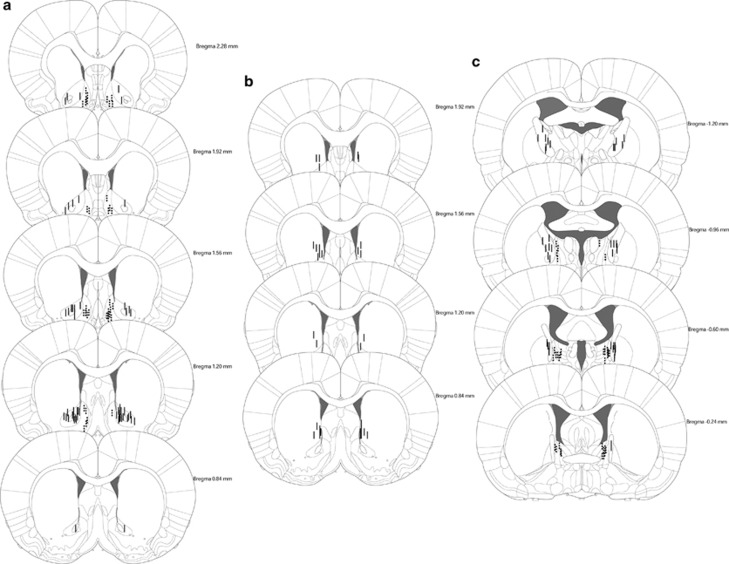
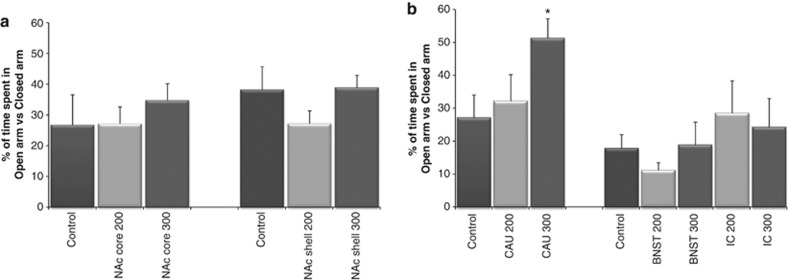
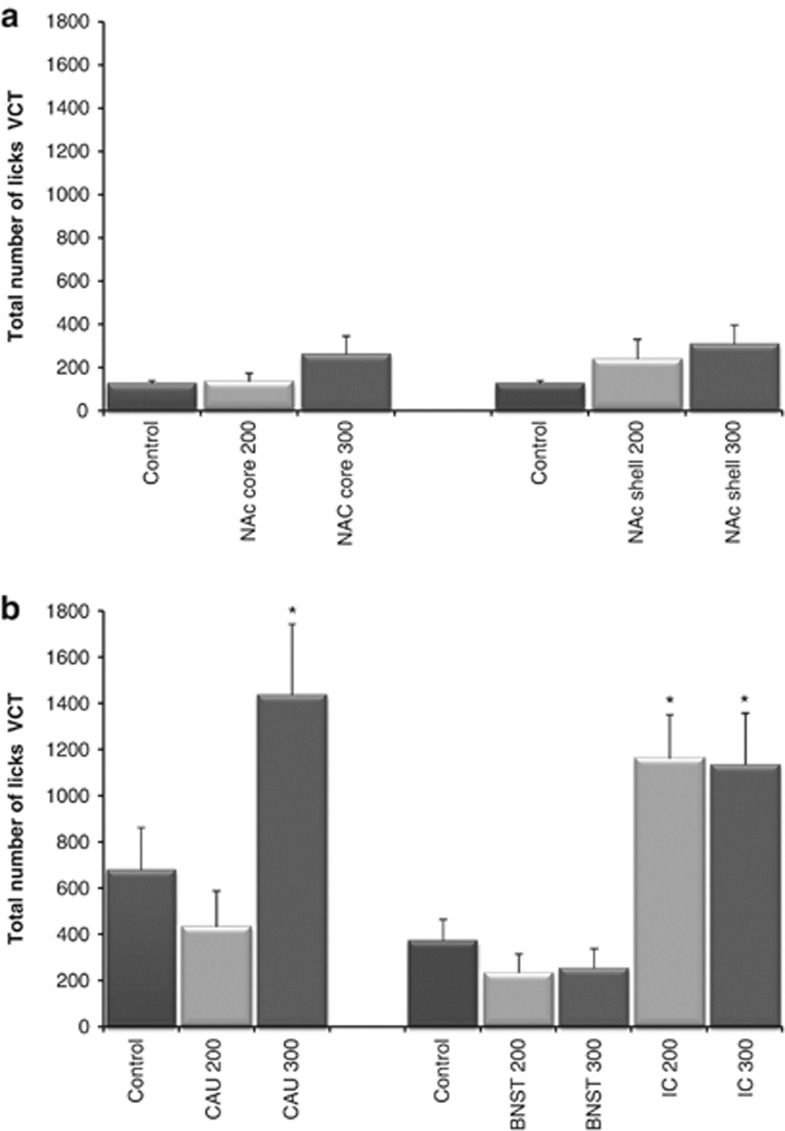
Deep brain stimulation (DBS) of the nucleus accumbens (NAc) has proven to be an effective treatment for therapy refractory obsessive-compulsive disorder. Clinical observations show that anxiety symptoms decrease rapidly following DBS. As in clinical studies different regions are targeted, it is of principal interest to understand which brain area is responsible for the anxiolytic effect and whether high-frequency stimulation of different areas differentially affect unconditioned (innate) and conditioned (learned) anxiety. In this study, we examined the effect of stimulation in five brain areas in rats (NAc core and shell, bed nucleus of the stria terminalis (BNST), internal capsule (IC) and the ventral medial caudate nucleus (CAU)). The elevated plus maze was used to test the effect of stimulation on unconditioned anxiety, the Vogel conflict test for conditioned anxiety, and an activity test for general locomotor behaviour. We found different anxiolytic effects of stimulation in the five target areas. Stimulation of the CAU decreased both conditioned and unconditioned anxiety, while stimulation of the IC uniquely reduced conditioned anxiety. Remarkably, neither the accumbens nor the BNST stimulation affected conditioned or unconditioned anxiety. Locomotor activity increased with NAc core stimulation but decreased with the BNST. These findings suggest that (1) DBS may have a differential effect on unconditioned and conditioned anxiety depending on the stimulation area, and that (2) stimulation of the IC exclusively reduces conditioned anxiety. This suggests that the anxiolytic effects of DBS seen in OCD patients may not be induced by stimulation of the NAc, but rather by the IC.
Figures
References
-
- Denys D,, Mantione M, Figee M, van den Munckhof P, Koerselman F, Westenberg H, et al. Deep brain stimulation of the nucleus accumbens for treatment-refractory obsessive-compulsive disorder. Arch Gen Psychiatry. 2010;67:1061–1068. - PubMed
-
- Gabriels L, Cosyns P, Nuttin B, Demeulemeester H, Gybels J. Deep brain stimulation for treatment-refractory obsessive-compulsive disorder: psychopathological and neuropsychological outcome in three cases. Acta Psychiatr Scand. 2003;107:275–282. - PubMed
-
- Belzung C, Griebel G. Measuring normal and pathological anxiety-like behaviour in mice: a review. Behav Brain Res. 2001;125:141–149. - PubMed
-
- Gross CT, Canteras NS. The many paths to fear. Nat Rev Neurosci. 2012;13:651–658. - PubMed
MeSH terms
LinkOut - more resources
Full Text Sources
Other Literature Sources
Medical
Research Materials
