Review
. 2013 Sep;14(9):626-36.
doi: 10.1038/nrn3549. Epub 2013 Jul 31.

Parkinson's disease dementia: convergence of α-synuclein, tau and amyloid-β pathologies

Affiliations
Review

Parkinson's disease dementia: convergence of α-synuclein, tau and amyloid-β pathologies

David J Irwin et al. Nat Rev Neurosci. 2013 Sep.

Abstract

Dementia is increasingly being recognized in cases of Parkinson's disease (PD); such cases are termed PD dementia (PDD). The spread of fibrillar α-synuclein (α-syn) pathology from the brainstem to limbic and neocortical structures seems to be the strongest neuropathological correlate of emerging dementia in PD. In addition, up to 50% of patients with PDD also develop sufficient numbers of amyloid-β plaques and tau-containing neurofibrillary tangles for a secondary diagnosis of Alzheimer's disease, and these pathologies may act synergistically with α-syn pathology to confer a worse prognosis. An understanding of the relationships between these three distinct pathologies and their resultant clinical phenotypes is crucial for the development of effective disease-modifying treatments for PD and PDD.


Figures
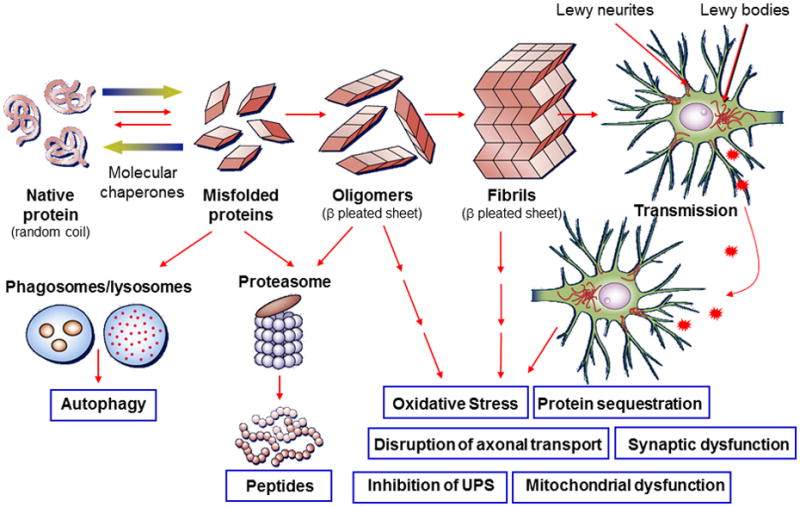
Figure 1
Figure 1. Hypothetical model of α-syn toxicity and spread of pathology in PD and PDD
From left to right in the top row: native α-syn in normal conditions exists in a soluble random coil state and under pathological conditions undergoes misfolding into pathogenic species of α-syn (dimers, trimers, oligomers, etc.) that further aggregate into higher order structures (protofibrils, other intermediates and fibrils) which ultimately are the building blocks for pathological inclusions visualized under light microscopy at autopsy (i.e. Lewy bodies and Lewy Neurites). Genetic abnormalities and environmental factors may accelerate this process.-, , , Normal quality-control systems (chaperones, ubiquitin proteosome and phagosome–lysosome systems) that prevent or reverse protein misfolding or eliminate misfolded proteins are overwhelmed (indicated by dashed lines). Remarkably, recent data suggest that the progression of PD and related disorders may be linked to the cell-to-cell spread of pathological species of α-syn,-, as illustrated in the upper right of the figure. The inter-related toxic consequences of pathological α-syn transmission are listed in the lower right of the figure. It is unclear which species of pathogenic α-syn is directly toxic to neurons; however recent animal studies show that synthetic α-syn fibrils alone are sufficient to transmit disease, i.e. α-syn pathology, between neurons and cause clinical disease (indicated by the furthest right arrow).,
Figure 2
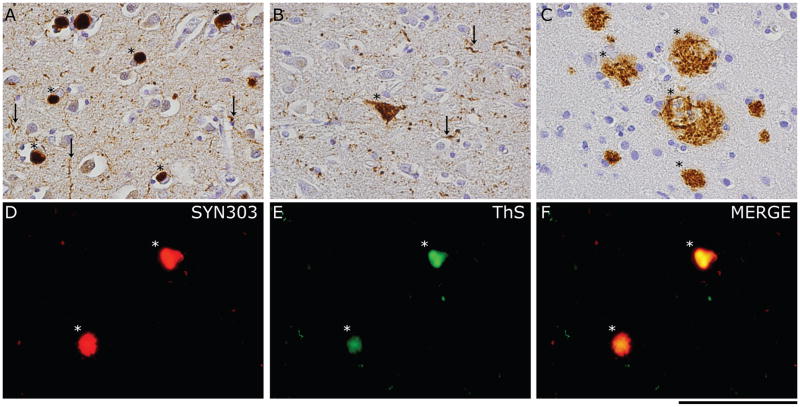
Figure 2. Neuropathology of PDD
The main neuropathological features of PDD include: a) a severe burden of Lewy bodies (asterisks) and Lewy neurites (arrows) in the mid-frontal cortex (detected with SYN303 monoclonal-antibody (MAb)), b) moderate tau-reactive diffuse threads (arrows) and NFTs (asterisk) in the anterior cingulate gyrus (detected with PHF-1 MAb) and c) extensive diffuse Aβ-reactive plaque pathology in the superior temporal cortex (detected with the Nab228 MAb). d–f) The co-localization of pathological α-syn in LBs (asterisks; detected by SYN303) and the amyloid-binding dye Thioflavin-S reveal the fibrillar nature of the majority of α-syn pathology. Scale bar= 100 μm.

References

    1. Goedert M, Spillantini MG, Del Tredici K, Braak H. 100 years of Lewy pathology. Nat Rev Neurol. 2012;9:13–24. - PubMed
    1. Hely MA, Reid WG, Adena MA, Halliday GM, Morris JG. The Sydney multicenter study of Parkinson's disease: the inevitability of dementia at 20 years. Mov Disord. 2008;23:837–44. - PubMed
    1. Aarsland D, Andersen K, Larsen JP, Lolk A, Kragh-Sorensen P. Prevalence and characteristics of dementia in Parkinson disease: an 8-year prospective study. Arch Neurol. 2003;60:387–92. - PubMed
    1. Kempster PA, O'Sullivan SS, Holton JL, Revesz T, Lees AJ. Relationships between age and late progression of Parkinson's disease: a clinico-pathological study. Brain. 2010;133:1755–62. - PubMed
    1. Emre M, et al. Clinical diagnostic criteria for dementia associated with Parkinson's disease. Mov Disord. 2007;22:1689–707. quiz 1837. The Movement Disorder Society Task Force criteria for PDD. - PubMed

Publication types