. 2013 Nov 1;208(9):1464-73.
doi: 10.1093/infdis/jit352. Epub 2013 Jul 29.

Serum drug concentrations predictive of pulmonary tuberculosis outcomes

Affiliations

Serum drug concentrations predictive of pulmonary tuberculosis outcomes

Jotam G Pasipanodya et al. J Infect Dis. .

Abstract

Background: Based on a hollow-fiber system model of tuberculosis, we hypothesize that microbiologic failure and acquired drug resistance are primarily driven by low drug concentrations that result from pharmacokinetic variability.

Methods: Clinical and pharmacokinetic data were prospectively collected from 142 tuberculosis patients in Western Cape, South Africa. Compartmental pharmacokinetic parameters of isoniazid, rifampin, and pyrazinamide were identified for each patient. Patients were then followed for up to 2 years. Classification and regression tree analysis was used to identify and rank clinical predictors of poor long-term outcome such as microbiologic failure or death, or relapse.

Results: Drug concentrations and pharmacokinetics varied widely between patients. Poor long-term outcomes were encountered in 35 (25%) patients. The 3 top predictors of poor long-term outcome, by rank of importance, were a pyrazinamide 24-hour area under the concentration-time curve (AUC) ≤ 363 mg·h/L, rifampin AUC ≤ 13 mg·h/L, and isoniazid AUC ≤ 52 mg·h/L. Poor outcomes were encountered in 32/78 patients with the AUC of at least 1 drug below the identified threshold vs 3/64 without (odds ratio = 14.14; 95% confidence interval, 4.08-49.08). Low rifampin and isoniazid peak and AUC concentrations preceded all cases of acquired drug resistance.

Conclusions: Low drug AUCs are predictive of clinical outcomes in tuberculosis patients.

Keywords: classification and regression tree analysis; drug concentrations; hollow-fiber system; nonlinear systems; outcomes; pharmacokinetic variability; tuberculosis.


Figures
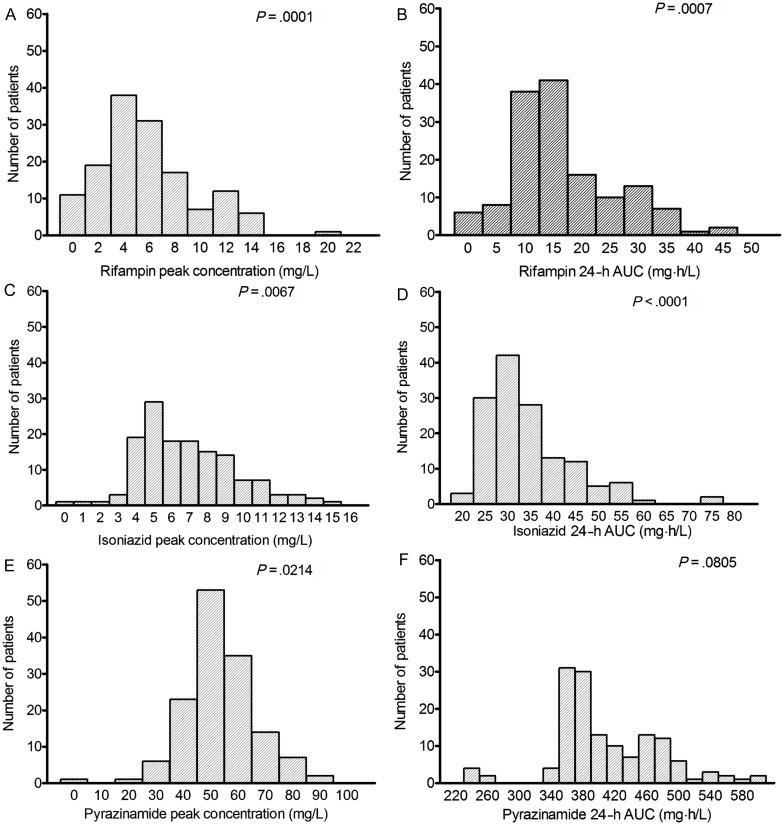
Figure 1.
Figure 1.
Pharmacokinetic variability in 142 patients. In most instances, except for pyrazinamide 24-hour area under the concentration–time curve (AUC), the pharmacokinetic parameters were not normally distributed, as demonstrated by P < .05. The figures demonstrate the wide variability in the peak concentration and AUC. No concentrations of one drug covaried with that of another.
Figure 2.
Figure 2.
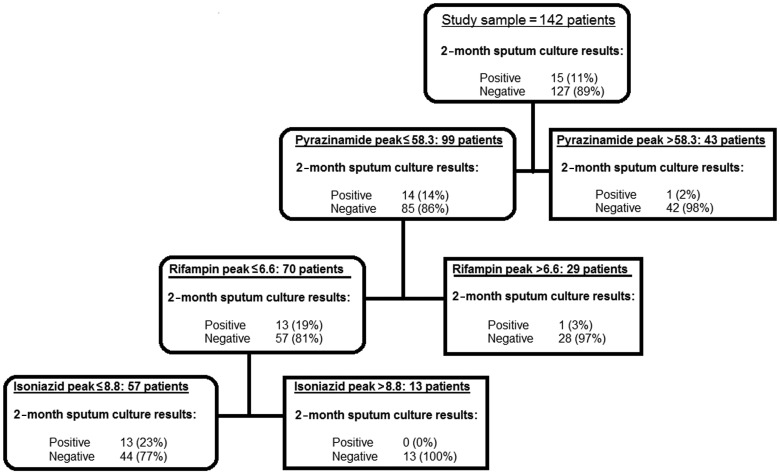
Variables predictive of 2-month sputum conversion in 142 patients. Pharmacokinetic parameters as well as patient demographic factors were examined in the initial models and the decision trees. Peak concentrations (mg/L) of pyrazinamide, rifampin, and isoniazid were the best predictors of 2-month sputum conversion. Only 2% of patients with a pyrazinamide peak above threshold were still sputum positive at 2 months. In those who had a lower pyrazinamide peak (more likely to fail), a high rifampin peak was associated with a positive 2-month sputum in only 3% of patients.
Figure 3.
Figure 3.
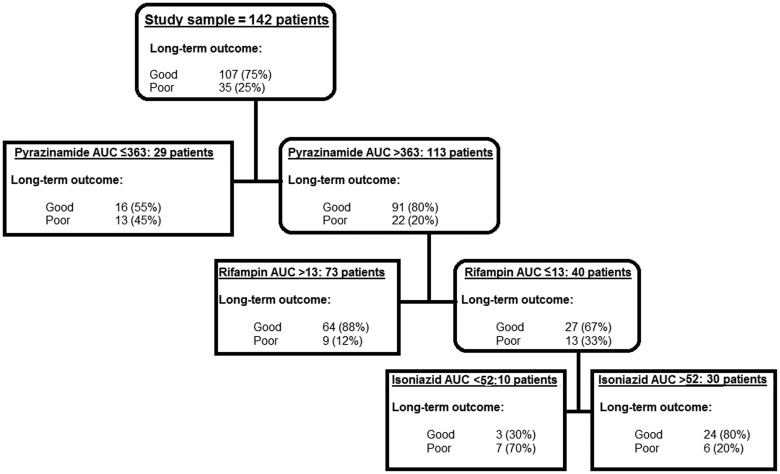
Variables predictive of poor long-term outcome in 142 patients. Pharmacokinetic parameters as well as patient demographic factors were examined in the initial models and the decision trees. The decision nodes demonstrate the primary node was for pyrazinamide 24-hour area under the concentration–time curve (AUC), followed by rifampin AUC. The AUC cutoff values that were identified as important predictive factors are shown.

References

    1. Visser ME, Grewal HM, Swart EC, et al. The effect of vitamin A and zinc supplementation on treatment outcomes in pulmonary tuberculosis: a randomized controlled trial. Am J Clin Nutr. 2011;93:93–100. - PubMed
    1. MacKenzie WR, Heilig CM, Bozeman L, et al. Geographic differences in time to culture conversion in liquid media: tuberculosis trials consortium study 28. Culture conversion is delayed in Africa. PLoS One. 2011;6:e18358. - PMC - PubMed
    1. Abdool Karim SS, Naidoo K, Grobler A, et al. Timing of initiation of antiretroviral drugs during tuberculosis therapy. N Engl J Med. 2010;362:697–706. - PMC - PubMed
    1. Calver AD, Falmer AA, Murray M, et al. Emergence of increased resistance and extensively drug-resistant tuberculosis despite treatment adherence, South Africa. Emerg Infect Dis. 2010;16:264–71. - PMC - PubMed
    1. Gumbo T, Louie A, Deziel MR, et al. Concentration-dependent Mycobacterium tuberculosis killing and prevention of resistance by rifampin. Antimicrob Agents Chemother. 2007;51:3781–8. - PMC - PubMed

Publication types

MeSH terms