


Survival after hospital discharge for ST-segment elevation and non-ST-segment elevation acute myocardial infarction: a population-based study
- PMID: 23901296
- PMCID: PMC3724561
- DOI: 10.2147/CLEP.S45646
Survival after hospital discharge for ST-segment elevation and non-ST-segment elevation acute myocardial infarction: a population-based study
Abstract
Background: Limited recent data are available describing differences in long-term survival, and factors affecting prognosis, after ST-segment elevation myocardial infarction (STEMI) and non-ST-segment elevation myocardial infarction (NSTEMI), especially from the more generalizable perspective of a population-based investigation. The objectives of this study were to examine differences in post-discharge prognosis after hospitalization for STEMI and NSTEMI, with a particular focus on factors associated with reduced long-term survival.
Methods: We reviewed the medical records of residents of the Worcester, MA, USA metropolitan area hospitalized at eleven central Massachusetts medical centers for acute myocardial infarction (AMI) during 2001, 2003, 2005, and 2007.
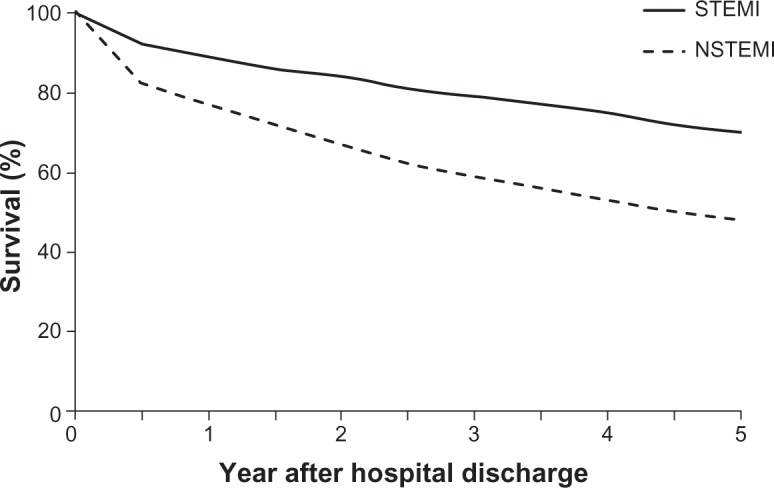
Results: A total of 3762 persons were hospitalized with confirmed AMI; of these, 2539 patients (67.5%) were diagnosed with NSTEMI. The average age of study patients was 70.3 years and 42.9% were women. Patients with NSTEMI experienced higher post-discharge death rates with 3-month, 1-year, and 2-year death rates of 12.6%, 23.5%, and 33.2%, respectively, compared to 6.1%, 11.5%, and 16.4% for patients with STEMI. After multivariable adjustment, patients with NSTEMI were significantly more likely to have died after hospital discharge (adjusted hazards ratio 1.28; 95% confidence interval 1.14-1.44). Several demographic (eg, older age) and clinical (eg, history of stroke) factors were associated with reduced long-term survival in patients with NSTEMI and STEMI.
Conclusions: The results of this study in residents of central Massachusetts suggest that patients with NSTEMI are at higher risk for dying after hospital discharge, and several subgroups are at particularly increased risk.
Keywords: STEMI/NSTEMI; community-based study; temporal trends.
Figures
References
-
- Lloyd-Jones D, Adams RJ, Brown TM, et al. American Heart Association Statistics Committee and Stroke Statistics Subcommittee Heart disease and stroke statistics – 2010 update: a report from the American Heart Association. Circulation. 2010;121(7):e46–e215. - PubMed
-
- Ross J., Jr Electorcardiographic ST-segment analysis in the characterization of myocardial ischemia and infarction. Circulation. 1976;53(3 Suppl):I73–I81. - PubMed
-
- Braunwald E, Antman EM, Beasley JW, et al. ACC/AHA guidelines for the management of patients with unstable angina and non-ST-segment elevation myocardial infarction: executive summary and recommendations. A report of the American College of Cardiology/American Heart Association task force on practice guidelines (committee on the management of patients with unstable angina) Circulation. 2000;102(10):1193–1209. - PubMed
-
- Braunwald E, Jones RH, Mark DB, et al. Diagnosing and managing unstable angina. Agency for Health Care Policy and Research. Circulation. 1994;90(1):613–622. - PubMed
-
- Anderson JL, Adams CD, Antman EM, et al. 2011 WRITING GROUP MEMBERS; ACCF/AHA TASK FORCE MEMBERS ACCF/AHA Focused Update Incorporated Into the ACC/AHA 2007 Guidelines for the Management of Patients With Unstable Angina/Non-ST-Elevation Myocardial Infarction: a report of the American College of Cardiology Foundation/American Heart Association Task Force on Practice Guidelines. Circulation. 2011;2011;123(18):e426, e579. - PubMed
Grants and funding
LinkOut - more resources
Full Text Sources
Other Literature Sources
