


Screening and brief interventions for hazardous and harmful alcohol use among patients with active tuberculosis attending primary public care clinics in South Africa: results from a cluster randomized controlled trial
- PMID: 23902931
- PMCID: PMC3733870
- DOI: 10.1186/1471-2458-13-699
Screening and brief interventions for hazardous and harmful alcohol use among patients with active tuberculosis attending primary public care clinics in South Africa: results from a cluster randomized controlled trial
Abstract
Background: In 2008 the World Health Organization (WHO) reported that South Africa had the highest tuberculosis (TB) incidence in the world. This high incidence rate is linked to a number of factors, including HIV co-infection and alcohol use disorders. The diagnosis and treatment package for TB and HIV co-infection is relatively well established in South Africa. However, because alcohol use disorders may present more insidiously, making it difficult to diagnose, those patients with active TB and misusing alcohol are not easily cured from TB. With this in mind, the primary purpose of this cluster randomized controlled trial was to provide screening for alcohol misuse and to test the effectiveness of brief interventions in reducing alcohol intake in those patients with active TB found to be misusing alcohol in primary public health care clinics in three districts in South Africa.
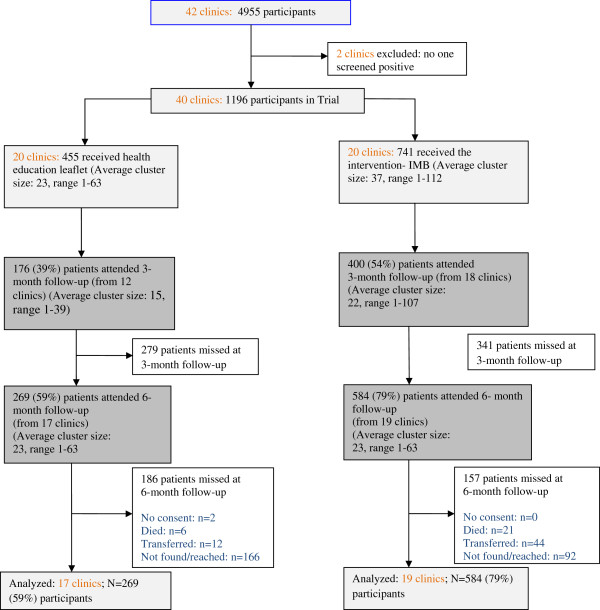
Methods: Within each of the three provinces targeted, one district with the highest TB burden was selected. Furthermore, 14 primary health care facilities with the highest TB caseload in each district were selected. In each district, 7 of the 14 (50%) clinics were randomly assigned to a control arm and another 7 of the 14 (50%) clinics assigned to intervention arm. At the clinic level systematic sampling was used to recruit newly diagnosed and retreatment TB patients. Those consenting were screened for alcohol misuse using the Alcohol Use Disorder Identification Test (AUDIT). Patients who screened positive for alcohol misuse over a 6-month period were given either a brief intervention based on the Information-Motivation-Behavioural Skills (IMB) Model or an alcohol use health education leaflet.
Results: Of the 4882 tuberculosis patients screened for alcohol and agreed to participate in the trial, 1196 (24.6%) tested positive for the AUDIT. Among the 853 (71%) patients who also attended the 6-month follow-up session, the frequency of positive screening results at baseline/follow-up were 100/21.2% for the AUDIT (P < 0.001) for the control group and 100/16.8% (P < 0.001) for the intervention group. The intervention effect on the AUDIT score was statistically not significant. The intervention effect was also not significant for hazardous or harmful drinkers and alcohol dependent drinkers (
Audit: 7-40), alcohol dependent drinkers and heavy episodic drinking, while the control group effect was significant for hazardous drinkers (
Audit: 7-19) (P = 0.035).
Conclusion: The results suggest that alcohol screening and the provision of a health education leaflet on sensible drinking performed at the beginning of anti-tuberculosis treatment in public primary care settings may be effective in reducing alcohol consumption.
Trial registrations: PACTR201105000297151.
Figures
References
-
- World Health Organization. Global tuberculosis report 2012. Report No. WHO/HTM/TB/2012.6. Geneva, Switzerland: WHO; 2012.
-
- Parry CDH, Rehm JR, Poznyak V, Room R. Alcohol and infectious diseases: are there causal linkages? Addiction. 2009;104:331–332. - PubMed
Publication types
MeSH terms
LinkOut - more resources
Full Text Sources
Other Literature Sources
Medical
