


Comment
doi: 10.1038/mt.2013.160.
Immunotherapy exposes cancer stem cell resistance and a new synthetic lethality
Affiliations
- PMID: 23903573
- PMCID: PMC3740219
- DOI: 10.1038/mt.2013.160
Item in Clipboard
Comment
Immunotherapy exposes cancer stem cell resistance and a new synthetic lethality
Mol Ther.
2013 Aug.
No abstract available
Figures
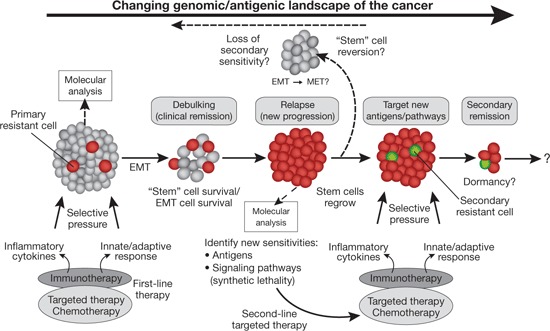
The evolving tumor genomic and antigenic landscape and cancer stem cell resistance and vulnerability during therapy. Immunotherapy and other types of cancer therapy can debulk tumors but also put selective pressure on tumors leading to the survival and outgrowth of resistant cells (relapse) that have cancer stem cell properties or properties of cells undergoing epithelial–mesenchymal transition (EMT). However, these resistant cells (shown in red) overexpress key antigens or metabolic vulnerabilities that can be targeted by newer antigen-specific immunotherapies or drugs. These new targets can be identified by molecular analysis of this changing genomic and antigenic landscape (represented by the solid arrow across the top). Immunotherapies could thus be combined with chemotherapies either simultaneously or in succession sooner to both debulk the original tumor and eradicate any emerging resistant cells. However, although relapsed tumors can be treated to induce a secondary remission, additional resistant cells could emerge (shown as the green cells). The cancer stem cell or EMT phenotype is plastic, and these cells can differentiate through mesenchymal–epithelial transition (MET) or revert to a molecular profile similar to that of the bulk of the original tumor (indicated at the top of the diagram and by the dotted arrow in reverse). Thus, these new stem cell vulnerabilities can be transient, and sensitivity to second-line therapies based on the new molecular or antigenic profile can be rapidly lost. Intermittent dosing of different regimens may be needed to overcome this problem.
Comment on
-
Functional cloning of recurrence-specific antigens identifies molecular targets to treat tumor relapse.Mol Ther. 2013 Aug;21(8):1507-16. doi: 10.1038/mt.2013.116. Epub 2013 Jun 11. Mol Ther. 2013. PMID: 23752316 Free PMC article.
References
-
- Sullivan RJ, Flaherty KT. Resistance to BRAF-targeted therapy in melanoma. Eur J Cancer. 2013;49:1297–1304. - PubMed
Publication types
MeSH terms
Substances
LinkOut - more resources
Full Text Sources
Other Literature Sources
