


Inactivating mutation in histone deacetylase 3 stabilizes its active conformation
- PMID: 23904210
- PMCID: PMC3795489
- DOI: 10.1002/pro.2317
Inactivating mutation in histone deacetylase 3 stabilizes its active conformation
Abstract
Histone deacetylases (HDACs), together with histone acetyltransferases (HATs), regulate gene expression by modulating the acetylation level of chromatin. HDAC3 is implicated in many important cellular processes, particularly in cancer cell proliferation and metastasis, making inhibition of HDAC3 a promising epigenetic treatment for certain cancers. HDAC3 is activated upon complex formation with both inositol tetraphosphate (IP4) and the deacetylase-activating domain (DAD) of multi-protein nuclear receptor corepressor complexes. In previous studies, we have shown that binding of DAD and IP4 to HDAC3 significantly restricts its conformational space towards its stable ternary complex conformation, and suggest this to be the active conformation. Here, we report a single mutation of HDAC3 that is capable of mimicking the stabilizing effects of DAD and IP4, without the presence of either. This mutation, however, results in a total loss of deacetylase activity, prompting a closer evaluation of our understanding of the activation of HDAC3.
Keywords: HDAC3; R265P; allostery; conformational selection; molecular recognition.
© 2013 The Protein Society.
Figures
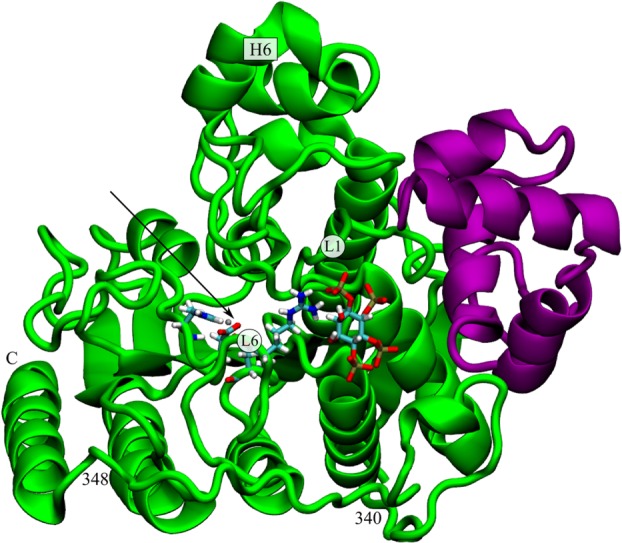

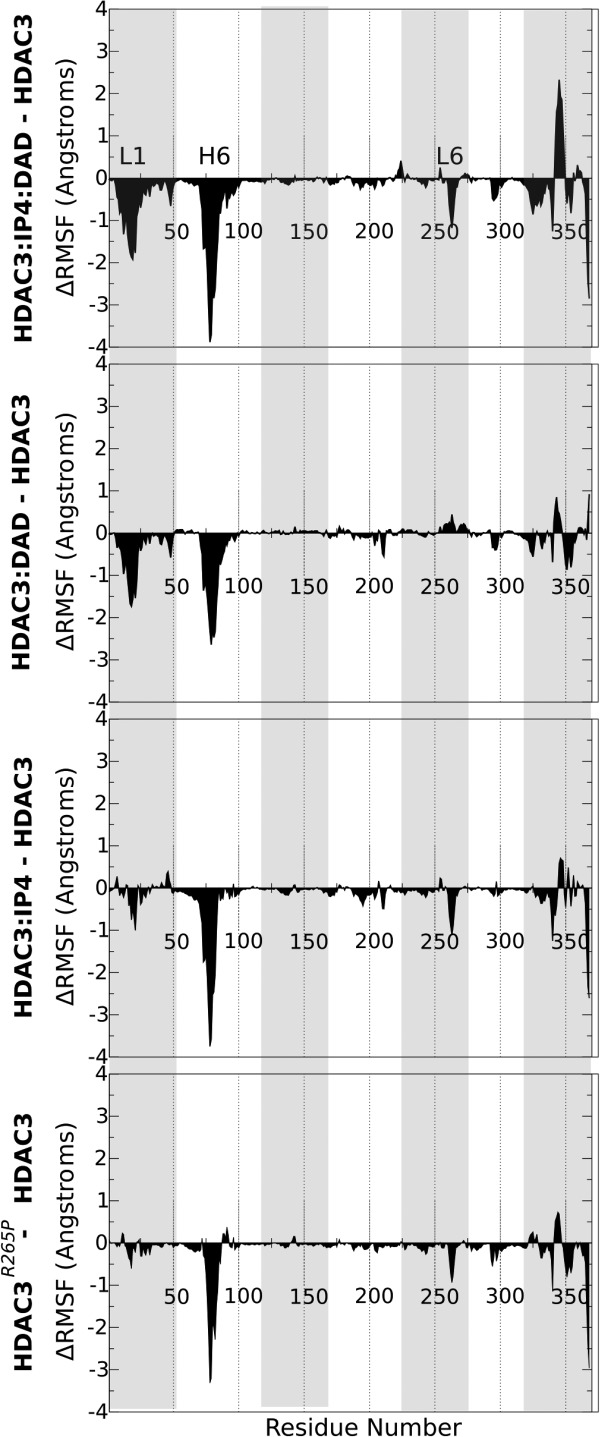
 Analysis of mutant and complexed HDAC3. Differences between per-residue RMSF values (Å) are shown for (from top to bottom) HDAC3:IP4:DAD, HDAC3:DAD, HDAC3:IP4, and HDAC3R265P, with reference to the apo HDAC3WT RMSF values. Negative
 values correspond to stabilized regions.
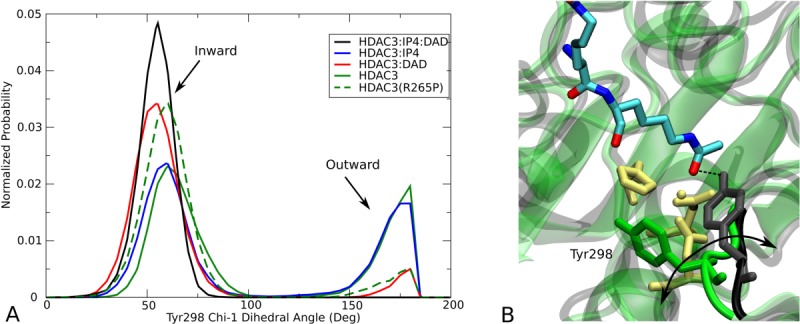
 dihedral angle. (A) Normalized probability of the
 side chain dihedral angle shows two states (inward and outward) sampled in the HDAC3 simulations. (B) Cartoon representation of HDAC3 from the HDAC3:IP4:DAD (black) and apo (green) simulations are superimposed to highlight the two Tyr298 conformations. An arbitrary acetyllysine peptide substrate was docked into the active site to show the functional relevance of the inward Tyr298 conformation (hydrogen atoms are not shown).
References
-
- Minucci S, Pelicci PG. Histone deacetylase inhibitors and the promise of epigenetic (and more) treatments for cancer. Nat Rev Cancer. 2006;6:38–51. - PubMed
-
- Witt O, Deubzer HE, Milde T, Oehme I. HDAC family: what are the cancer relevant targets? Cancer Lett. 2009;277:8–21. - PubMed
-
- Hagelkruys A, Sawicka A, Rennmayr M, Seiser C. The biology of HDAC in cancer: the nuclear and epigenetic components. In: Yao TP, Seto E, editors. Histone deacetylases: the biology and clinical implication. Spinger-Verlag Berlin: Heidelberg; 2011. pp. 13–37.
MeSH terms
Substances
LinkOut - more resources
Full Text Sources
Other Literature Sources
