


Trends in the use of bilateral mastectomy in England from 2002 to 2011: retrospective analysis of hospital episode statistics
- PMID: 23906951
- PMCID: PMC3733300
- DOI: 10.1136/bmjopen-2013-003179
Trends in the use of bilateral mastectomy in England from 2002 to 2011: retrospective analysis of hospital episode statistics
Abstract
Objectives: For healthy women at high risk of developing breast cancer, a bilateral mastectomy can reduce future risk. For women who already have unilateral breast cancer, removing the contralateral healthy breast is more difficult to justify. We examined trends in the number of women who had a bilateral mastectomy in England between 2002 and 2011.
Design: Retrospective cohort study using the Hospital Episode Statistics database.
Setting: NHS hospital trusts in England.
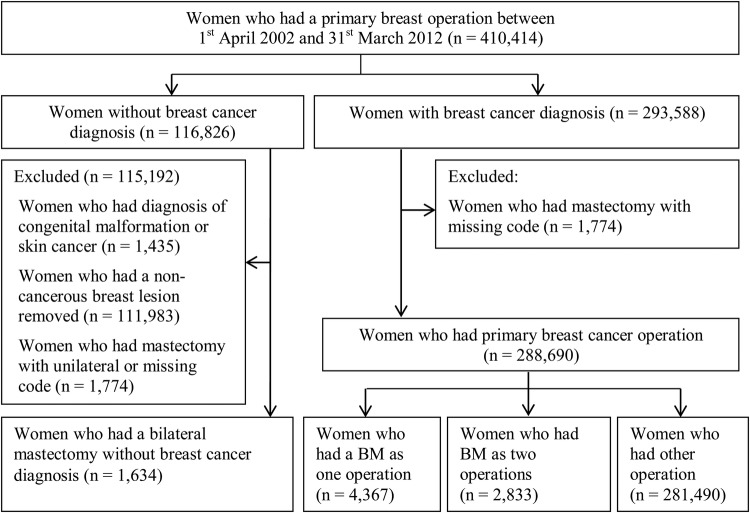
Participants: Women aged between 18 and 80 years who had a bilateral mastectomy (or a contralateral mastectomy within 24 months of unilateral mastectomy) with or without a diagnosis of breast cancer.
Main outcome measures: Number and incidence of women without breast cancer who had a bilateral mastectomy; number and proportion who had a bilateral mastectomy as their first breast cancer operation, and the proportion of those undergoing bilateral mastectomy who had immediate breast reconstruction.
Results: Among women without breast cancer, the number who had a bilateral mastectomy increased from 71 in 2002 to 255 in 2011 (annual incidence rate ratio 1.16, 95% CI 1.13 to 1.18). In women with breast cancer, the number rose from 529 to 931, an increase from 2% to 3.1% of first operations (OR for annual increase 1.07, 95% CI 1.05 to 1.08). Across both groups, rates of immediate breast reconstruction roughly doubled and reached 90% among women without breast cancer in 2011.
Conclusions: The number of women who had a bilateral mastectomy nearly doubled over the last decade, and more than tripled among women without breast cancer. This coincided with an increase in the use of immediate breast reconstruction.
Keywords: Oncology; Plastic & Reconstructive Surgery; Preventive Medicine.
Figures
References
-
- National Institute for Health and Clinical Excellence Familial breast cancer: The classification and care of women at risk of familial breast cancer in primary, secondary and tertiary care. NICE clinical guideline 41. October 2006. http://guidance.nice.org.uk/CG41/Guidance/pdf/English
-
- Hartmann LC, Schaid DJ, Woods JE, et al. Efficacy of bilateral prophylactic mastectomy in women with a family history of breast cancer. N Engl J Med 1999;340:77–84 - PubMed
-
- Hartmann LC, Sellers TA, Schaid DJ, et al. Efficacy of bilateral prophylactic mastectomy in BRCA1 and BRCA2 gene mutation carriers. J Natl Cancer Inst 2001;93:1633–7 - PubMed
-
- Rebbeck TR, Friebel T, Lynch HT, et al. Bilateral prophylactic mastectomy reduces breast cancer risk in BRCA1 and BRCA2 mutation carriers: The PROSE study group. J Clin Oncol 2004;22:1055–62 - PubMed
-
- Lostumbo L, Carbine NE, Wallace J. Prophylactic mastectomy for the prevention of breast cancer (review). Cochrane Collaboration 2010. http://onlinelibrary.wiley.com/doi/10.1002/14651858.CD002748.pub3/pdf - DOI - PubMed
LinkOut - more resources
Full Text Sources
Other Literature Sources
