


The impact of targeting all elderly persons in England and Wales for yearly influenza vaccination: excess mortality due to pneumonia or influenza and time trend study
- PMID: 23906952
- PMCID: PMC3733298
- DOI: 10.1136/bmjopen-2013-002743
The impact of targeting all elderly persons in England and Wales for yearly influenza vaccination: excess mortality due to pneumonia or influenza and time trend study
Abstract
Objective: To investigate the impact on mortality due to pneumonia or influenza of the change from risk-based to age group-based targeting of the elderly for yearly influenza vaccination in England and Wales.
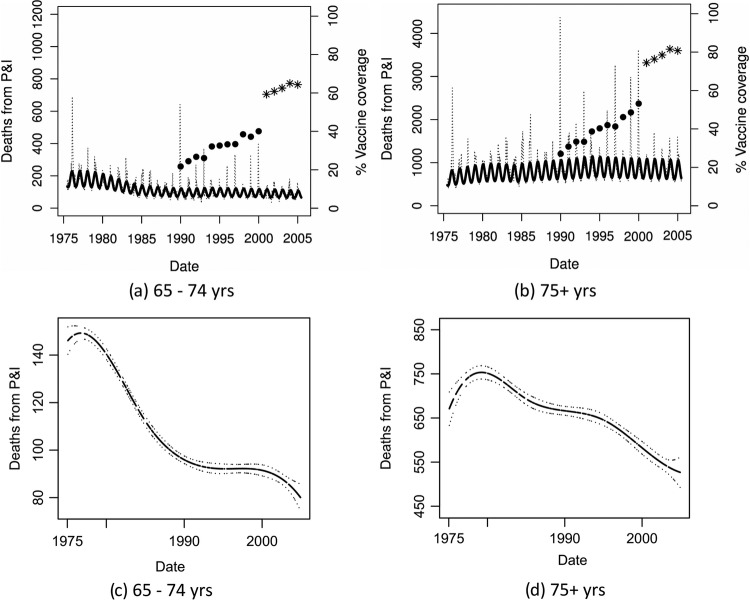
Design: Excess mortality estimated using time series of deaths registered to pneumonia or influenza, accounting for seasonality, trend and artefacts. Non-excess mortality plotted as proxy for long-term trend in mortality.
Setting: England and Wales.
Participants: Persons aged 65-74 and 75+ years whose deaths were registered to underlying pneumonia or influenza between 1975/1976 and 2004/2005.
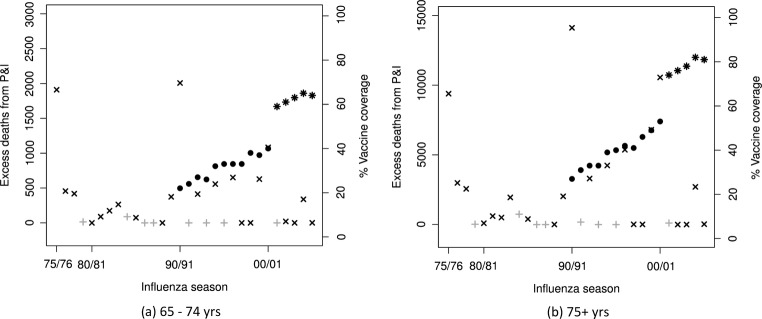
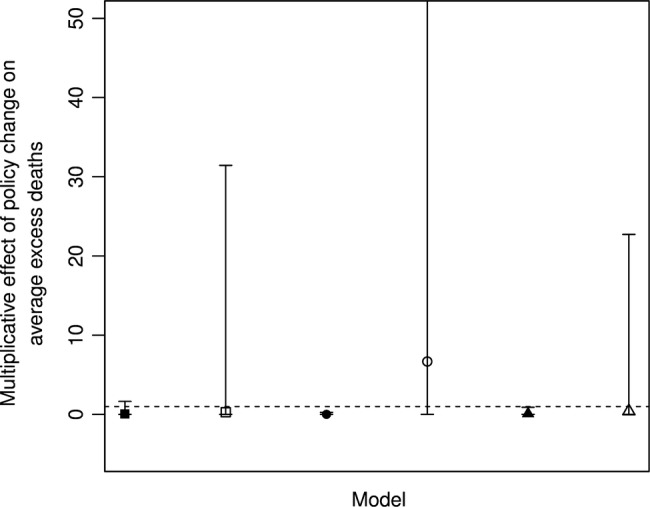
Outcome measures: Multiplicative effect on average excess pneumonia and influenza deaths each winter in the 4-6 winters since age group-based targeting of vaccination was introduced (in persons aged 75+ years from 1998/1999; in persons aged 65+ years from 2000/2001), estimated using multivariable regression adjusted for temperature, antigenic drift and vaccine mismatch, and stratified by dominant circulating influenza subtype. Trend in baseline weekly pneumonia and influenza death rates.
Results: There is a suggestion of lower average excess mortality in the six winters after age group-based targeting began compared to before, but the CI for the 65-74 years age group includes no difference. Trend in baseline pneumonia and influenza mortality shows an apparent downward turning point around 2000 for the 65-74 years age group and from the mid-1990s in the 75+ years age group.
Conclusions: There is weakly supportive evidence that the marked increases in vaccine coverage accompanying the switch from risk-based to age group-based targeting of the elderly for yearly influenza vaccination in England and Wales were associated with lower levels of pneumonia and influenza mortality in older people in the first 6 years after age group-based targeting began. The possible impact of these policy changes is observed as weak evidence for lower average excess mortality as well as a turning point in baseline mortality coincident with the changes.
Keywords: Aged; Influenza; Mass Vaccination; Mortality; Trends.
Figures
References
-
- Department of Health: from the Chief Medical Officer, the Chief Nursing Officer and the Chief Pharmaceutical Officer Influenza immunisation. PL/CMO/2000/3 London: Department of Health, 2000
-
- Joseph C, Goddard N, Gelb D. Influenza vaccine uptake and distribution in England and Wales using data from the General Practice Research Database, 1989/90-2003/04. J Public Health (Oxf) 2005;27:371–7 - PubMed
-
- Butt S, Zhang N, Joseph CA. Vaccination uptake among the 65 years and over and under 65 years at risk in England 2006–07. London: Health Protection Agency Centre for Infections, 2007
-
- Begum F, Pebody R. Seasonal influenza vaccine uptake amongst GP patient groups in England. London: Department of Health, 2012
Grants and funding
LinkOut - more resources
Full Text Sources
Other Literature Sources
