


Dissociable neural routes to successful prospective memory
- PMID: 23907544
- PMCID: PMC4398313
- DOI: 10.1177/0956797613481233
Dissociable neural routes to successful prospective memory
Abstract
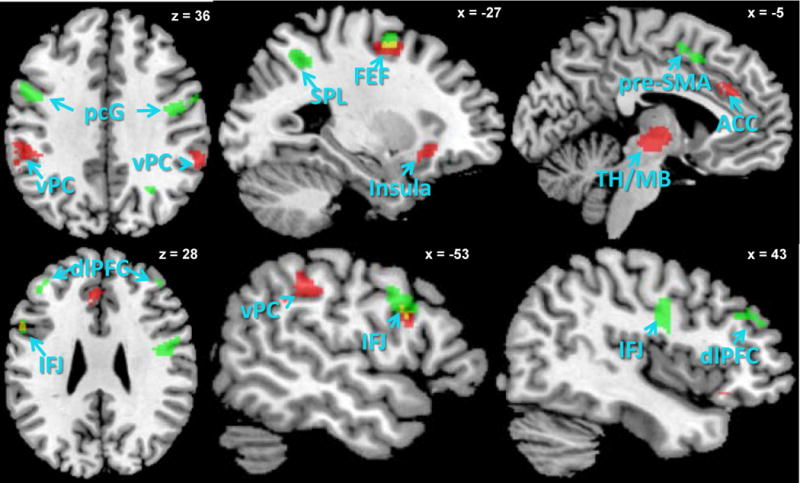
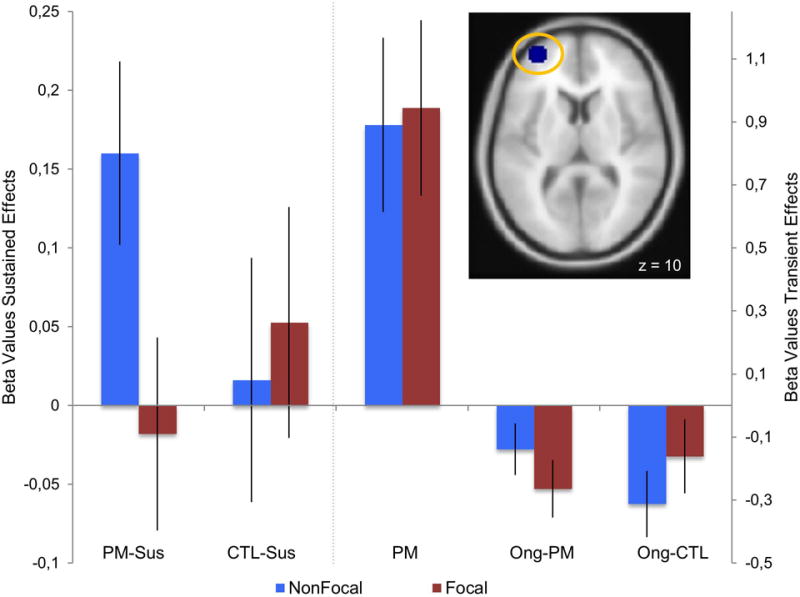
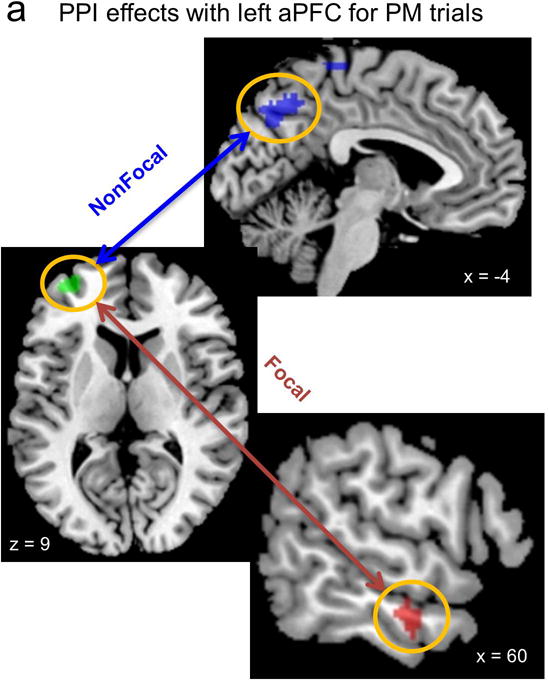
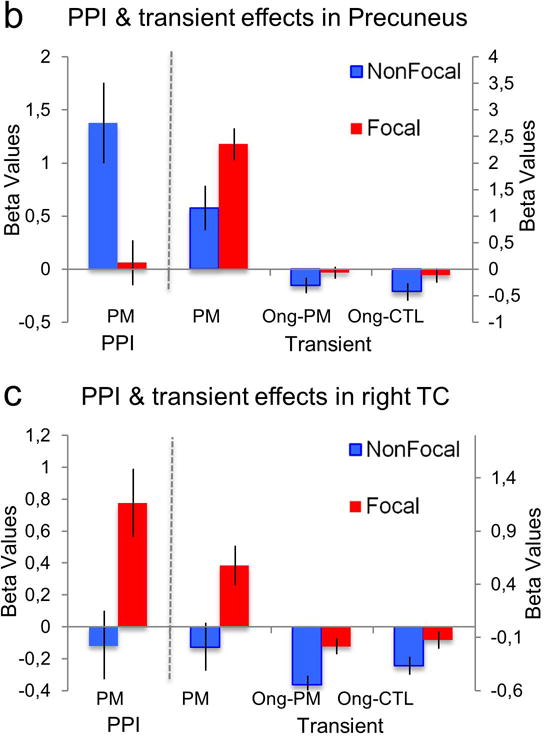
Identifying the processes by which people remember to execute an intention at an appropriate moment (prospective memory) remains a fundamental theoretical challenge. According to one account, top-down attentional control is required to maintain activation of the intention, initiate intention retrieval, or support monitoring. A diverging account suggests that bottom-up, spontaneous retrieval can be triggered by cues that have been associated with the intention and that sustained attentional processes are not required. We used a specialized experimental design and functional MRI methods to selectively marshal and identify each process. Results revealed a clear dissociation. One prospective-memory task recruited sustained activity in attentional-control areas, such as the anterior prefrontal cortex; the other engaged purely transient activity in parietal and ventral brain regions associated with attentional capture, target detection, and episodic retrieval. These patterns provide critical evidence that there are two neural routes to prospective memory, with each route emerging under different circumstances.
Keywords: cognitive neuroscience; memory.
Figures
References
-
- Beck SM, Ruge H, Walser M, Goschke T. The Functional Neuroanatomy of Spontaneous Retrieval and Strategic Monitoring of Delayed Intentions. Department of Psychology, Technische Universität Dresden; Dresden, Germany: 2012. Manuscript under review. - PubMed
-
- Buckner RL, Carroll DC. Self-projection and the brain. Trends in Cognitive Science. 2007;11(2):49–57. - PubMed
-
- Bugg JM, McDaniel MA, Einstein GO. Event-Based Prospective Remembering: An Integration of Prospective Memory and Cognitive Control Theories. In: Reisberg D, editor. The Oxford Handbook of Cognitive Psychology. (in press)
-
- Burgess PW, Gonen-Yaacovi G, Volle E. Functional neuroimaging studies of prospective memory: what have we learnt so far? Neuropsychologia. 2011;49(8):2246–2257. - PubMed
Publication types
MeSH terms
Grants and funding
LinkOut - more resources
Full Text Sources
Other Literature Sources
Medical
