. 2013 Aug;2(4):576-94.
doi: 10.1002/mbo3.96. Epub 2013 Jun 12.

Genetic determinants of swimming motility in the squid light-organ symbiont Vibrio fischeri

Affiliations

Genetic determinants of swimming motility in the squid light-organ symbiont Vibrio fischeri

Caitlin A Brennan et al. Microbiologyopen. 2013 Aug.

Abstract

Bacterial flagellar motility is a complex cellular behavior required for the colonization of the light-emitting organ of the Hawaiian bobtail squid, Euprymna scolopes, by the beneficial bioluminescent symbiont Vibrio fischeri. We characterized the basis of this behavior by performing (i) a forward genetic screen to identify mutants defective in soft-agar motility, as well as (ii) a transcriptional analysis to determine the genes that are expressed downstream of the flagellar master regulator FlrA. Mutants with severe defects in soft-agar motility were identified due to insertions in genes with putative roles in flagellar motility and in genes that were unexpected, including those predicted to encode hypothetical proteins and cell division-related proteins. Analysis of mutants for their ability to enter into a productive symbiosis indicated that flagellar motility mutants are deficient, while chemotaxis mutants are able to colonize a subset of juvenile squid to light-producing levels. Thirty-three genes required for normal motility in soft agar were also downregulated in the absence of FlrA, suggesting they belong to the flagellar regulon of V. fischeri. Mutagenesis of putative paralogs of the flagellar motility genes motA, motB, and fliL revealed that motA1, motB1, and both fliL1 and fliL2, but not motA2 and motB2, likely contribute to soft-agar motility. Using these complementary approaches, we have characterized the genetic basis of flagellar motility in V. fischeri and furthered our understanding of the roles of flagellar motility and chemotaxis in colonization of the juvenile squid, including identifying 11 novel mutants unable to enter into a productive light-organ symbiosis.

Keywords: Chemotaxis; Euprymna scolopes; Flagellar motility; symbiosis.


Figures

Figure 1
Figure 1
Soft-agar motility screening of a Vibrio fischeri transposon mutant library. (A) A representative soft-agar motility plate. White arrows indicate strains considered as candidate amotile mutants. (B) Summary of the characteristics of the transposon mutant library and the results of the soft-agar motility screen. Directionality refers to the direction of the transposon's erm cassette relative to chromosome nucleotide orientation as deposited in GenBank.
Figure 2
Figure 2
Entrance into a productive symbiosis with juvenile Euprymna scolopes by selected swimming-motility mutants. Squid were transiently exposed to the indicated strain for 24 h and the percentage that produced detectable luminescence at 48 h postcolonization was determined. Functional groups indicated beneath the strains correspond to those in Table 1. Liquid motility and soft-agar motility assays were performed as described in Experimental Procedures. White scale bars in wild-type soft-agar motility plates represent a distance of 20 mm in whole-plate views (top) and 5 mm in the higher magnification images (bottom).
Figure 3
Figure 3
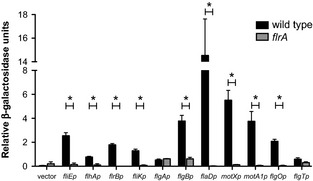
Flagellar-gene promoter activities in wild-type and flrA-mutant strains. Promoters for 11 genes were transcriptionally fused to lacZ as described in Experimental Procedures, and β-galactosidase activity was measured in wild type and the flrA::Tnerm mutant after growth in seawater-based tryptone (SWT) to an OD600 of ∼0.5. Note that not all promoters (e.g., flgA) are controlled by FlrA. Asterisks indicate both a significance difference at P ≤ 0.05 using a Student's t-test and a fold change ≥2.
Figure 4
Figure 4
Comparison of soft-agar motility screening and microarray analyses. The set of genes required for normal soft-agar motility (genes disrupted in those mutants with severe defects; Table 1) was compared to the flagellar regulon (FlrA-activated genes; Table S3). The 33 genes present in both data sets are considered “core flagellar genes”, and include 31 predicted flagellar motility and chemotaxis genes, together with flgO and flgP (“unknown function”).
Figure 5
Figure 5
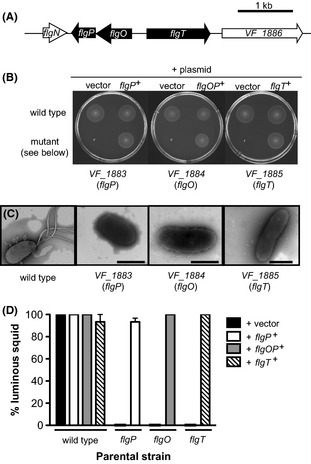
Mutants in the Vibrio fischeri flgOP and flgT loci. (A) Genomic organization of the flgOP and flgT loci. (B) Motility of indicated strains in seawater-based tryptone (SWT) containing 0.3% agar. (C) Negative-stained transmission electron micrographs of strains grown in SWT broth. Scale bars indicate 1 μm. (D) Complementation of flgO flgP, and flgT mutant colonization defects. Squid were transiently exposed to the indicated strain for 24 h, and a successful colonization was scored by the presence of detectable luminescence at 48 h postcolonization.
Figure 6
Figure 6
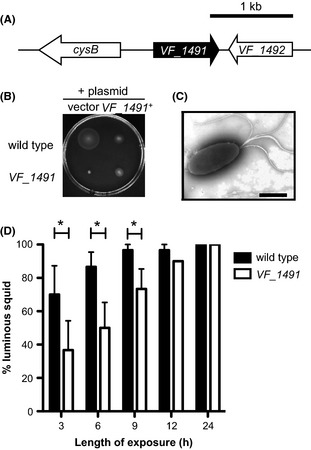
Motility and symbiotic-competence analysis of a VF_1491 mutant. (A) Genomic organization of the VF_1491 locus. (B) Motility of indicated strains in seawater-based tryptone (SWT) containing 0.3% agar. (C) Negative-stained transmission electron micrographs of the VF_1491 mutant grown in SWT broth. Scale bars indicate 1 μm. (D) Relative effectiveness of VF_1491 in colonizing juvenile squid. Squid were transiently exposed to either the VF_1491 mutant or wild-type Vibrio fischeri for either 3, 6, 9, 12, or 24 h, and a successful colonization was scored by the presence of detectable luminescence at 48 h postcolonization. Asterisks indicate a significance difference at P ≤ 0.05 using a two-way repeated measure analysis of variance (ANOVA), with a post hoc Bonferroni correction.
Figure 7
Figure 7
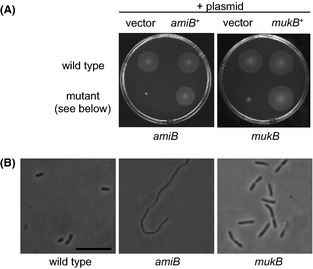
Soft-agar motility and phase-contrast microscopy of cell division mutants. (A) Motility of indicated strains in seawater-based tryptone (SWT) containing 0.3% agar. (B) Phase-contrast micrographs of SWT broth cultures of indicated strains. Scale bar indicate 5 μm.
Figure 8
Figure 8
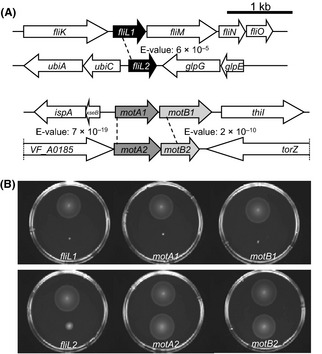
Genomic organization and soft-agar motility analysis of mutants in predicted paralogs of three flagellar genes (fliL motA, and motB). (A) Genomic organization of loci surrounding fliL1 fliL2 motA1B1, and motA2B2. E-values listed were determined by BLASTP analysis. (B) Motility of indicated strains in seawater-based tryptone (SWT) containing 0.3% agar. On all plates, the upper strain is wild-type Vibrio fischeri, and the lower strain carries a mutation in the gene indicated at the bottom of the plate.

References

    1. Adler J. Chemotaxis in bacteria. Science. 1966;153:708–716. - PubMed
    1. Allen RD, Baumann P. Structure and arrangement of flagella in species of the genus Beneckea and Photobacterium fischeri. J. Bacteriol. 1971;107:295–302. - PMC - PubMed
    1. Arnosti DN, Chamberlin MJ. Secondary σ factor controls transcription of flagellar and chemotaxis genes in Escherichia coli. Proc. Natl Acad. Sci. USA. 1989;86:830–834. - PMC - PubMed
    1. Baldi P, Long AD. A Bayesian framework for the analysis of microarray expression data: regularized t -test and statistical inferences of gene changes. Bioinformatics. 2001;17:509–519. - PubMed
    1. Boettcher KJ, Ruby EG. Depressed light emission by symbiotic Vibrio fischeri of the sepiolid squid Euprymna scolopes. J. Bacteriol. 1990;172:3701–3706. - PMC - PubMed

Publication types