


Stereotactic body radiation therapy for primary and metastatic liver tumors
- PMID: 23908687
- PMCID: PMC3730019
- DOI: 10.1593/tlo.12448
Stereotactic body radiation therapy for primary and metastatic liver tumors
Abstract
Objectives: The full potential of stereotactic body radiation therapy (SBRT), in the treatment of unresectable intrahepatic malignancies, has yet to be realized as our experience is still limited. Thus, we evaluated SBRT outcomes for primary and metastatic liver tumors, with the goal of identifying factors that may aid in optimization of therapy.
Methods: From 2005 to 2010, 62 patients with 106 primary and metastatic liver tumors were treated with SBRT to a median biologic effective dose (BED) of 100 Gy (42.6-180). The majority of patients received either three (47%) or five fractions (48%). Median gross tumor volume (GTV) was 8.8 cm(3) (0.2-222.4).
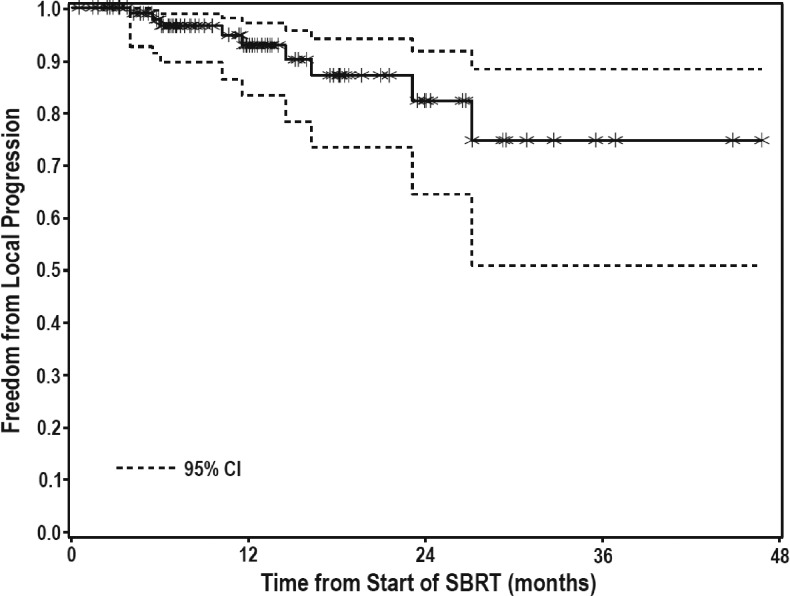
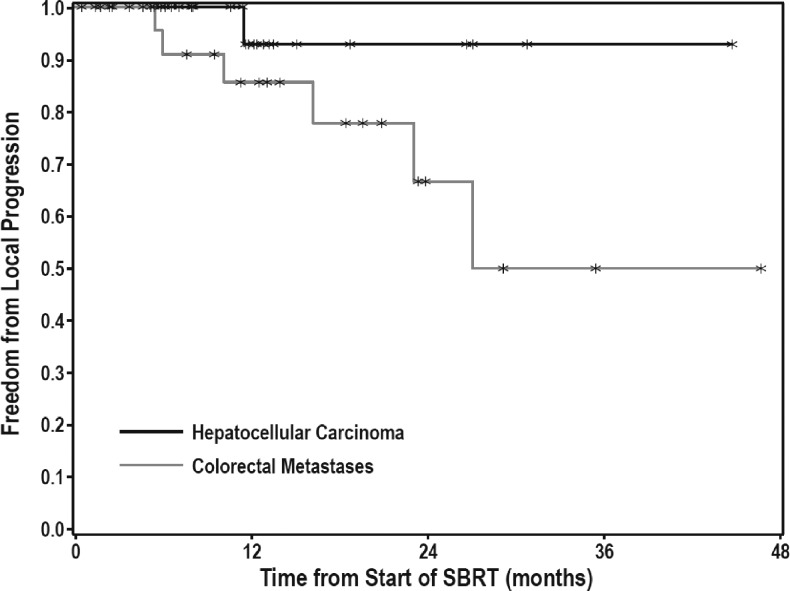
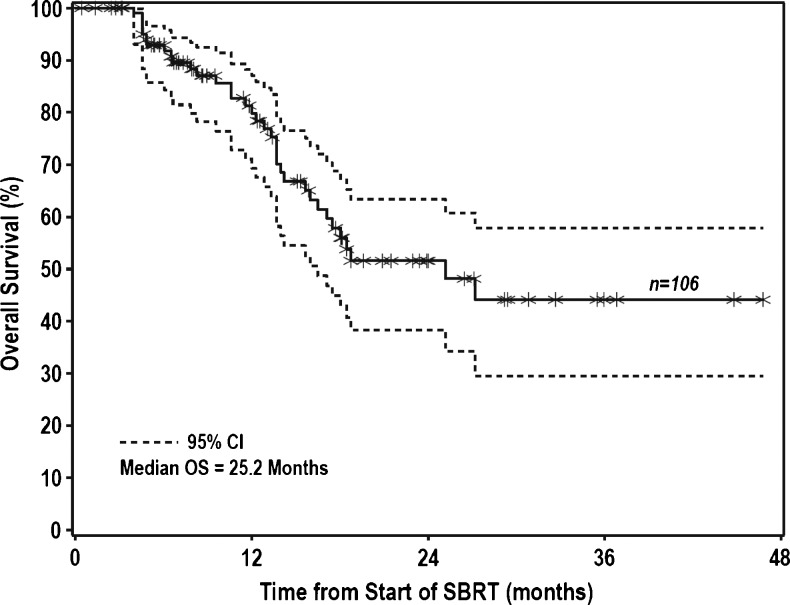
Results: With a median follow-up of 18 months (0.46-46.8), freedom from local progression (FFLP) was observed in 97 of 106 treated tumors, with 1- and 2-year FFLP rates of 93% and 82%. Median overall survival (OS) for all patients was 25.2 months, with 1- and 2-year OS of 81% and 52%. Neither BED nor GTV significantly predicted for FFLP. Local failure was associated with a higher risk of death [hazard ratio (HR) = 5.1, P = .0007]. One Child-Pugh Class B patient developed radiation-induced liver disease. There were no other significant toxicities.
Conclusions: SBRT provides excellent local control for both primary and metastatic liver lesions with minimal toxicity. Future studies should focus on appropriate selection of patients and on careful assessment of liver function to maximize both the safety and efficacy of treatment.
Figures
References
-
- Wong SL, Mangu PB, Choti MA, Crocenzi TS, Dodd GD, III, Dorfman GS, Eng C, Fong Y, Giusti AF, Lu D, et al. American Society Of Clinical Oncology 2009 clinical evidence review on radiofrequency ablation of hepatic metastases from colorectal cancer. J Clin Oncol. 2010;28:493–508. - PubMed
-
- Lawrence TS, Robertson JM, Anscher MS, Jirtle RL, Ensminger WD, Fajardo LF. Hepatic toxicity resulting from cancer treatment. Int J Radiat Oncol Biol Phys. 1995;31:1237–1248. - PubMed
-
- Ben-Josef E, Normolle D, Ensminger WD, Walker S, Tatro D, Ten Haken RK, Knol J, Dawson LA, Pan C, Lawrence TS. Phase II trial of high-dose conformal radiation therapy with concurrent hepatic artery floxuridine for unresectable intrahepatic malignancies. J Clin Oncol. 2005;23:8739–8747. - PubMed
-
- Herfarth KK, Debus J, Lohr F, Bahner ML, Rhein B, Fritz P, Hoss A, Schlegel W, Wannenmacher MF. Stereotactic single-dose radiation therapy of liver tumors: results of a phase I/II trial. J Clin Oncol. 2001;19:164–170. - PubMed
-
- Rusthoven KE, Kavanagh BD, Burri SH, Chen C, Cardenes H, Chidel MA, Pugh TJ, Kane M, Gaspar LE, Schefter TE. Multi-institutional phase I/II trial of stereotactic body radiation therapy for lung metastases. J Clin Oncol. 2009;27:1579–1584. - PubMed
Grants and funding
LinkOut - more resources
Full Text Sources
Other Literature Sources