


The association between household poverty rates and tuberculosis case notification rates in Cambodia, 2010
- PMID: 23908952
- PMCID: PMC3729111
- DOI: 10.5365/WPSAR.2013.4.1.002
The association between household poverty rates and tuberculosis case notification rates in Cambodia, 2010
Abstract
Introduction: Poverty is a risk factor for tuberculosis (TB); it increases the risk of infection and active disease but limits diagnostic opportunities. The role of poverty in the stagnant case detection in Cambodia is unclear. This study aims to assess the relationship between district household poverty rates and sputum-positive TB case notification rates (CNRs) in Cambodia in 2010.
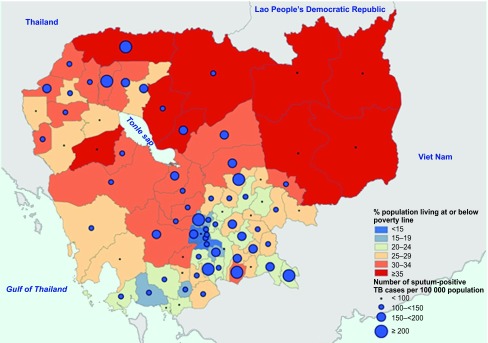
Methods: Poisson regression models were used to calculate the relative risk of new sputum-positive TB CNR for Operational Districts (ODs) with different poverty rates using data from the National Centre for Tuberculosis and Leprosy Control and the National Committee for SubNational Democratic Development. Models were adjusted for other major covariates and a geographical information system was used to examine the spatial distribution of these covariates in the country.
Results: The univariate model showed a positive association between household poverty rates and sputum-positive TB CNRs. However, in multivariate models, after adjusting for major covariates, household poverty rates showed a significantly negative association with sputum-positive TB CNRs (relative risk [RR] = 0.95 per 5% increase in poverty rate). The negative association was stronger among males than females (RR = 0.93 versus 0.96 per 5% increase in poverty rate). Similar spatial patterns were observed between household poverty rates and other covariates, particularly OD population density.
Conclusion: Household poverty rate is associated with a decrease in sputum-positive TB CNR in Cambodia, particularly in men. The potential of combining surveillance data and socioeconomic variables should be explored further to provide more insights for TB control programme planning.
Figures


References
-
- Global tuberculosis report 2012. Geneva: World Health Organization; 2012. http://www.who.int/tb/publications/global_report/gtbr12_main.pdf accessed 30 September 2012.
-
- Tuberculosis Profile Cambodia, 2009. Washington, DC: United States Agency for International Development; 2010.
Publication types
MeSH terms
LinkOut - more resources
Full Text Sources
Other Literature Sources
Medical