Effect of the telephone-delivered nutrition education on dietary intake and biochemical parameters in subjects with metabolic syndrome
- PMID: 23908978
- PMCID: PMC3728461
- DOI: 10.7762/cnr.2013.2.2.115
Effect of the telephone-delivered nutrition education on dietary intake and biochemical parameters in subjects with metabolic syndrome
Abstract
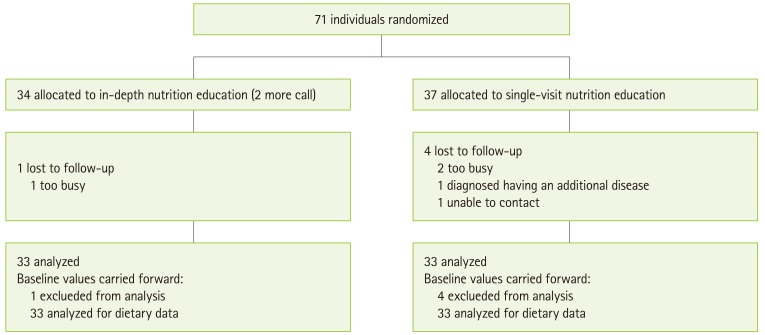
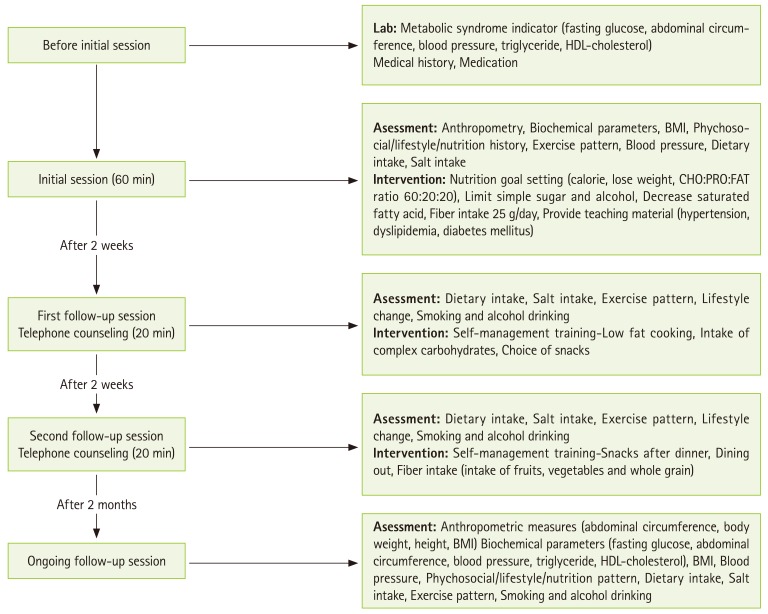
As prevalence of metabolic syndrome has rapidly increased over the past decade, lifestyle changes including dietary habits are considered as a therapeutic cornerstone for metabolic syndrome, cardiovascular complications and type 2 diabetes. We evaluated the effectiveness of a telephone-delivered nutrition education to improve metabolic parameters compared with a single-visit with a dietitian in subjects with metabolic syndrome. A total of seventy-one adults who met diagnostic criteria for the metabolic syndrome were randomly assigned to either the single-visit group or the in-depth nutrition education group during a 3-month intervention study period. The in-depth telephone-delivered nutrition education group had an initial visit with a dietitian and additional two telephone counseling during the first 4 weeks of the study periods. Sixty-six subjects completed a 3-month intervention study. The trial examined participant's anthropometric changes and dietary intakes as well as changes in the metabolic syndrome factors. At the end of the trial, the in-depth nutrition education group showed significantly higher reduction in weight, body fat and abdominal circumference compared with the other group (p < 0.05). In the in-depth nutrition groups, the prevalence of metabolic syndrome was decreased to 45.5%, while 69.7% of the subjects were metabolic syndrome patients in the single-visit group (p < 0.05). These results demonstrate that the telephone-intervention counseling is a feasible mean to deliver dietary intervention in patients with metabolic syndrome.
Keywords: Metabolic syndrome; Nutrition therapy; Telephone intervention.
Figures
References
-
- Statistics Korea [Internet] The statistics of mortality and the causes. Daejeon: Statistics Korea; 2011. [cited 2013 May 10]. Available from: http://kostat.go.kr/
-
- Lim S, Park KS, Lee HK, Cho SI Korean National Health and Nutrition Examination Surveys. Changes in the characteristics of metabolic syndrome in Korea over the period 1998-2001 as determined by Korean National Health and Nutrition Examination Surveys. Diabetes Care. 2005;28:1810–1812. - PubMed
-
- Malik S, Wong ND, Franklin SS, Kamath TV, L'Italien GJ, Pio JR, Williams GR. Impact of the metabolic syndrome on mortality from coronary heart disease, cardiovascular disease, and all causes in United States adults. Circulation. 2004;110:1245–1250. - PubMed
-
- Lakka HM, Laaksonen DE, Lakka TA, Niskanen LK, Kumpusalo E, Tuomilehto J, Salonen JT. The metabolic syndrome and total and cardiovascular disease mortality in middle-aged men. JAMA. 2002;288:2709–2716. - PubMed
-
- Wilson C, Brown T, Acton K, Gilliland S. Effects of clinical nutrition education and educator discipline on glycemic control outcomes in the Indian health service. Diabetes Care. 2003;26:2500–2504. - PubMed
LinkOut - more resources
Full Text Sources
Other Literature Sources
Research Materials
Miscellaneous