


Medication adherence and stroke/TIA risk in treated hypertensives: results from the REGARDS study
- PMID: 23910009
- PMCID: PMC3807818
- DOI: 10.1016/j.jash.2013.05.002
Medication adherence and stroke/TIA risk in treated hypertensives: results from the REGARDS study
Abstract
Background: The extent to which low medication adherence in hypertensive individuals contributes to disparities in stroke and transient ischemic attack (TIA) risk is poorly understood.
Methods: Investigators examined the relationship between self-reported medication adherence and blood pressure (BP) control (<140/90 mm Hg), Framingham Stroke Risk Score, and physician-adjudicated stroke/TIA incidence in treated hypertensive subjects (n = 15,071; 51% black; 57% in Stroke Belt) over 4.9 years in the national population-based REGARDS cohort study.
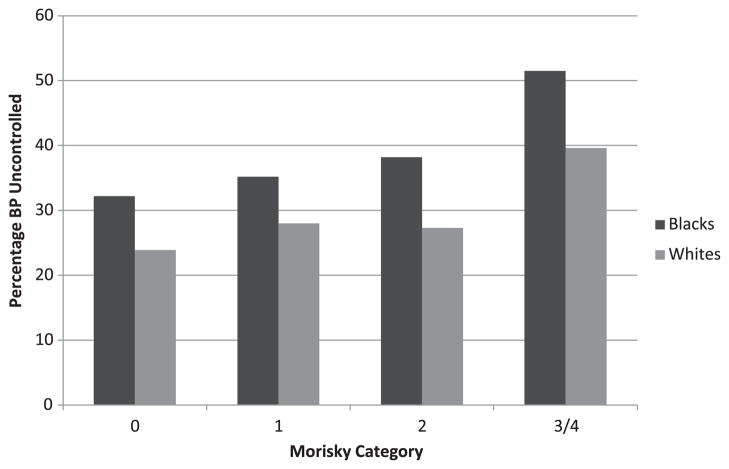
Results: Mean systolic BP varied from 130.8 ± 16.2 mm Hg in those reporting high adherence to 137.8 ± 19.5 mm Hg in those reporting low adherence (P for trend < .0001). In logistic regression models, each level of worsening medication adherence was associated with significant and increasing odds of inadequately controlled BP (≥140/90 mm Hg; score = 1, odds ratio [95% confidence interval], 1.20 [1.09-1.30]; score = 2, 1.27 [1.08-1.49]; score = 3 or 4, 2.21 [1.75-2.78]). In hazard models using systolic BP as a mediator, those reporting low medication adherence had 1.08 (1.04-1.14) times greater risk of stroke and 1.08 (1.03-1.12) times greater risk of stroke or TIA.
Conclusion: Low medication adherence was associated with inadequate BP control and an increased risk of incident stroke or TIA.
Keywords: Medication adherence; blood pressure control; stroke; transient ischemic attack.
Copyright © 2013 American Society of Hypertension. Published by Elsevier Inc. All rights reserved.
Conflict of interest statement
The authors have no financial conflicts of interest to disclose.
Figures
References
-
- Centers for Disease Control. Vital signs: prevalence, treatment, and control of hypertension—United States, 1999–2002 and 2005–2008. MMWR. 2011;60:103–8. - PubMed
-
- Muntner P, Halanych JH, Reynolds K, Durant R, Vupputuri S, Sung V, et al. Low medication adherence and the incidence of stroke symptoms among individuals with hypertension: data from the REasons for Geographic and Racial Differences in Stroke (REGARDS) study. J Clin Hypertens. 2011;13:479–86. - PMC - PubMed
Publication types
MeSH terms
Substances
Grants and funding
LinkOut - more resources
Full Text Sources
Other Literature Sources
Medical
