


The effect of postoperative myocardial ischemia on long-term survival after vascular surgery
- PMID: 23910457
- PMCID: PMC4013294
- DOI: 10.1016/j.jvs.2013.06.062
The effect of postoperative myocardial ischemia on long-term survival after vascular surgery
Abstract
Introduction: The impact of a postoperative troponin elevation on long-term survival after vascular surgery is not well-defined. We hypothesize that a postoperative troponin elevation is associated with significantly reduced long-term survival.
Methods: The Vascular Study Group of New England registry identified all patients who underwent carotid revascularization, open abdominal aortic aneurysm repair (AAA), endovascular AAA repair, or infrainguinal lower extremity bypass (2003-2011). The association of postoperative troponin elevation and myocardial infarction (MI) with 5-year survival was evaluated. Multivariable models identified predictors of survival and of postoperative myocardial ischemia.
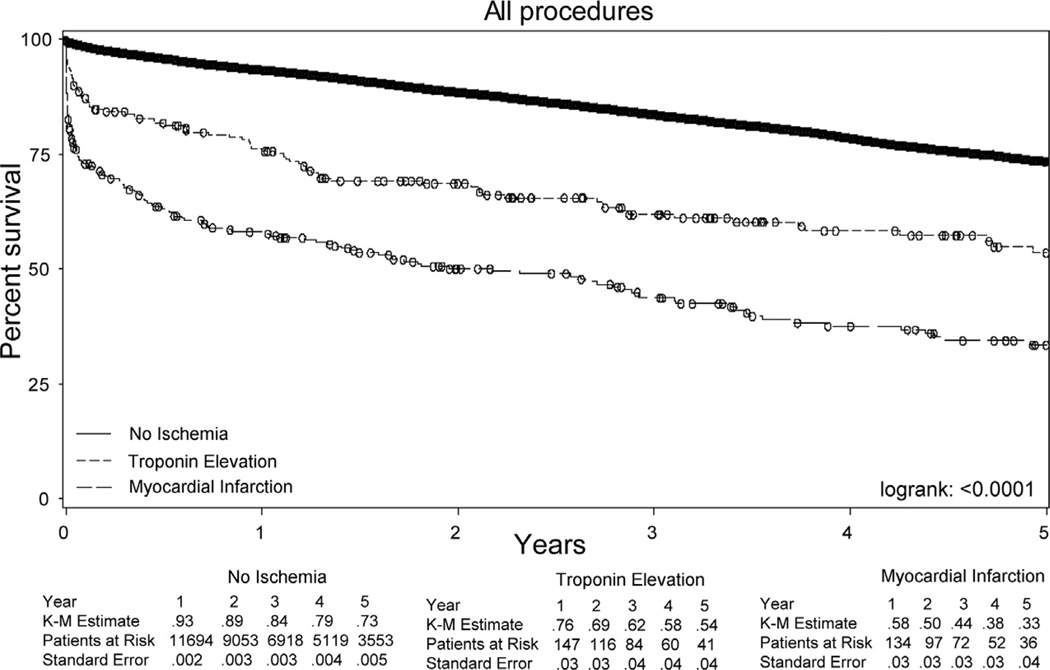
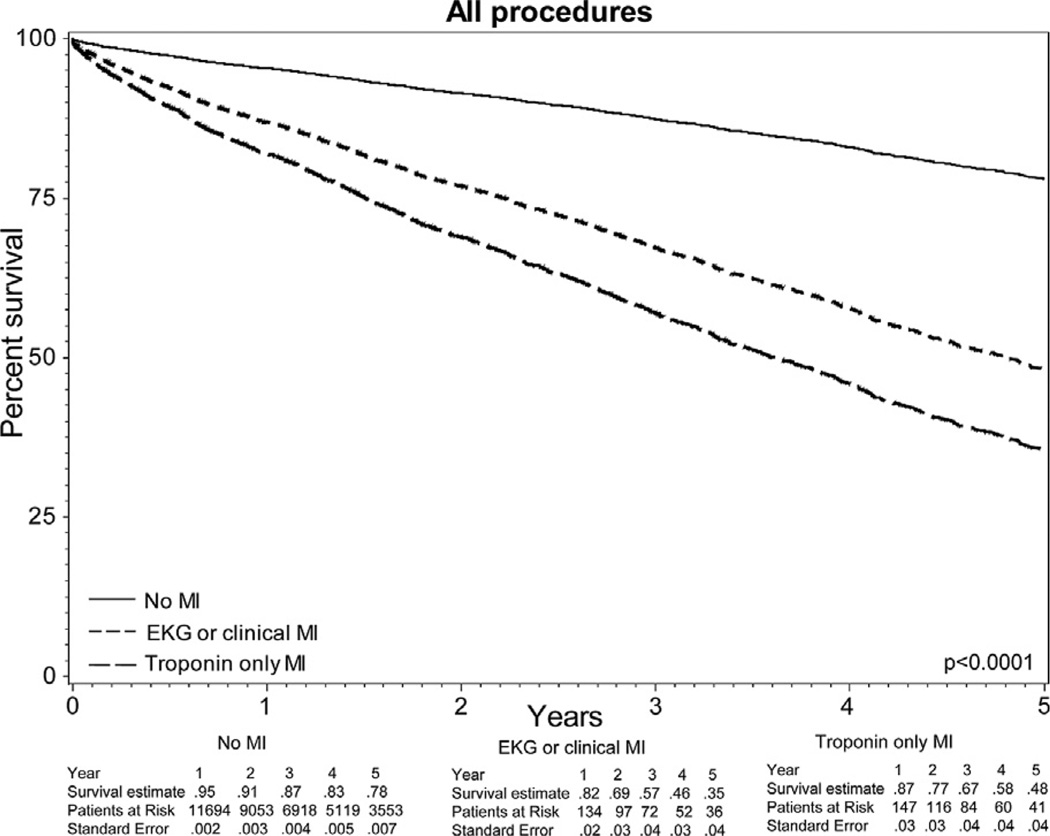
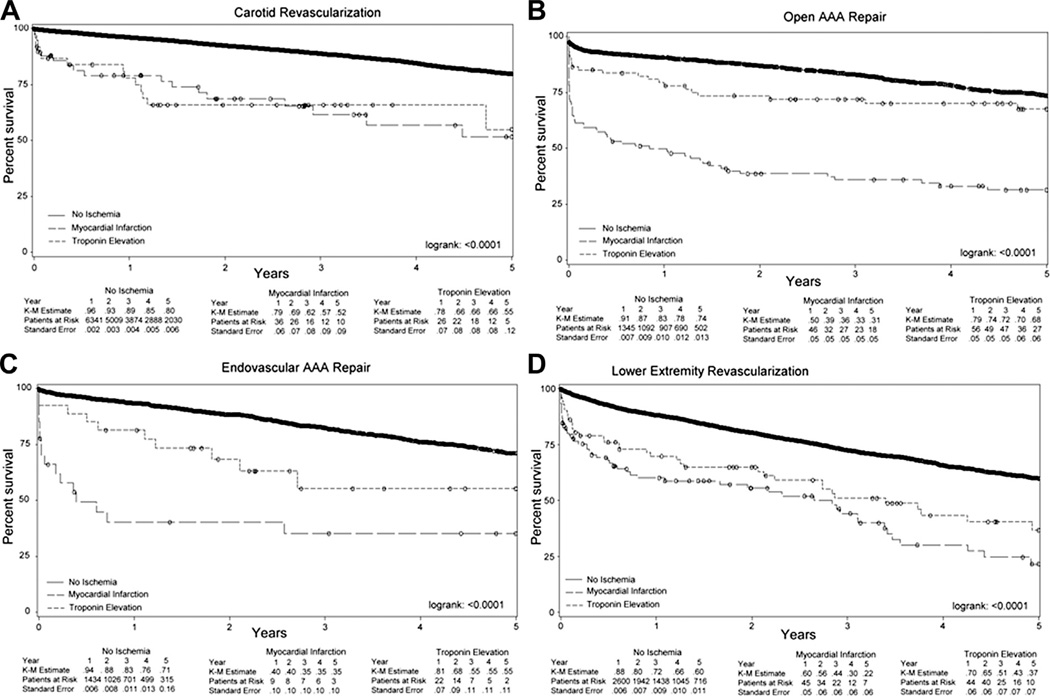
Results: In the entire cohort (n = 16,363), the incidence of postoperative troponin elevation was 1.3% (n = 211) and for MI was 1.6% (n = 264). Incidences differed across procedures (P < .0001) with the highest incidences after open AAA: troponin elevation, 3.9% (n = 74); MI, 5.1% (n = 96). On Kaplan-Meier analysis, any postoperative myocardial ischemia predicted reduced survival over 5 years postoperatively: no ischemia, 73% (standard error [SE], 0.5%); troponin elevation, 54% (SE, 4%); MI, 33% (SE, 4%) (P < .0001). This pattern was observed for each procedure subgroup analysis (P < .0001). Troponin elevation (hazard ratio, 1.45; 95% confidence interval, 1.1-2.0; P = .02) and MI (hazard ratio, 2.9; 95% confidence interval, 2.3-3.8; P < .0001) were independent predictors of reduced survival at 5 years.
Conclusions: Postoperative troponin elevation and MI predict a 26% or a 55% relatively lower survival in the 5 years following a vascular surgical procedure, respectively, compared with patients who do not experience myocardial ischemia. This highlights the need to better characterize factors leading to postoperative myocardial ischemia. Postoperative troponin elevation, either alone, or in combination with an MI, may be a useful marker for identifying high-risk patients who might benefit from more aggressive optimization in hopes of reducing adverse long-term outcomes.
Copyright © 2013 Society for Vascular Surgery. Published by Mosby, Inc. All rights reserved.
Conflict of interest statement
Author conflict of interest: none.
Figures
Comment in
-
Discussion.J Vasc Surg. 2013 Dec;58(6):1608. doi: 10.1016/j.jvs.2013.06.097. Epub 2013 Aug 7. J Vasc Surg. 2013. PMID: 23932801 No abstract available.
-
Reply: To PMID 23910457.J Vasc Surg. 2014 May;59(5):1474-5. doi: 10.1016/j.jvs.2014.01.004. J Vasc Surg. 2014. PMID: 24767277 No abstract available.
-
Regarding "The effect of postoperative myocardial ischemia on long-term survival after vascular surgery".J Vasc Surg. 2014 May;59(5):1474. doi: 10.1016/j.jvs.2014.01.003. J Vasc Surg. 2014. PMID: 24767278 No abstract available.
References
-
- Massie MT, Rohrer MJ, Leppo JA, Cutler BS. Is coronary angiography necessary for vascular surgery patients who have positive results of dipyridamole thallium scans? J Vasc Surg. 1997;25:975–982. discussion: 982–3. - PubMed
-
- Johnston KW. Nonruptured abdominal aortic aneurysm: six-year follow-up results from the multicenter prospective Canadian aneurysm study. Canadian Society for Vascular Surgery Aneurysm Study Group. J Vasc Surg. 1994;20:163–170. - PubMed
-
- Hertzer NR, Mascha EJ, Karafa MT, O’Hara PJ, Krajewski LP, Beven EG. Open infrarenal abdominal aortic aneurysm repair: the Cleveland Clinic experience from 1989 to 1998. J Vasc Surg. 2002;35:1145–1154. - PubMed
-
- McFalls EO, Ward HB, Moritz TE, Apple FS, Goldman S, Pierpont G, et al. Predictors and outcomes of a perioperative myocardial infarction following elective vascular surgery in patients with documented coronary artery disease: results of the CARP trial. Eur Heart J. 2008;29:394–401. - PubMed
Publication types
MeSH terms
Substances
Grants and funding
LinkOut - more resources
Full Text Sources
Other Literature Sources
