


A simple bedside stroke dysphagia screen, validated against videofluoroscopy, detects dysphagia and aspiration with high sensitivity
- PMID: 23910514
- PMCID: PMC4019433
- DOI: 10.1016/j.jstrokecerebrovasdis.2013.06.030
A simple bedside stroke dysphagia screen, validated against videofluoroscopy, detects dysphagia and aspiration with high sensitivity
Abstract
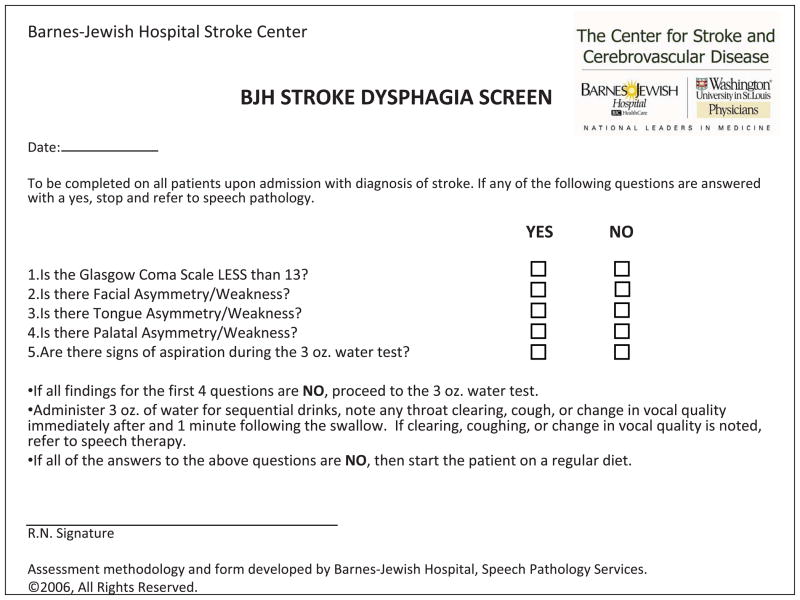
Background: Early identification of dysphagia is associated with lower rates of pneumonia after acute stroke. The Barnes-Jewish Hospital Stroke Dysphagia Screen (BJH-SDS) was previously developed as a simple bedside screen performed by nurses for sensitive detection of dysphagia and was previously validated against the speech pathologist's clinical assessment for dysphagia. In this study, acute stroke patients were prospectively enrolled to assess the accuracy of the BJH-SDS when tested against the gold standard test for dysphagia, the videofluoroscopic swallow study (VFSS).
Methods: Acute stroke patients were prospectively enrolled at a large tertiary care inpatient stroke unit. The nurse performed the BJH-SDS at the bedside. After providing consent, patients then underwent VFSS for determination of dysphagia and aspiration. The VFSS was performed by a speech pathologist who was blinded to the results of the BJH-SDS. Sensitivity and specificity were calculated. Pneumonia rates were assessed across the 5-year period over which the BJH-SDS was introduced into the stroke unit.
Results: A total of 225 acute stroke patients were enrolled. Sensitivity and specificity of the screen to detect dysphagia were 94% and 66%, respectively. Sensitivity and specificity of the screen to detect aspiration were 95% and 50%, respectively. No increase in pneumonia was identified during implementation of the screen (P = .33).
Conclusion: The BJH-SDS, validated against videofluoroscopy, is a simple bedside screen for sensitive identification of dysphagia and aspiration in the stroke population.
Keywords: Stroke; aspiration; dysphagia; pneumonia; screening test.
Copyright © 2014 National Stroke Association. Published by Elsevier Inc. All rights reserved.
Conflict of interest statement
The authors have no conflict of interest to report.
Figures
References
-
- Mann G, Hankey GJ, Cameron D. Swallowing function after stroke: prognosis and prognostic factors at 6 months. Stroke; a journal of cerebral circulation. 1999;30(4):744–748. - PubMed
-
- Martino R, Foley N, Bhogal S, Diamant N, Speechley M, Teasell R. Dysphagia after stroke: incidence, diagnosis, and pulmonary complications. Stroke; a journal of cerebral circulation. 2005;36(12):2756–2763. - PubMed
-
- Katzan IL, Cebul RD, Husak SH, Dawson NV, Baker DW. The effect of pneumonia on mortality among patients hospitalized for acute stroke. Neurology. 2003;60(4):620–625. - PubMed
-
- Katzan IL, Dawson NV, Thomas CL, Votruba ME, Cebul RD. The cost of pneumonia after acute stroke. Neurology. 2007;68(22):1938–1943. - PubMed
-
- Hinchey JA, Shephard T, Furie K, Smith D, Wang D, Tonn S Stroke Practice Improvement Network I. Formal dysphagia screening protocols prevent pneumonia. Stroke; a journal of cerebral circulation. 2005;36(9):1972–1976. - PubMed
Publication types
MeSH terms
Grants and funding
LinkOut - more resources
Full Text Sources
Other Literature Sources
Medical
