


Rewarding and aversive effects of ethanol in High Drinking in the Dark selectively bred mice
- PMID: 23910826
- PMCID: PMC3866216
- DOI: 10.1111/adb.12079
Rewarding and aversive effects of ethanol in High Drinking in the Dark selectively bred mice
Abstract
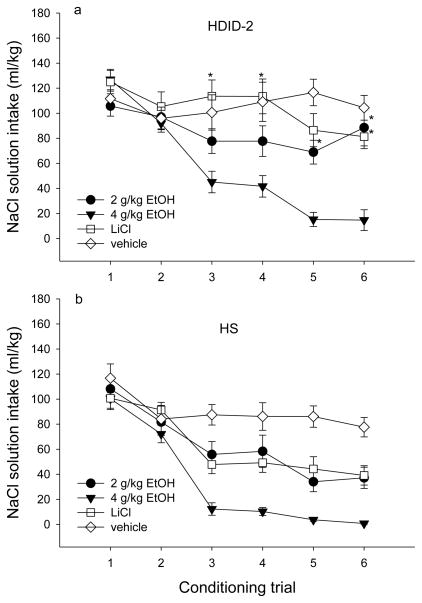
Both rewarding and aversive effects contribute to alcohol consumption. Animals genetically predisposed to be high drinkers show reduced sensitivity to the aversive effects of alcohol, and in some instances, increased sensitivity to alcohol's rewarding effects. The present studies tested the high drinking in the dark (HDID) selected lines, a genetic model of drinking to intoxication, to determine whether intake in these mice was genetically related to sensitivity to alcohol aversion or reward. Male HDID mice from the first and second replicate lines (HDID-1 and HDID-2, respectively) and mice from the heterogeneous progenitor control population (HS/Npt, or HS) were conditioned for a taste aversion to a salt solution using two doses of alcohol, and lithium chloride (LiCl) and saline controls. In separate experiments, male and female HDID-1, HDID-2 and HS mice were conditioned for place preference using alcohol. HDID mice were found to have an attenuated sensitivity to alcohol at a moderate (2 g/kg) dose compared to HS mice, but did not differ on conditioned taste aversion to a high (4 g/kg) dose or LiCl or saline injections. HDID and HS mice showed comparable development of alcohol-induced conditioned place preference. These results indicate that high blood alcohol levels after drinking in the HDID mice is genetically related to attenuated aversion to alcohol, while sensitivity to alcohol reward is not altered in these mice. Thus, HDID mice may find a moderate dose of alcohol to be less aversive than control mice and consequently may drink more because of this reduced aversive sensitivity.
Keywords: alcohol; behavioral genetics; binge drinking; conditioned place preference; conditioned taste aversion; selected lines.
© 2013 Society for the Study of Addiction.
Figures



References
-
- Broadbent J, Muccino KJ, Cunningham CL. Ethanol-induced conditioned taste aversion in 15 inbred mouse strains. Behav Neurosci. 2002;116(1):138–148. - PubMed
-
- Brunetti G, Carai MA, Lobina C, Melis S, Serra S, Vacca G, Gessa GL, Colombo G. Differences in ethanol-induced conditioned taste aversion in Sardinian alcohol-preferring and Sardinian alcohol-nonpreferring rats. Alcohol. 2002;26(3):167–72. - PubMed
-
- Chester JA, Lumeng L, Li T-K, Grahame NJ. High- and low-alcohol-preferring mice show differences in conditioned taste aversion to alcohol. Alcohol Clin Exp Res. 2003;27(1):12–18. - PubMed
Publication types
MeSH terms
Substances
Grants and funding
- AA13519/AA/NIAAA NIH HHS/United States
- P50 AA010760/AA/NIAAA NIH HHS/United States
- T32 AA007468/AA/NIAAA NIH HHS/United States
- AA007468/AA/NIAAA NIH HHS/United States
- R37 AA007702/AA/NIAAA NIH HHS/United States
- U01 AA013519/AA/NIAAA NIH HHS/United States
- R24 AA020245/AA/NIAAA NIH HHS/United States
- AA07702/AA/NIAAA NIH HHS/United States
- P60 AA010760/AA/NIAAA NIH HHS/United States
- AA10760/AA/NIAAA NIH HHS/United States
- AA020245/AA/NIAAA NIH HHS/United States
- I01 BX000313/BX/BLRD VA/United States
- R01 AA007702/AA/NIAAA NIH HHS/United States
LinkOut - more resources
Full Text Sources
Other Literature Sources
Medical
