


An observational study reveals that neonatal vitamin D is primarily determined by maternal contributions: implications of a new assay on the roles of vitamin D forms
- PMID: 23911222
- PMCID: PMC3680300
- DOI: 10.1186/1475-2891-12-77
An observational study reveals that neonatal vitamin D is primarily determined by maternal contributions: implications of a new assay on the roles of vitamin D forms
Abstract
Background: Vitamin D concentrations during pregnancy are measured to diagnose states of insufficiency or deficiency. The aim of this study is to apply accurate assays of vitamin D forms [single- hydroxylated [25(OH)D₂, 25(OH)D₃], double-hydroxylated [1α,25(OH)₂D₂, 1a25(OH)₂D₃], epimers [3-epi-25(OH)D₂, 3-epi-25(OH)D₃] in mothers (serum) and neonates (umbilical cord) to i) explore maternal and neonatal vitamin D biodynamics and ii) to identify maternal predictors of neonatal vitamin D concentrations.
Methods: All vitamin D forms were quantified in 60 mother- neonate paired samples by a novel liquid chromatography -mass spectrometry (LC-MS/MS) assay. Maternal characteristics [age, ultraviolet B exposure, dietary vitamin D intake, calcium, phosphorus and parathyroid hormone] were recorded. Hierarchical linear regression was used to predict neonatal 25(OH)D concentrations.
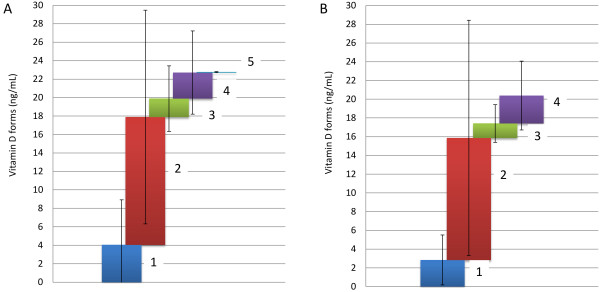
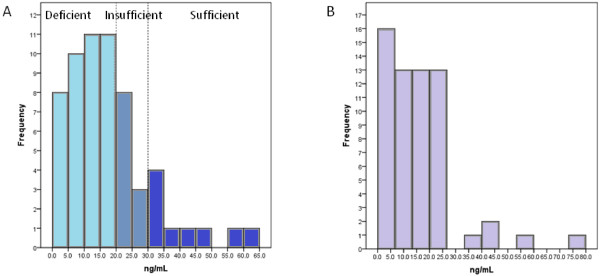
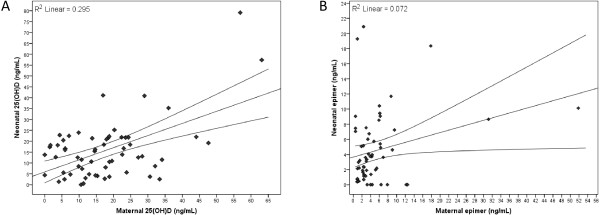
Results: Mothers had similar concentrations of 25(OH)D₂ and 25(OH)D₃ forms compared to neonates (17.9 ± 13.2 vs. 15.9 ± 13.6 ng/mL, p=0.289) with a ratio of 1:3. The epimer concentrations, which contribute approximately 25% to the total vitamin D levels, were similar in mothers and neonates (4.8 ± 7.8 vs. 4.5 ± 4.7 ng/mL, p=0.556). No correlation was observed in mothers between the levels of the circulating form (25OHD₃) and its active form. Neonatal 25(OH)D₂ was best predicted by maternal characteristics, whereas 25(OH)D₃ was strongly associated to maternal vitamin D forms (R²=0.253 vs. 0.076 and R2=0.109 vs. 0.478, respectively). Maternal characteristics explained 12.2% of the neonatal 25(OH)D, maternal 25(OH)D concentrations explained 32.1%, while epimers contributed an additional 11.9%.
Conclusions: By applying a novel highly specific vitamin D assay, the present study is the first to quantify 3-epi-25(OH)D concentrations in mother-newborn pairs. This accurate assay highlights a considerable proportion of vitamin D exists as epimers and a lack of correlation between the circulating and active forms. These results highlight the need for accurate measurements to appraise vitamin D status. Maternal characteristics and circulating forms of vitamin D, along with their epimers explain 56% of neonate vitamin D concentrations. The roles of active and epimer forms in the maternal-neonatal vitamin D relationship warrant further investigation.
Figures
References
-
- Haris N, Wall AP, Sangster M, Paton RW. The presentation of rickets to orthopaedic clinics: return of the English disease. Acta Orthop Belg. 2011;77:239–245. - PubMed
-
- Munns CF, Simm PJ, Rodda CR, Garnett SP, Zacharin MR, Ward LM, Geddes J, Cherian S, Zurynski Y, Cowell CTY. APSU Vitamin D Study Group. Incidence of vitamin D deficiency rickets among Australian children: an Australian Paediatric Surveillance Unit study. Med J Australia. 2012;196:466–468. - PubMed
Publication types
MeSH terms
Substances
LinkOut - more resources
Full Text Sources
Other Literature Sources
Medical
