. 2014 Jan;32(1):43.e23-30.
doi: 10.1016/j.urolonc.2013.05.008. Epub 2013 Aug 2.

Tissue slice grafts of human renal cell carcinoma: an authentic preclinical model with high engraftment rate and metastatic potential

Affiliations

Tissue slice grafts of human renal cell carcinoma: an authentic preclinical model with high engraftment rate and metastatic potential

Alan E Thong et al. Urol Oncol. 2014 Jan.

Abstract

Objective: Discovery of curative therapies for renal cell carcinoma (RCC) is hampered by lack of authentic preclinical models. Tumorgrafts, generated by direct implantation of patient-derived tissues into mice, have demonstrated superior ability to predict therapeutic response. We evaluated "tissue slice grafts" (TSGs) as an improved tumorgraft model of RCC.

Materials and methods: Cores of fresh RCC were precision-cut at 300 µm and implanted under the renal capsule of RAG2(-/-)γC(-/-) mice. Engraftment rate, histology, biomarker expression, genetic fidelity, and metastatic potential were evaluated. Magnetic resonance imaging (MRI) was tested as a noninvasive method to measure tumor volume, and response to a targeted therapy was determined.

Results: All 13 cases of RCC engrafted and displayed characteristic histology and biomarkers. TSG volume quantified noninvasively by MRI highly correlated with graft weights, providing a unique tool for monitoring orthotopic growth. Moreover, in 2 cases, cancer cells from TSGs metastasized to clinically relevant sites, including bone. Microarray analysis and DNA sequencing demonstrated a high degree of correlation of global gene expression and von Hippel-Lindau (VHL) status between TSGs and parental tumors. Treatment of TSGs with sunitinib significantly decreased graft weight and mean vessel density compared with controls.

Conclusion: The TSG model of RCC faithfully recapitulates tumor pathology, gene expression, genetic mutation, and drug response. The high engraftment rate and metastatic potential of this authentic model, in conjunction with the ability to generate large first-generation animal cohorts and to quantitate tumor volume at the orthotopic site by MRI, proffer significant advantages compared with other preclinical platforms.

Keywords: Metastases; Renal cancer; Tumorgrafts.


Figures

Fig. 1
Fig. 1
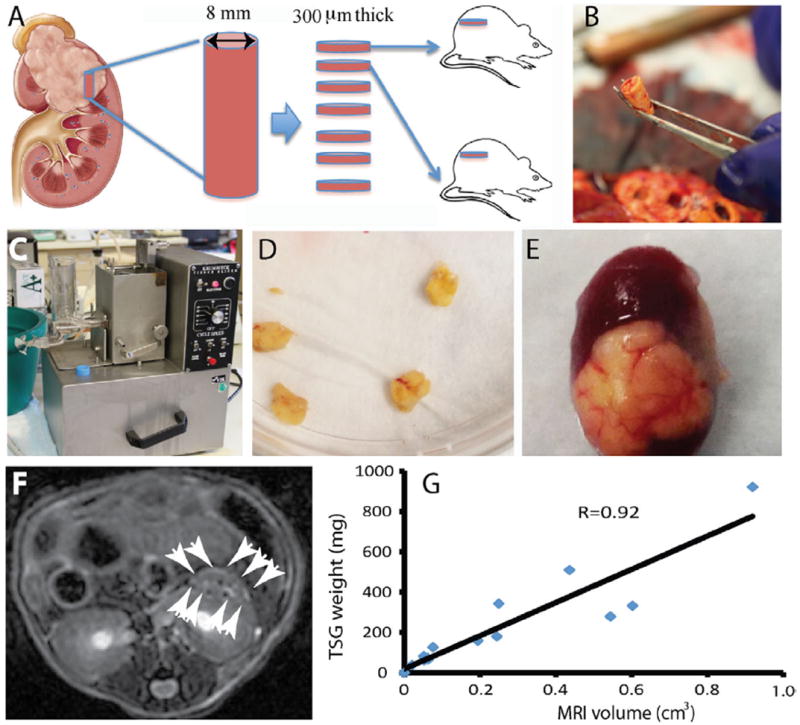
Generation and imaging of TSGs. (A) diagram of TSG generation. (B) a tissue core taken from cancer area of a fresh nephrectomy specimen. (C) Krumdieck tissue slicer. (D) tissue slices precision-cut to 8 mm in diameter and 300 μm in thickness. (E) a representative TSG with good vascularization. (F) a representative MRI image of TSG with white arrows marking the boundary. (G) correlation of tumor volume determined by MRI and graft weight for TSGs derived from case 2. (Color version of the figure is available online.)
Fig. 2
Fig. 2
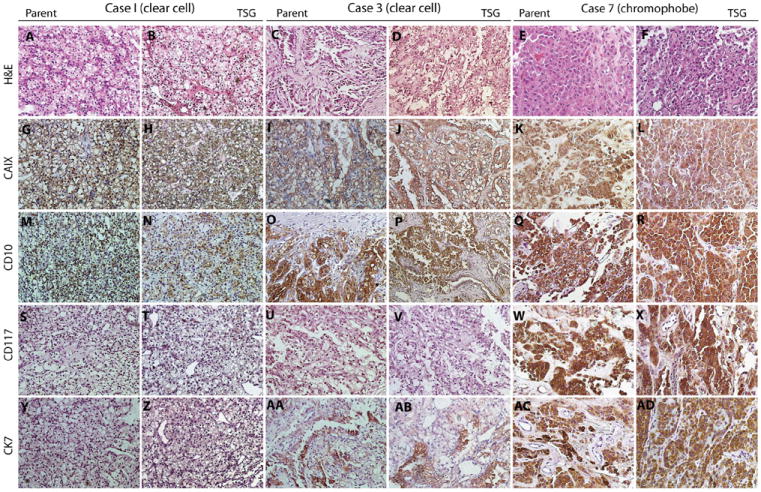
TSGs preserved histologic features and biomarker expression of corresponding parental tumors. A, C, and E are H&E-stained tumor sections from cases 1, 3, and 7, which showed similar histology to the derivative TSGs in B, D, and F, respectively. All 3 cases and their TSGs displayed expression of CAIX (G–L) and CD10 (M–R). Cases 1 and 3 and their TSGs were negative for CD117 (S–V), whereas case 7 and its TSG were positive (W and X). Case 1 and its TSG were negative for CK7 (Y and Z), and cases 3 and 7 and their TSGs were positive (AA–AD). (Color version of the figure is available online.)
Fig. 3
Fig. 3
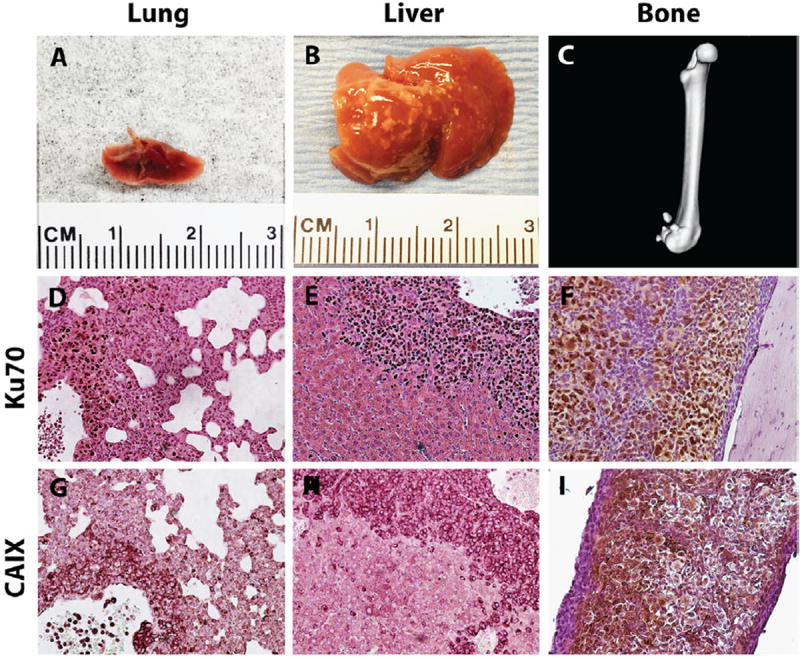
TSGs displayed metastatic potential. Gross metastases were detected in lung, A, liver, B, and bone, C, of mice bearing TSGs derived from case 1. RCC cells were distinguished from host cells at the metastatic sites by intense staining of human-specific nuclear antigen Ku70 (D–F). These cells were also positive for CAIX (G–I). (Color version of the figure is available online.)
Fig. 4
Fig. 4
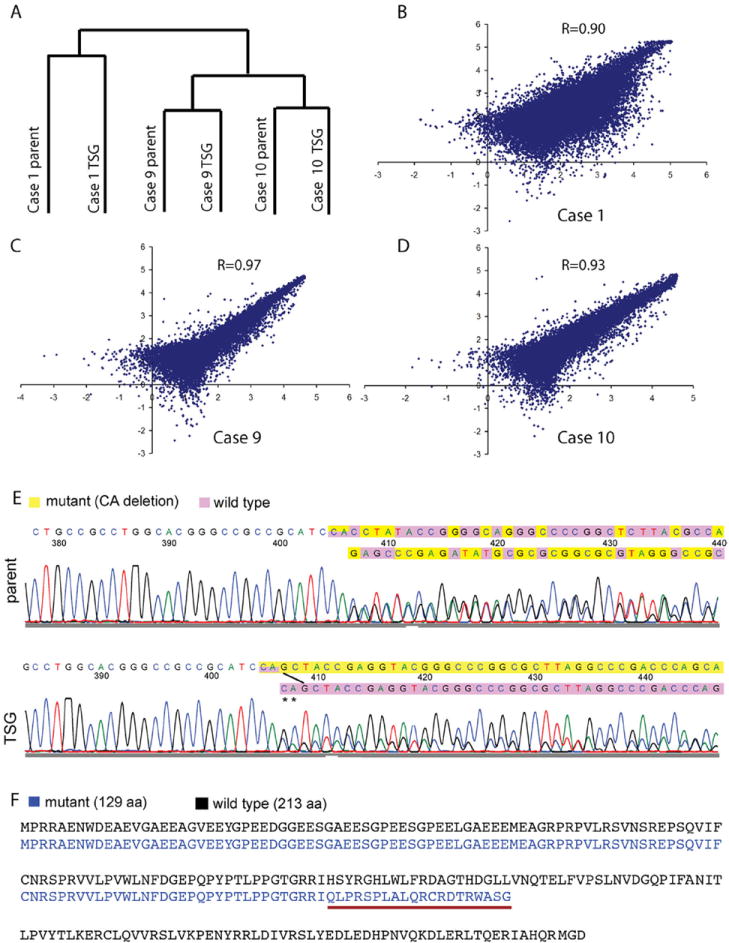
TSGs maintained similar global gene expression and identical genetic mutation of VHL to the parental tumors. (A) dendrogram of average linkage clustering of 3 pairs of TSGs and their corresponding parental tumors. (B–D) scatter plots of gene expression in TSGs and corresponding parental tumors with correlation coefficients. (E) a “CA” deletion in exon 1 was identified in the parental tumor and TSG from case 9. The mutant VHL sequence was shown in yellow and the wild type in purple. The ratio of mutant to wild-type VHL nucleotide signal was increased in the chromatogram from TSG. (F) wild-type VHL protein sequence is in black. Mutant VHL protein sequence in case 9 is in blue. Mutant protein sequence underlined in red after the mutation is different from wild type due to a frameshift. The mutation also caused an early stop resulting in a truncated protein of 129 amino acids compared with the wild-type protein of 213 amino acids. (Color version of the figure is available online.)
Fig. 5
Fig. 5
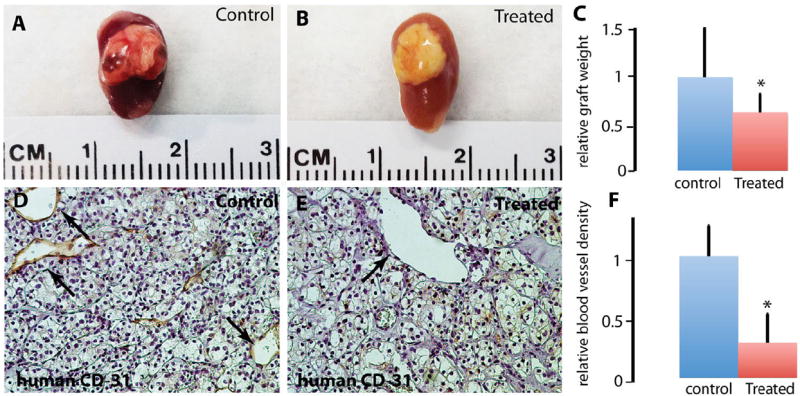
TSGs responded to sunitinib treatment. Control TSGs generated from case 1 showed good vascularization, (A) compared with TSGs treated with sunitinib, (B) Treated TSGs had significantly lower graft weights compared with control TSGs, (C) Blood vessels lined by human endothelial cells were readily observed in control TSGs (arrows in D), whereas empty spaces in the shape of blood vessels were seen in treated TSGs (arrow in E). The mean vessel intensity in 10 high-power fields in control TSGs was significantly higher than that in treated TSGs, (F). (Color version of the figure is available online.)

References

    1. Dennis C. Mouse avatars couldaidpancreaticcancertherapy. Nature News. 2012 doi: 10.1038/nature.2012.10259. Available at. - DOI
    1. DeRose YS, Wang G, Lin YC, Bernard PS, Buys SS, Ebbert MT, et al. Tumor grafts derived from women with breast cancer authentically reflect tumor pathology, growth, metastasis and disease outcomes. Nat Med. 2011;17:1514–20. - PMC - PubMed
    1. Garber K. Personal mouse colonies give hope for pancreatic cancer patients. J Natl Cancer Inst. 2007;99:105–7. - PubMed
    1. Garber K. From human to mouse and back: tumorgraft models surge in popularity. J Natl Cancer Inst. 2009;101:6–8. - PubMed
    1. Hidalgo M, Bruckheimer E, Rajeshkumar NV, Garrido-Laguna I, De Oliveira E, Rubio-Viqueira B, et al. A pilot clinical study of treatment guided by personalized tumorgrafts in patients with advanced cancer. Mol Cancer Ther. 2011;10:1311–6. - PMC - PubMed

Publication types

MeSH terms