


Antihypertensive medication use and risk of cognitive impairment: the Honolulu-Asia Aging Study
- PMID: 23911753
- PMCID: PMC3885214
- DOI: 10.1212/WNL.0b013e3182a351d4
Antihypertensive medication use and risk of cognitive impairment: the Honolulu-Asia Aging Study
Abstract
Objective: To determine the associations between classes of antihypertensive medication use and the risk of cognitive impairment among elderly hypertensive men.
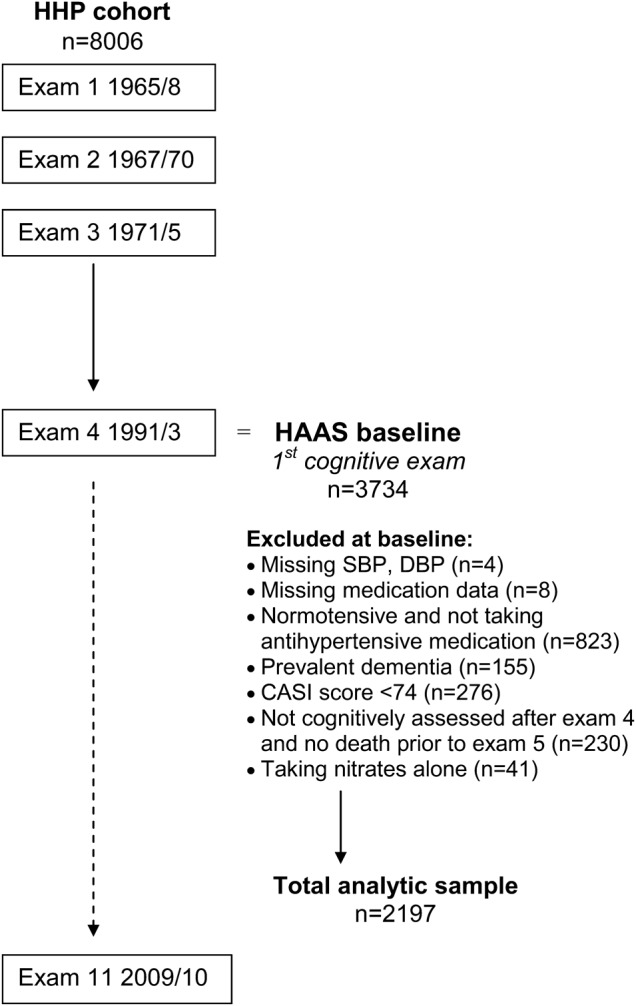
Methods: The Honolulu-Asia Aging Study is a prospective, community-based cohort study of Japanese American men conducted in Honolulu, Hawaii. We examined 2,197 participants (mean age 77 years at cohort entry, 1991-1993, followed through September 2010) with hypertension and without dementia or cognitive impairment at baseline, who provided information on medication use. Cognitive function was assessed at 7 standardized examinations using the Cognitive Abilities Screening Instrument (CASI). Cognitive impairment was defined as a CASI score <74.
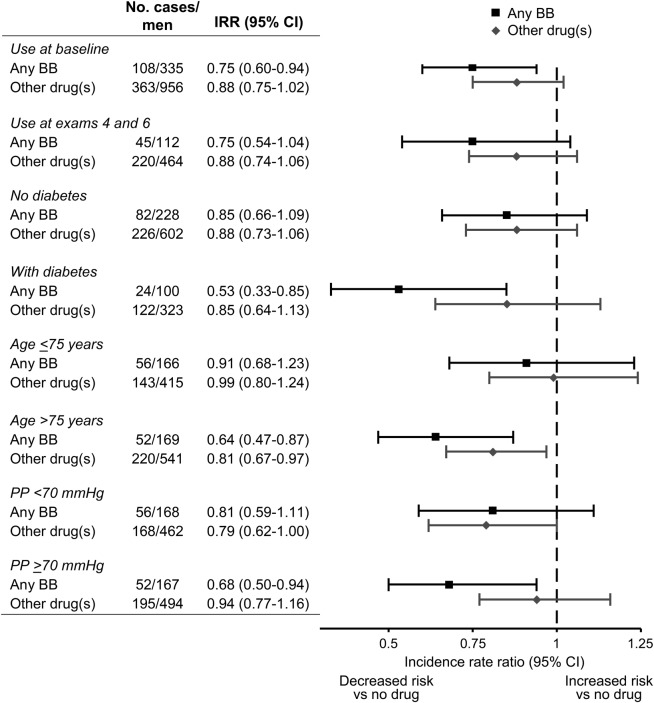
Results: A total of 854 men developed cognitive impairment (median follow-up, 5.8 years). β-Blocker use as the sole antihypertensive drug at baseline was consistently associated with a lower risk of cognitive impairment (incidence rate ratio [IRR] 0.69; 95% confidence interval [CI] 0.50-0.94), as compared with men not taking any antihypertensive medications, adjusting for multiple potential confounders. The use of diuretics, calcium channel blockers, angiotensin-converting enzyme inhibitors, or vasodilators alone was not significantly associated with cognitive impairment. Results were similar excluding those with cardiovascular disease or <1 year of follow-up, and additionally adjusting for pulse pressure, heart rate, baseline and midlife systolic blood pressure, and midlife antihypertensive treatment (IRR 0.65; 95% CI 0.45-0.94). The association between β-blocker use and cognitive impairment was stronger among men with diabetes, men aged >75 years, and those with pulse pressure ≥70 mm Hg.
Conclusions: β-blocker use is associated with a lower risk of developing cognitive impairment in elderly Japanese American men.
Figures
Comment in
-
Delaying dementia: can antihypertensives prevent Alzheimer dementia?Neurology. 2013 Sep 3;81(10):860-2. doi: 10.1212/WNL.0b013e3182a35296. Epub 2013 Aug 2. Neurology. 2013. PMID: 23911755 No abstract available.
References
-
- Raina P, Santaguida P, Ismaila A, et al. Effectiveness of cholinesterase inhibitors and memantine for treating dementia: evidence review for a clinical practice guideline. Ann Intern Med 2008;148:379–397 - PubMed
-
- World Health Organization Dementia: A Public Health Priority. Geneva: World Health Organization; 2012
-
- Freitag MH, Peila R, Masaki K, et al. Midlife pulse pressure and incidence of dementia: the Honolulu-Asia Aging Study. Stroke 2006;37:33–37 - PubMed
-
- Launer LJ, Masaki K, Petrovitch H, Foley D, Havlik RJ. The association between midlife blood pressure levels and late-life cognitive function: the Honolulu-Asia Aging Study. JAMA 1995;274:1846–1851 - PubMed
-
- Launer LJ, Ross GW, Petrovitch H, et al. Midlife blood pressure and dementia: the Honolulu-Asia Aging Study. Neurobiol Aging 2000;21:49–55 - PubMed
Publication types
MeSH terms
Substances
Grants and funding
LinkOut - more resources
Full Text Sources
Other Literature Sources
Medical
