


Motor impairments related to brain injury timing in early hemiparesis. Part II: abnormal upper extremity joint torque synergies
- PMID: 23911972
- PMCID: PMC3974905
- DOI: 10.1177/1545968313497829
Motor impairments related to brain injury timing in early hemiparesis. Part II: abnormal upper extremity joint torque synergies
Abstract
Background: Extensive neuromotor development occurs early in human life, and the timing of brain injury may affect the resulting motor impairment. In Part I of this series, it was demonstrated that the distribution of weakness in the upper extremity depended on the timing of brain injury in individuals with childhood-onset hemiparesis.
Objective: The goal of this study was to characterize how timing of brain injury affects joint torque synergies, or losses of independent joint control.
Method: Twenty-four individuals with hemiparesis were divided into 3 groups based on the timing of their injury: before birth (PRE-natal, n = 8), around the time of birth (PERI-natal, n = 8), and after 6 months of age (POST-natal, n = 8). Individuals with hemiparesis and 8 typically developing peers participated in maximal isometric shoulder, elbow, wrist, and finger torque generation tasks while their efforts were recorded by a multiple degree-of-freedom load cell. Motor output in 4 joints of the upper extremity was concurrently measured during 8 primary torque generation tasks to quantify joint torque synergies.
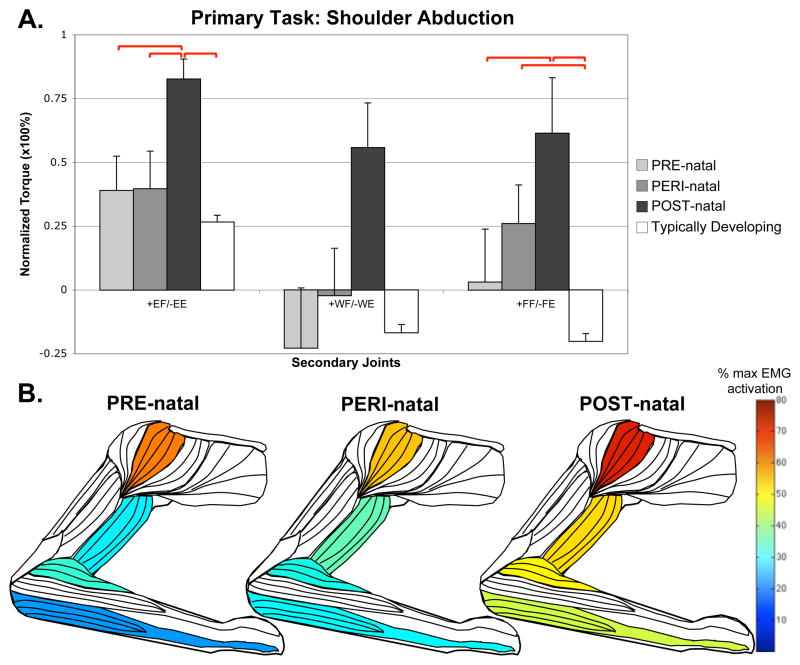
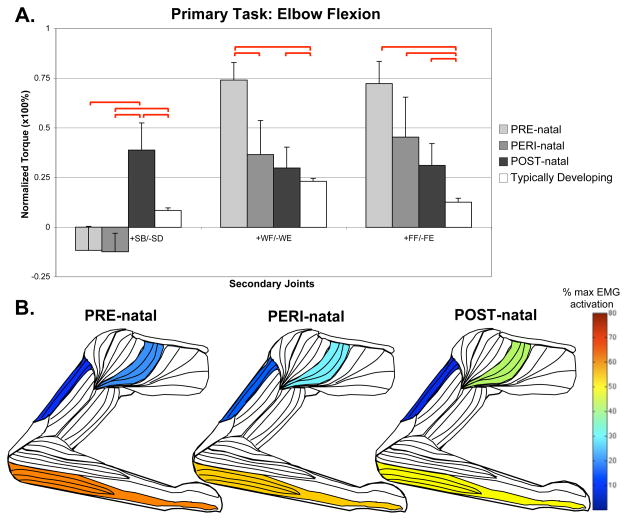
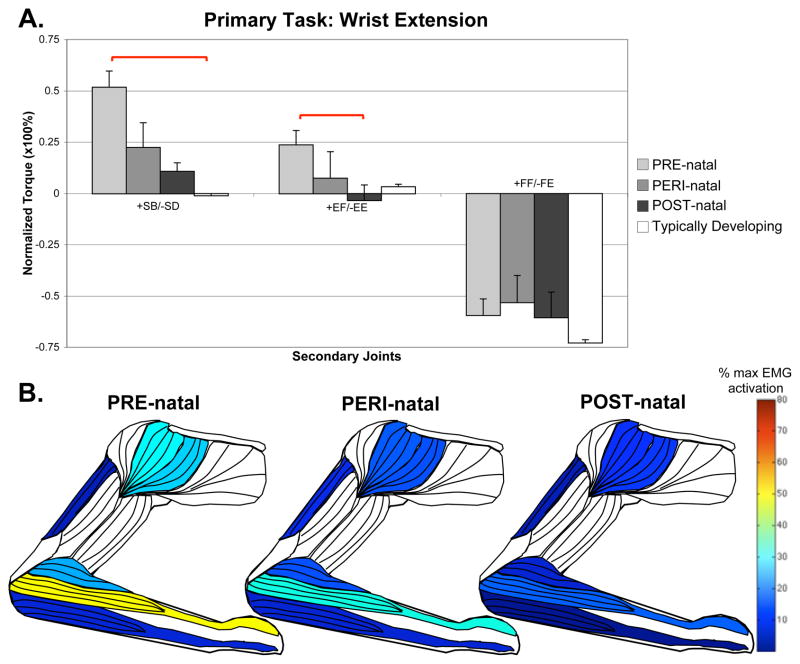
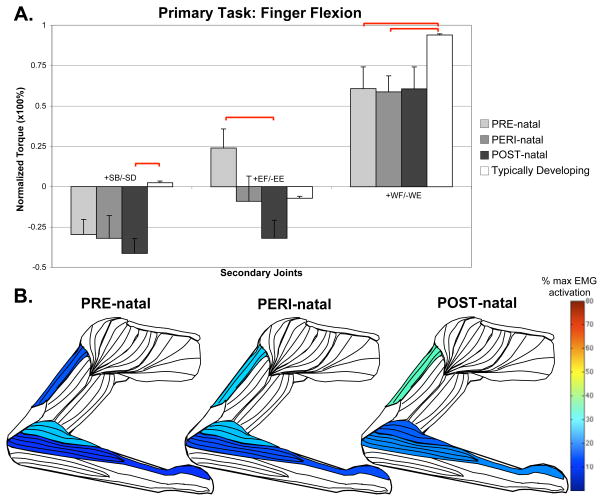
Results: There were a number of significant coupling patterns identified in individuals with hemiparesis that differed from the typically developing group. POST-natal differences were most noted in the coupling of shoulder abductors with elbow, wrist, and finger flexors, while the PRE-natal group demonstrated significant distal joint coupling with elbow flexion.
Conclusion: The torque synergies measured provide indirect evidence for the use of bulbospinal pathways in the POST-natal group, while those with earlier injury may use relatively preserved ipsilateral corticospinal motor pathways.
Keywords: cerebral palsy; childhood hemiparesis; childhood hemiplegia; independent joint control; selective motor control.
Figures
References
-
- Sanger TD, Delgado MR, Gaebler-Spira D, Hallett M, Mink JW. Classification and definition of disorders causing hypertonia in childhood. Pediatrics. 2003;111:e89–97. - PubMed
-
- Tedroff K, Knutson LM, Soderberg GL. Synergistic muscle activation during maximum voluntary contractions in children with and without spastic cerebral palsy. Dev Med Child Neurol. 2006;48:789–96. - PubMed
-
- Fowler EG, Staudt LA, Greenberg MB. Lower-extremity selective voluntary motor control in patients with spastic cerebral palsy: increased distal motor impairment. Dev Med Child Neurol. 2010;52:264–9. - PubMed
-
- Brunnstrom S. Movement therapy in hemiplegia: a neurophysiological approach. New York: Medical Dept; 1970.
-
- Dewald JP, Beer RF. Abnormal joint torque patterns in the paretic upper limb of subjects with hemiparesis. Muscle Nerve. 2001;24:273–83. - PubMed
Publication types
MeSH terms
Grants and funding
LinkOut - more resources
Full Text Sources
Other Literature Sources
