


Review
doi: 10.3390/nu5083022.
Magnesium and osteoporosis: current state of knowledge and future research directions
Affiliations
- PMID: 23912329
- PMCID: PMC3775240
- DOI: 10.3390/nu5083022
Item in Clipboard
Review
Magnesium and osteoporosis: current state of knowledge and future research directions
Nutrients.
.
Abstract
A tight control of magnesium homeostasis seems to be crucial for bone health. On the basis of experimental and epidemiological studies, both low and high magnesium have harmful effects on the bones. Magnesium deficiency contributes to osteoporosis directly by acting on crystal formation and on bone cells and indirectly by impacting on the secretion and the activity of parathyroid hormone and by promoting low grade inflammation. Less is known about the mechanisms responsible for the mineralization defects observed when magnesium is elevated. Overall, controlling and maintaining magnesium homeostasis represents a helpful intervention to maintain bone integrity.
Figures
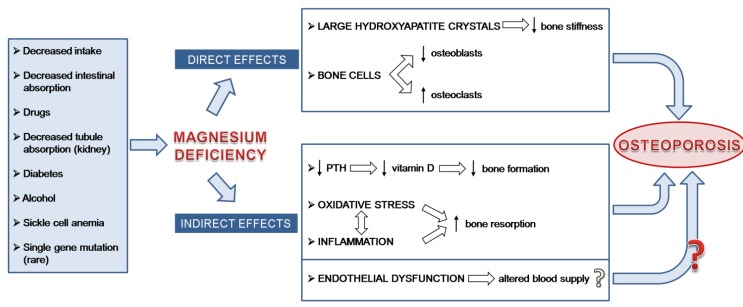
Present knowledge about the mechanisms involved in linking Mg deficiency and osteoporosis. Remarkably, similar events are implicated in experimental models and in humans. Because the vasculature plays an important role in bone remodeling, we also hypothesize that low Mg induced-endothelial dysfunction contributes to the decline of bone mass.
References
-
- Nieves J.W. Osteoporosis: The role of micronutrients. Am. J. Clin. Nutr. 2005;81:1232S–1239S. - PubMed
-
- Ström O., Borgström F., Kanis J.A., Compston J., Cooper C., McCloskey E.V., Jönsson B. Osteoporosis: Burden, health care provision and opportunities in the EU: A report prepared in collaboration with the International Osteoporosis Foundation (IOF) and the European Federation of Pharmaceutical Industry Associations (EFPIA) Arch.Osteoporos. 2011;6:59–155. doi: 10.1007/s11657-011-0060-1. - DOI - PubMed
-
- Song Y., Li T.Y., van Dam R.M., Manson J.E., Hu F.B. Magnesium intake and plasma concentrations of markers of systemic inflammation and endothelial dysfunction in women. Am. J. Clin. Nutr. 2007;85:1068–1074. - PubMed
Publication types
MeSH terms
Substances
LinkOut - more resources
Full Text Sources
Other Literature Sources
Medical
