


Surgical preparation: are patients "ready" for stress urinary incontinence surgery?
- PMID: 23912506
- PMCID: PMC3833875
- DOI: 10.1007/s00192-013-2184-x
Surgical preparation: are patients "ready" for stress urinary incontinence surgery?
Abstract
Introduction and hypothesis: Patient preparedness for stress urinary incontinence (SUI) surgery is associated with improvements in post-operative satisfaction, symptoms and quality of life (QoL). This planned secondary analysis examined the association of patient preparedness with surgical outcomes, treatment satisfaction and quality of life.
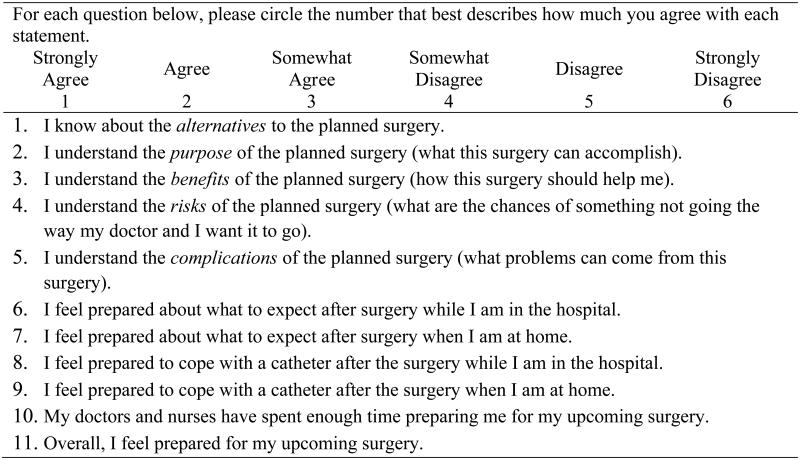
Methods: The ValUE trial compared the effect of pre-operative urodynamic studies with a standardized office evaluation of outcomes of SUI surgery at 1 year. In addition to primary and secondary outcome measures, patient satisfaction with treatment was measured using a five-point Likert scale (very dissatisfied to very satisfied) that queried subjects to rate the treatment's effect on overall incontinence, urge incontinence, SUI, and frequency. Preparedness for surgery was assessed using an 11-question Patient Preparedness Questionnaire (PPQ).
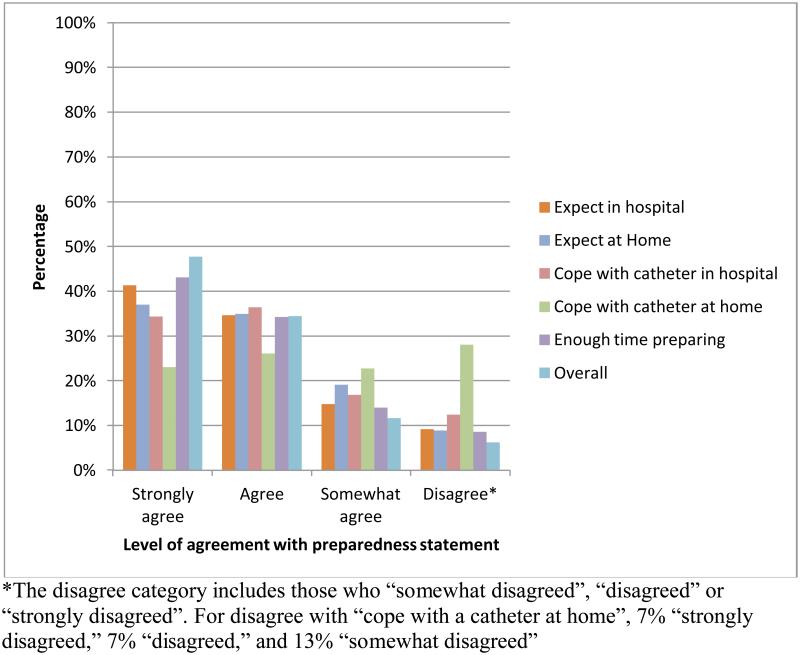
Results: Based on PPQ question 11, 4 out of 5 (81 %) of women reported they "agreed" or "strongly agreed" that they were prepared for surgery. Selected demographic and clinical characteristics were similar in unprepared and prepared women. Among SUI severity baseline measures, total UDI score was significantly but weakly associated with preparedness (question 11 of the PPQ; Spearman's r = 0.13, p = 0.001). Although preparedness for surgery was not associated with successful outcomes, it was associated with satisfaction (r s = 0.11, p = 0.02) and larger PGI-S improvement (increase; p = 0.008).
Conclusions: Approximately half (48 %) of women "strongly agreed" that they felt prepared for SUI. Women with higher pre-operative preparedness scores were more satisfied, although surgical outcomes did not differ.
Figures
References
-
- Hullfish KL, Bovbjerg VE, Steers WD. Patient-centered goals for pelvic floor dysfunction surgery: long-term follow-up. American Journal of Obstetrics & Gynecology. 2004;191:201–5. - PubMed
-
- Kenton K, Pham T, Mueller E, Brubaker L. Patient preparedness: an important predictor of surgical outcome. American Journal of Obstetrics & Gynecology. 2007;197:654.e1–654.e6. - PubMed
-
- Elkadry EA, Kenton KS, FitzGerald MP, Shott S, Brubaker L. Patient-selected goals: A new perspective on surgical outcome. Obstet Gynecol. 2003;189:1551–1557. - PubMed
-
- Mahajan ST, Elkadry EA, Kenton KS, Shott S, Brubaker L. Patient-centered surgical outcomes: The impact of goal achievement and urge incontinence on patient satisfaction one year after surgery. Amer J Obstet Gynecol. 2006;194:722–728. - PubMed
Publication types
MeSH terms
Grants and funding
- L60 MD000931/MD/NIMHD NIH HHS/United States
- U01 DK60393/DK/NIDDK NIH HHS/United States
- U01 DK058234/DK/NIDDK NIH HHS/United States
- U01 DK58234/DK/NIDDK NIH HHS/United States
- U01 DK060393/DK/NIDDK NIH HHS/United States
- U01 DK60379/DK/NIDDK NIH HHS/United States
- U01 DK060380/DK/NIDDK NIH HHS/United States
- U01 DK060397/DK/NIDDK NIH HHS/United States
- U01 DK60380/DK/NIDDK NIH HHS/United States
- U01 DK60395/DK/NIDDK NIH HHS/United States
- U01 DK060401/DK/NIDDK NIH HHS/United States
- U01 DK060395/DK/NIDDK NIH HHS/United States
- U01 DK58229/DK/NIDDK NIH HHS/United States
- U01 DK58231/DK/NIDDK NIH HHS/United States
- U01 DK060379/DK/NIDDK NIH HHS/United States
- U01 DK60401/DK/NIDDK NIH HHS/United States
- U01 DK058229/DK/NIDDK NIH HHS/United States
- U01 DK58225/DK/NIDDK NIH HHS/United States
- UG1 HD054241/HD/NICHD NIH HHS/United States
- U01 DK60397/DK/NIDDK NIH HHS/United States
- U01 DK058225/DK/NIDDK NIH HHS/United States
- U01 DK058231/DK/NIDDK NIH HHS/United States
LinkOut - more resources
Full Text Sources
Other Literature Sources
Medical
